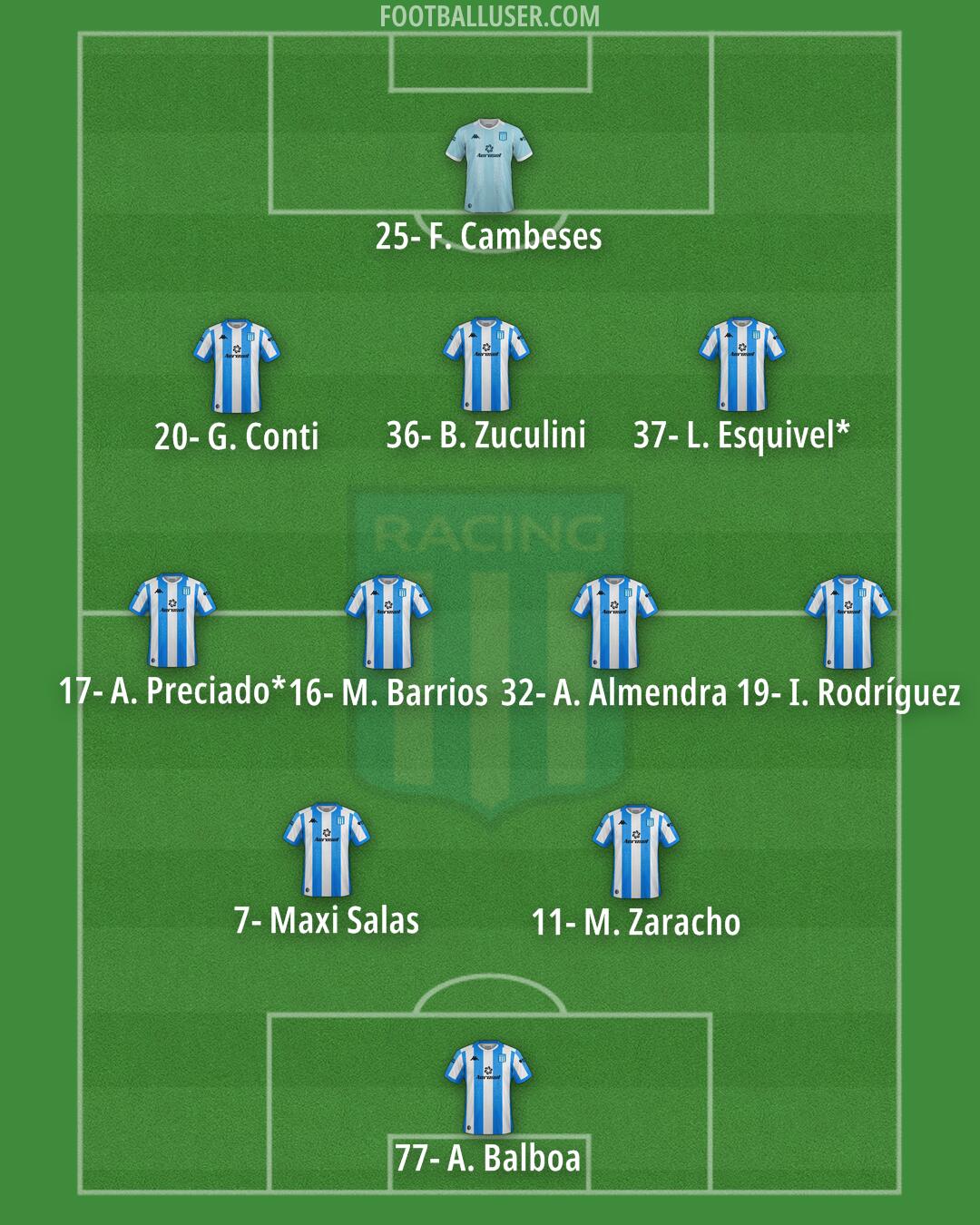

Racing Club Football Formation
 March 5, 2025


Starting Lineup
25- F. Cambeses20- G. Conti
36- B. Zuculini
37- L. Esquivel*
17- A. Preciado*
16- M. Barrios
32- A. Almendra
19- I. Rodríguez
7- Maxi Salas
11- M. Zaracho
77- A. Balboa
Racing Club aims to play a high press with a direct intent to win the ball back high up the pitch, utilizing a 3-4-3 formation. This lineup is built to stretch the defence and create constant pressure on the opposition. By staying compact and vertical, the team seeks to win the second ball and immediately look for ways to hit in behind on the transition.
In goal, F. Cambeses acts as the first line of defense. The defensive unit operates as a back three with B. Zuculini acting as the central anchor. He stays deep to provide cover while L. Esquivel and G. Conti play as wide centre-backs. L. Esquivel and G. Conti are tasked to step up and squeeze the space during the press, while B. Zuculini must defend zonally to protect the central area. This back three functions to keep the team compact when sitting deep in a mid-block.
The midfield employs a central pairing to control the middle of the pitch. M. Barrios and A. Almendra form a double pivot to shield the defence and recycle possession. M. Barrios acts as the main anchor to deny the pivot of the opposition, while A. Almendra looks to carry the ball forward to link the lines. On the flanks, A. Preciado and I. Rodríguez operate as wide midfielders who provide the width. A. Preciado works to overlap the winger and I. Rodríguez looks to drive into the half spaces to create overloads.
The attacking line uses three players across the front to pin the last defender. A. Balboa operates as the lone striker, tasked to hold up the ball and find the feet of the attackers. M. Zaracho and Maxi Salas play as inverted wingers who cut inside to create central presence. This movement creates space for A. Preciado and I. Rodríguez to push higher. The forwards work together to press from the front, forcing a long ball from the opposition back line.
Racing Club gains a significant advantage through the ability to press high in coordinated waves. The presence of three attackers and two wide midfielders allows for wide overloads to occur quickly. Additionally, the formation provides speed of transition once the ball is won back by the midfield. The compactness of the back three and the double pivot makes it difficult for opponents to play through the lines.
This 3-4-3 formation is designed for a team that wants to control games through aggressive pressing and rapid verticality. It is best suited for matches against opponents who struggle to play out from the back under heavy pressure.