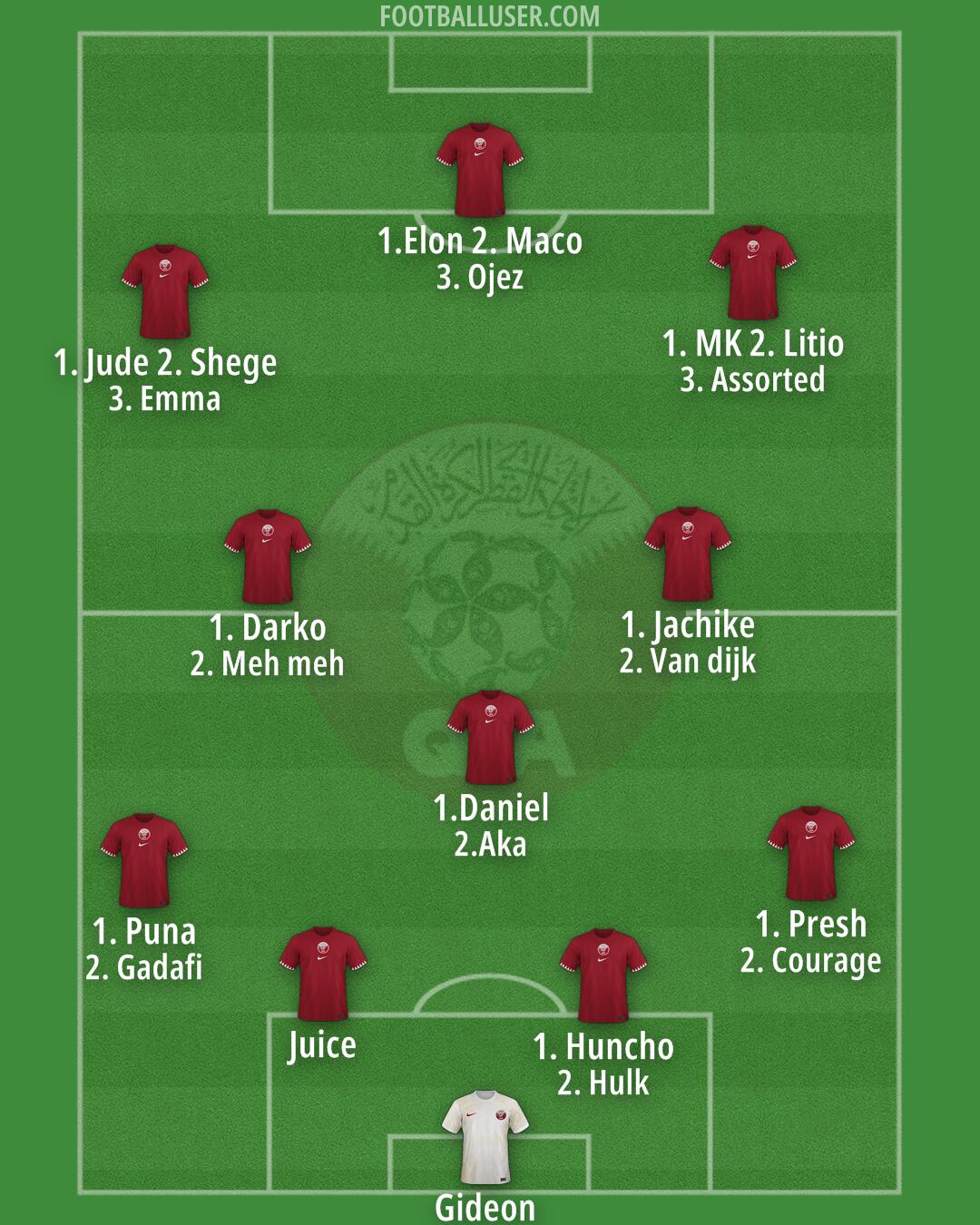

Qatar National Football Team Formation
 March 7, 2025
 Elon
Elon


Starting Lineup
Gideon · Juice · 1. Huncho (2. Hulk) · 1. Presh (2. Courage) · 1. Puna (2. Gadafi) · 1.Daniel (2.Aka) · 1. Jachike (2. Van dijk) · 1. Darko (2. Meh meh) · 1.Elon 2. Maco (3. Ojez) · 1. MK 2. Litio (3. Assorted) · 1. Jude 2. Shege (3. Emma)Qatar focuses on defensive solidity and quick transitions using a 5-2-3 formation. This lineup is built to sit deep and absorb pressure before looking to strike quickly. The team relies on a narrow defensive block to deny space in the middle of the pitch.
Huncho operates between the posts to manage the defensive unit. The back line consists of five defenders where Gideon, Juice, and Daniel form the central trio. Daniel and Gideon act as central defenders who are dominant in the air, while Juice plays as the left centre-back to provide cover. Puna acts as an attacking wing-back on the left to provide width and Presh plays as the right wing-back to provide support. This unit works to stay close together to squeeze the space and deny the turn.
The midfield works as a double pivot to control the central area. Darko and Jachike occupy the two central roles to shield the defence and link the lines. Darko focuses on protecting the space in front of the centre-backs, while Jachike looks to carry the ball forward when the team wins possession. Together, they aim to recycle possession and prevent the opposition from playing through the middle. They work to win the second ball and move the play from the back to the front.
In the final third, Qatar uses three attackers to stretch the defence. Elon 2. Maco plays as a lone striker to hold up the ball and pressure the opposition back line. Jude 2. Shege stays wide on the left as an inverted winger to cut inside and create chances, while MK 2. Litio operates on the right wing. The wingers look to pull wide to create space for the wing-backs to overlap the winger. The team seeks to attack on the break by using runs in behind to catch the opponent.
This formation offers several advantages, such as numerical superiority in the defensive third. The presence of five defenders makes it difficult for opponents to find gaps. Qatar can also use wide overloads when Puna and Presh push forward to support the wingers. Additionally, the ability to press in a mid-block allows the team to win the ball back high up the pitch and break quickly.
Qatar relies on a compact defensive unit to absorb pressure and strike on the break. This formation is best suited for matches against teams that dominate possession and play with high lines.