
Austria National Football Team Formation
 March 8, 2025


Starting Lineup
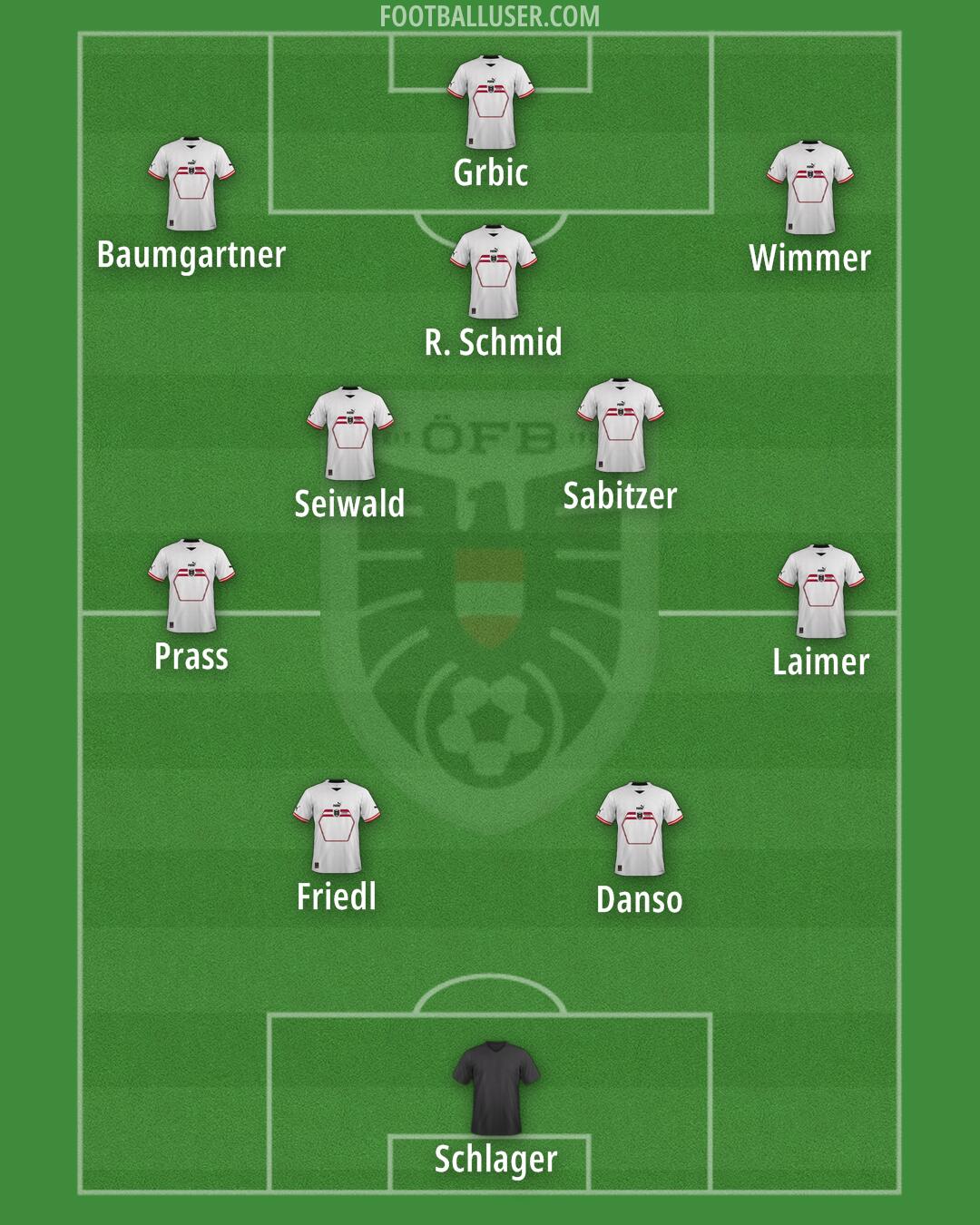
Grbic · Baumgartner · Wimmer · R. Schmid · Sabitzer · Seiwald · Laimer · Prass · Friedl · Danso · SchlagerAustria aims to play a high press game with a 2-5-3 formation. This lineup is designed to squeeze the space in the opponent's half and win the ball back high up the pitch. The team focuses on verticality, looking to break the line quickly once possession is regained.
Schlager sits behind the two central defenders to act as a sweeper if the line is high. Danso and Friedl play as a narrow pair of centre-backs who must be ready to cover the space when the midfield pushes up. Danso uses his aerial strength to win the header and clear the lines. Friedl must stay focused to hold the line and intercept passes in the central zone. This pair of defenders functions as a zonal unit that relies on the midfield to prevent direct runs.
The midfield is a five player unit that dominates the center of the pitch. Laimer and Prass work as a double pivot to shield the defence and win the second ball. Seiwald and Sabitzer operate in the half spaces to connect the defensive and attacking lines, with Sabitzer using his passing range to switch play. R. Schmid plays as an attacking ten behind the striker to find pockets of space and arrive late into the box. This group works together to compress the midfield and deny the pivot of the opposition.
The attack uses three players to stretch the defence and create chaos. Grbic plays as a central striker to hold up the ball and engage in link-up play. Wimmer and Baumgartner act as wide attackers who want to cut inside to create chances. Wimmer looks to get to the byline and deliver early crosses, while Baumgartner makes runs in behind to exploit the space. These three forwards press from the front to force a long ball from the opponent.
One major advantage of this formation is the numerical superiority in midfield, which allows the team to recycle possession easily. The ability to press high in coordinated waves makes it very difficult for opponents to play out from the back. Austria also benefits from the speed of transition, using the wide players to hit in behind on the transition.
This 2-5-3 formation is built for aggressive teams that want to control the game through heavy pressure. It works best when facing opponents who struggle to play under pressure in their own half.