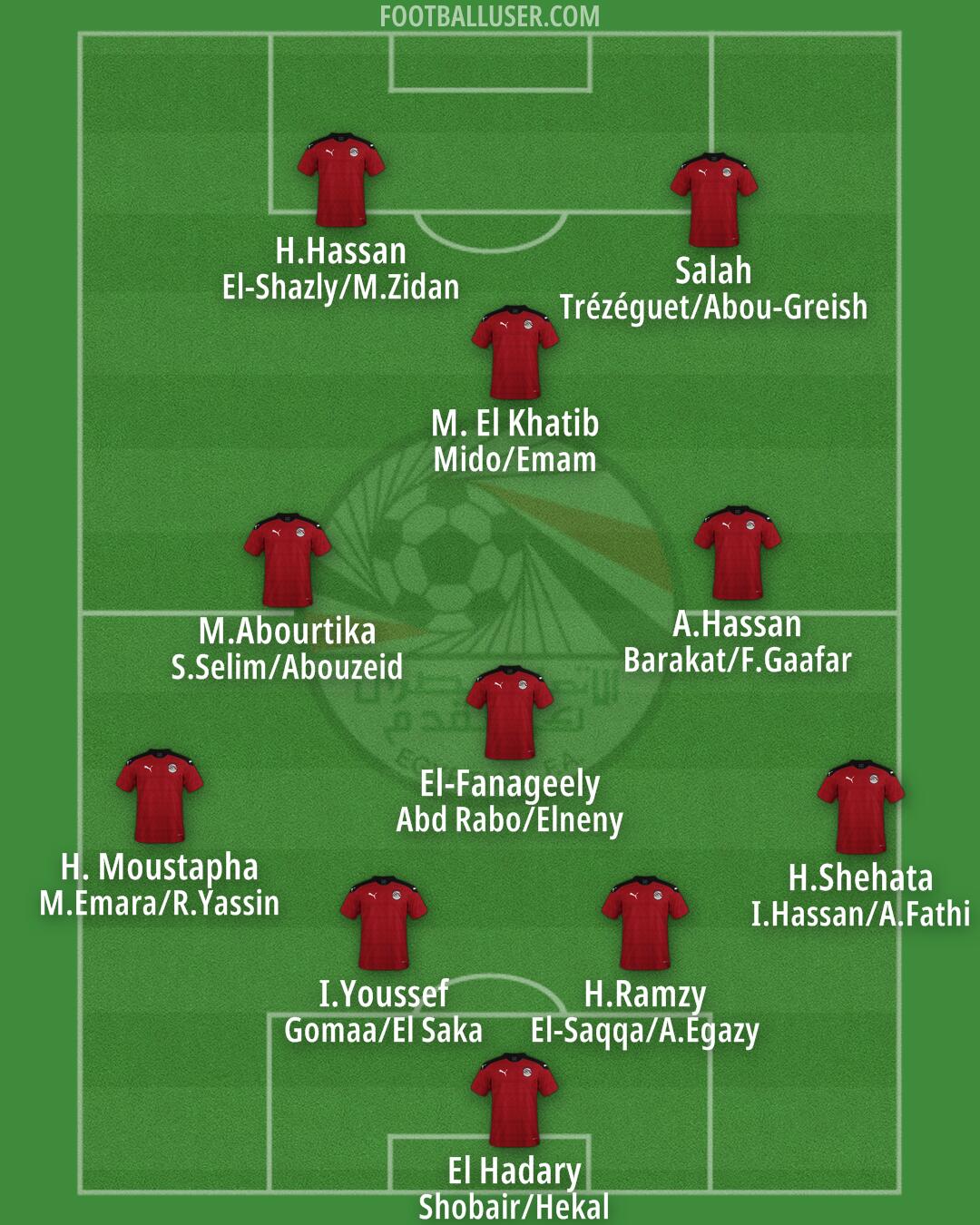
Egypt National Football Team Formation
Starting Lineup
Salah (Trézéguet/Abou-Greish) · H.Hassan (El-Shazly/M.Zidan) · I.Youssef (Gomaa/El Saka) · El-Fanageely (Abd Rabo/Elneny) · H.Ramzy (El-Saqqa/A.Egazy) · M.Abourtika (S.Selim/Abouzeid) · M. El Khatib (Mido/Emam) · A.Hassan (Barakat/F.Gaafar) · H. Moustapha (M.Emara/R.Yassin) · H.Shehata (I.Hassan/A.Fathi) · El Hadary (Shobair/Hekal)Egypt focuses on a compact defensive block and quick transitions in a 4-5-1. This lineup is built to sit deep and wait for the opposition to commit numbers forward before striking on the break. The team relies on density in the middle of the pitch to force opponents wide and prevent play through the center.
H.Hassan guards the goal while a back four holds the line. M.Abourtika and A.Hassan act as full backs to provide width and cover the flanks, while Salah and M. El Khatib operate as the two central defenders. Salah is tasked with being a ball playing defender to help play out from the back, while M. El Khatib provides aerial strength and covers the space behind the full backs. This defensive unit works to keep the lines tight and squeeze the space between the defense and the midfield.
The midfield is a five man unit designed to clog the central zones. El-Fanageely sits as a single pivot to shield the defense and intercept passes. Ahead of him, H. Moustapha and H.Shehata operate as two central midfielders who work to win the second ball and drive the play forward. I.Youssef and H.Ramzy play in the half spaces as attacking midfielders to connect the midfield to the attack. This group works to press in a mid-block and immediately look to win the ball back high up the pitch once they regain possession.
In the attacking phase, El Hadary operates as a lone striker. He acts as a target man to hold up the ball and bring others into play. I.Youssef and H.Ramzy push forward to support him, often making runs in behind the opposition defense. The wingers pull wide to stretch the defense and deliver crosses into the box. This attacking setup relies on quick combinations and moving the ball through the lines to catch the opponent out of position.
Egypt offers several tactical advantages with this formation. They can create numerical superiority in the midfield by congesting the central areas, making it hard for opponents to play through them. The team also benefits from a high level of compactness when defending, which forces the opposition into low percentage areas. Once the ball is won, the speed of transition allows them to hit the opposition on the break before they can set their defensive lines.
This 4-5-1 formation provides a solid platform for teams that want to control the central zones and defend deep. It is best suited for matches against dominant sides where Egypt can sit deep and counter at pace.