
Austria National Football Team Formation
 March 15, 2025


Starting Lineup
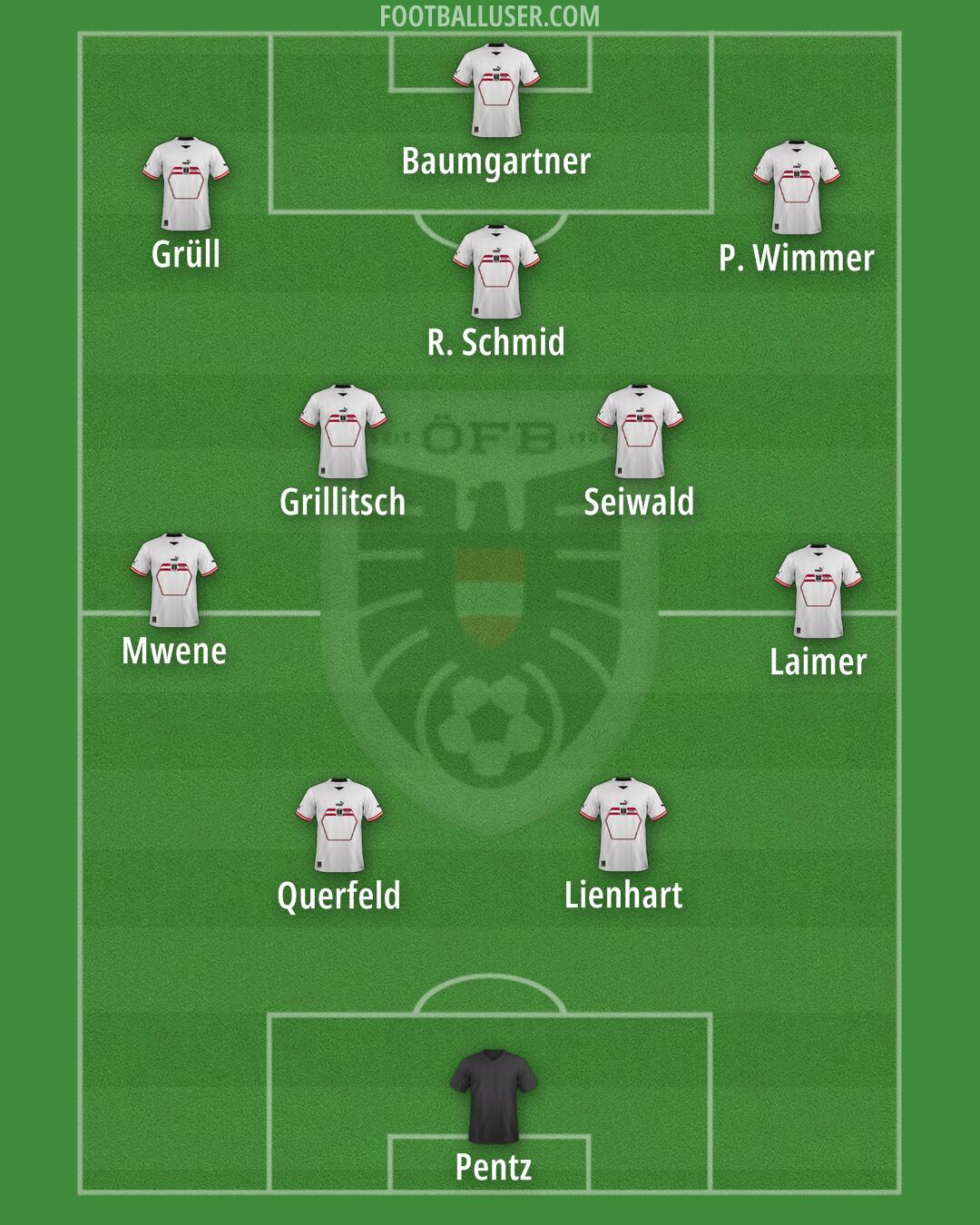
Grillitsch · Seiwald · Grüll · R. Schmid · Baumgartner · P. Wimmer · Laimer · Lienhart · Mwene · Querfeld · PentzAustria relies on a heavy press and verticality, utilizing a 2-5-3 formation to dominate games. This lineup is built to win the ball high up the pitch and force the opposition into errors. The team seeks to control the tempo through central density and rapid movements in the attacking third.
Pentz operates as the goalkeeper to organize the defensive unit. Querfeld and Lienhart form a central pair in a high line, acting as ball playing defenders who can step up to intercept passes. These two must remain alert to cover the space behind them and protect against runners in behind. The defensive unit functions to squeeze the space and support the intense pressure applied by the players in front of them.
The midfield is a five man block that controls the center of the pitch. Laimer and Mwene act as the deep pair to shield the defense and win the second ball. Seiwald and Grillitsch play as two central midfielders who carry the ball forward and connect the defensive and attacking lines. R. Schmid plays as an attacking ten, looking to find pockets of space to play through the lines or arrive late into the box. This midfield core works to recycle possession and switch play quickly to the wings to find the attackers in space.
In the final third, Austria employs three attackers across the front to pin the opposition defense. Baumgartner serves as the striker to hold up the ball and link play with the midfield. P. Wimmer and Grüll play as wide wingers who look to cut inside or spread wide to deliver a cross. The attackers press from the front to force a long ball and create turnovers in dangerous areas. This formation uses rapid combinations to attack the space between the defenders.
The formation offers massive numerical superiority in the midfield. This allows the team to compress the midfield and win it back high up the pitch. Another strength is the speed of transition. When the ball is won high, the team can hit in behind on the transition before the opponent can recover their positions or get organized. This compactness makes it difficult for opponents to play through the middle.
This 2-5-3 formation provides an aggressive way to squeeze the opponent. It is ideally suited for matches where the team needs to dominate possession and play in the opponent's half.