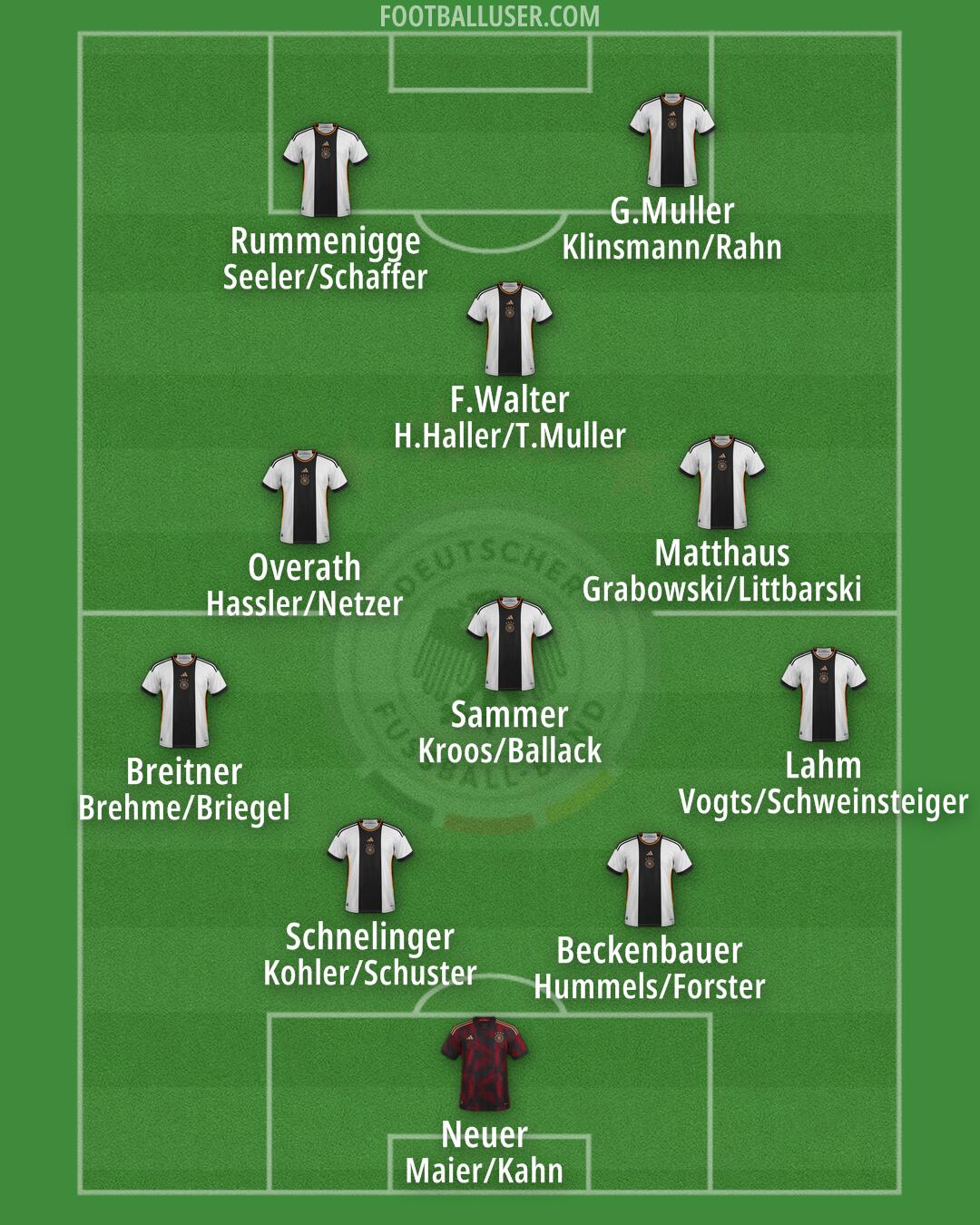

Germany National Football Team Formation
 March 20, 2025


Starting Lineup
Beckenbauer (Hummels/Forster) · Sammer (Kroos/Ballack) · Overath (Hassler/Netzer) · G.Muller (Klinsmann/Rahn) · Rummenigge (Seeler/Schaffer) · Matthaus (Grabowski/Littbarski) · Lahm (Vogts/Schweinsteiger) · Neuer (Maier/Kahn) · Schnelinger (Kohler/Schuster) · Breitner (Brehme/Briegel) · F.Walter (H.Haller/T.Muller)Germany plays with a 2-6-2 formation that focuses on central dominance and heavy ball control. This lineup is built to overwhelm the middle of the pitch to ensure the opposition cannot find space to play. The team looks to control the tempo through a massive middle block and drive straight at the heart of the defense.
Neuer stays between the posts and is known for his ability to play out from the back. The defensive unit consists of a very narrow back two featuring Beckenbauer and Schnelinger. Beckenbauer is known for his ability to step into midfield and his reading of the game, which is vital when playing with so few defenders. They must hold the line and cover the wide spaces left by the lack of full backs. The two central defenders act as the last line of defense, often needing to sweep behind a high line to intercept long balls.
The midfield is the engine of Germany, using a unit of six players to dictate play. A defensive trio of Breitner, Sammer, and Lahm shields the back two. Lahm uses his positional intelligence to recycle possession and protect the center. Ahead of them, Overath, Matthaus, and F.Walter operate in the half spaces. Matthaus provides a huge passing range and strong tackling to win the ball back high up the pitch. This dense middle group connects the defense to the attack by playing through the lines and moving the ball quickly to the front.
The attack relies on a partnership of two forwards, Rummenigge and G.Muller. G.Muller is a legendary presence known for his clinical finishing, while Rummenigge uses his pace to run in behind the defense. They do not play as isolated attackers but instead work closely with the advancing midfielders. The midfielders often arrive late into the box to support the strike force. This movement creates constant pressure and allows the team to attack in combinations to split the defense with a through ball.
This formation offers significant numerical superiority in the center of the pitch. Because there are six players in the middle, they can easily win the second ball and control the game. The team also benefits from the ability to press in coordinated waves, making it very hard for opponents to build out from the back. The heavy midfield allows for quick transitions when they win the ball and can immediately push forward to overload the opposition.
This 2-6-2 formation is a tool for total midfield suffocation and central dominance. It is best suited for games against teams that lack the physical presence to compete in a crowded midfield.