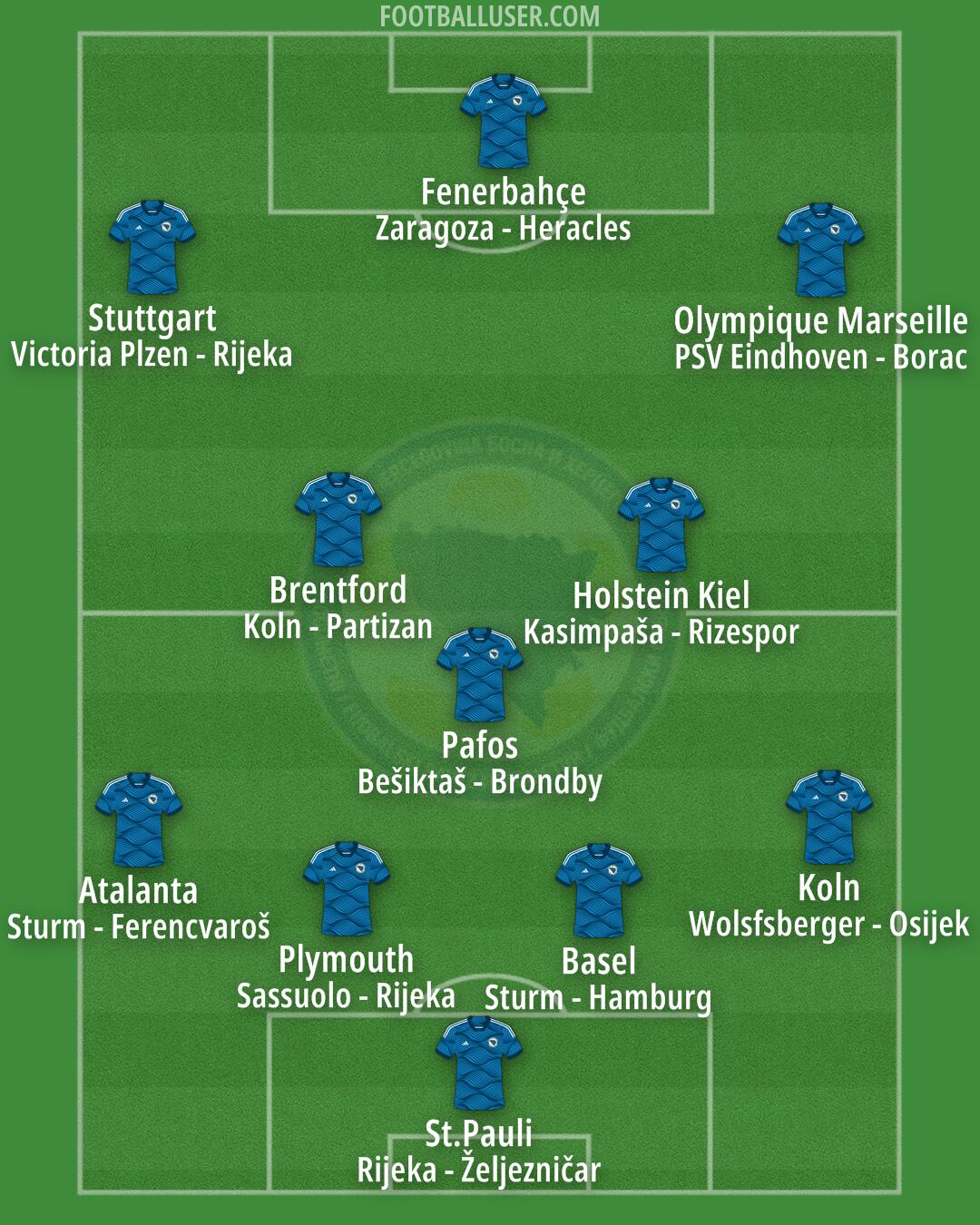

Bosnia and Herzegovina National Football Team Formation
 March 26, 2025


Starting Lineup
St.Pauli (Rijeka - Željezničar) · Atalanta (Sturm - Ferencvaroš) · Plymouth (Sassuolo - Rijeka) · Basel (Sturm - Hamburg) · Koln (Wolsfsberger - Osijek) · Pafos (Bešiktaš - Brondby) · Brentford (Koln - Partizan) · Holstein Kiel (Kasimpaša - Rizespor) · Stuttgart (Victoria Plzen - Rijeka) · Olympique Marseille (PSV Eindhoven - Borac) · Fenerbahçe (Zaragoza - Heracles)Bosnia and Herzegovina play with a heavy emphasis on controlling the central areas through a high density of players in the middle of the pitch. This lineup utilizes a 2-5-3 formation designed to overwhelm the opposition once the ball is won. The team seeks to dominate through central congestion, making it very difficult for opponents to play through the lines.
Fenerbahçe guards the goal in this system. Ahead of him, the defensive unit consists of only two central defenders, Stuttgart and Olympique Marseille. These two must act as a high line, stepping up to intercept passes and squeeze the space in the middle. Because there are no full backs, Stuttgart and Olympique Marseille must be able to defend wide areas and cover one another when the ball is switched. They need to be physically strong to win the header and clear the lines during direct attacks.
The midfield is the heart of the Bosnia and Herzegovina engine room. Brentford and Holstein Kiel form a double pivot to shield the two defenders and win the second ball. In front of them, Pafos operates as a central midfielder to connect the lines. To add extra numbers, Koln and Atalanta occupy the half spaces as attacking midfielders. This five man block allows the team to press in a mid-block or push forward to win it back high up the pitch, using the density of players to pick up runners.
The attacking unit focuses on width and directness with three players across the front. Basel and Plymouth act as wide wingers, pulling the opposition back line apart to create space. St.Pauli leads the line as the main striker, looking to find the feet of the striker or make runs in behind. When the team moves forward, Basel and Plymouth often look to get to the byline and deliver early crosses into the box. The movement of Koln and Atalanta also creates a threat as they arrive late into the box to support the front three.
This formation offers significant tactical advantages by creating massive numerical superiority in the midfield. By packing the center with Brentford, Holstein Kiel, Pafos, Koln, and Atalanta, the team can easily win the battle for possession. Another strength is the ability to press in coordinated waves, using the front three and the five midfielders to trap the opponent. This makes it extremely hard for the other side to find a way out of their own half.
This 2-5-3 formation is built to dominate possession and suffocate the opponent in the center of the park. It is best suited for matches where Bosnia and Herzegovina face teams that struggle to play through heavy central pressure.