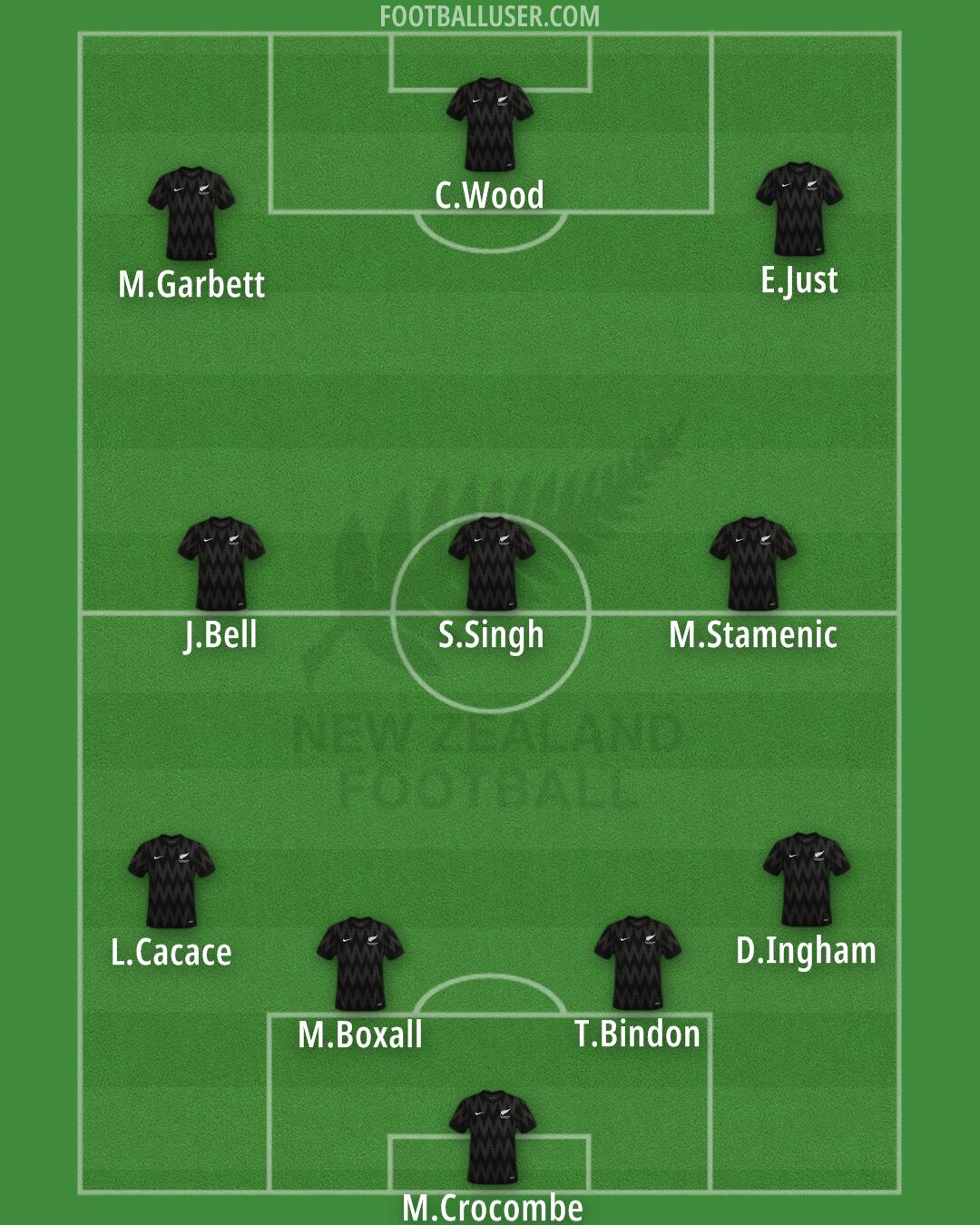

New Zealand National Football Team Formation
 March 27, 2025
 bosan
bosan


Starting Lineup
M.Crocombe · T.Bindon · M.Boxall · D.Ingham · L.Cacace · J.Bell · S.Singh · M.Stamenic · C.Wood · M.Garbett · E.JustNew Zealand aims to play a direct and high pressing brand of football using a 4-3-3 formation. This lineup relies on quick transitions and verticality to catch the opposition off guard. The team seeks to win the ball high up the pitch and use the physical presence of their frontline to drive the play forward.
M.Crocombe stays between the posts to organize the defensive line. The back four operates as a flat back four that can push up to set the offside trap. L.Cacace and D.Ingham act as full backs, providing width when the team has the ball. M.Boxall and T.Bindon serve as the central defenders, where M.Boxall uses his aerial strength to defend crosses and T.Bindon works to cover the space behind the high line. This unit functions to keep the lines tight and force the opposition wide.
The midfield consists of a three-man midfield with a carrier. S.Singh sits in the middle to shield the defense and recycle possession. M.Stamenic and J.Bell operate as the more advanced midfielders, looking to win the second ball and progress through the thirds. M.Stamenic looks to carry the ball forward into the half spaces, while J.Bell connects the defensive and attacking lines by finding the feet of the forwards. This trio works to compress the midfield and prevent the opponent from playing through the center.
In the final third, New Zealand uses three attackers across the front. C.Wood acts as the lone striker and target man, using his aerial strength to hold up the ball and win headers. M.Garbett and E.Just operate as wide wingers who try to stretch the defense. M.Garbett often looks to cut inside to create space for L.Cacace to overlap, while E.Just stays wide to provide crosses. The attack is built to create runs in behind and isolate defenders in one on one situations during the transition.
A primary advantage for New Zealand is the ability to press high in coordinated waves to force a long ball from the opposition. The team also benefits from the physical presence of C.Wood, which allows them to play long and win the second ball. This creates wide overloads when the full backs push up to support the wingers.
The 4-3-3 formation provides New Zealand with a clear identity focused on pressing and direct attacking. This lineup is best suited for games against teams that struggle to play out from the back under pressure.