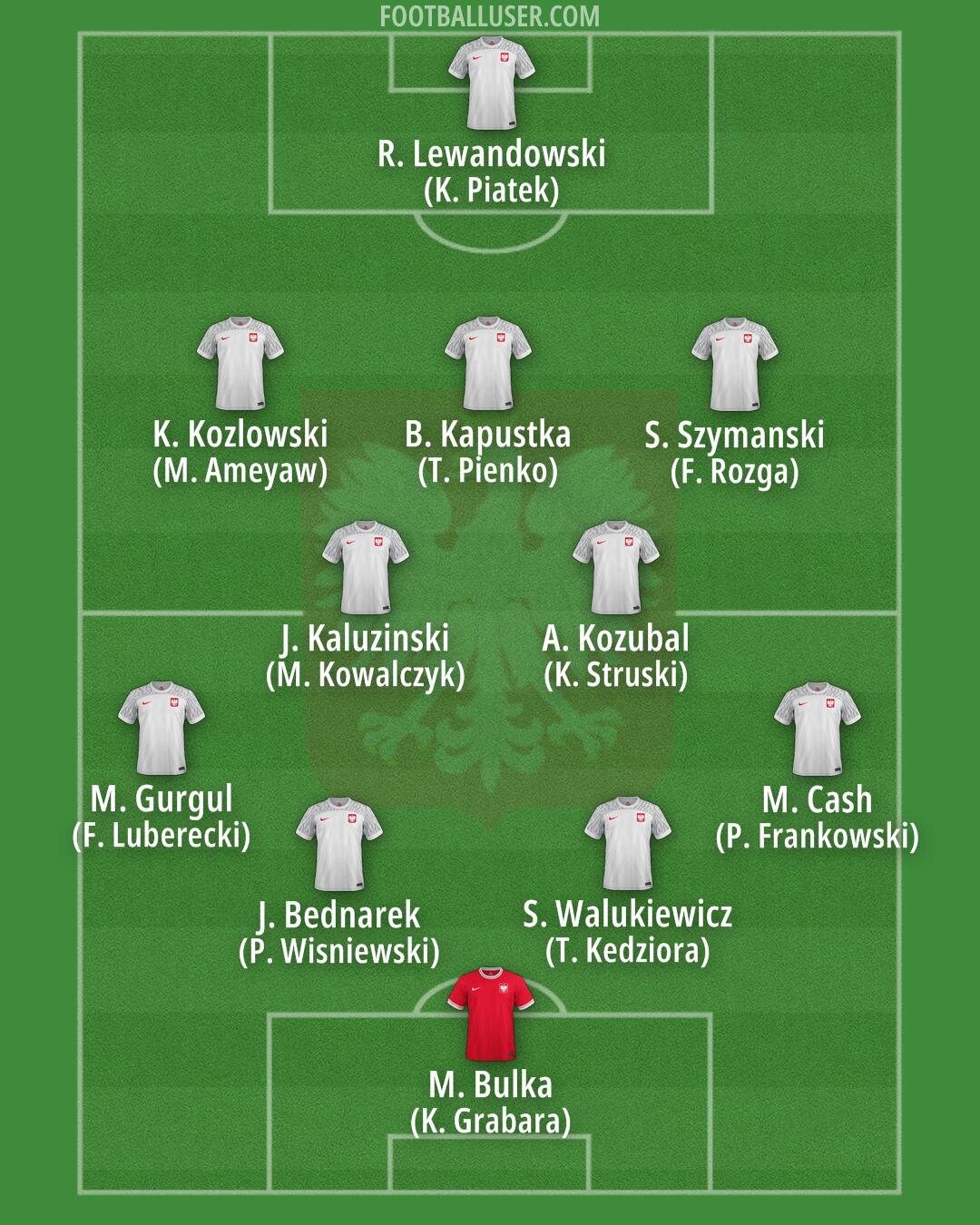

Poland National Football Team Formation
 March 27, 2025


Starting Lineup
M. Bulka (K. Grabara) · M. Cash (P. Frankowski) · M. Gurgul (F. Luberecki) · J. Bednarek (P. Wisniewski) · S. Walukiewicz (T. Kedziora) · A. Kozubal (K. Struski) · S. Szymanski (F. Rozga) · K. Kozlowski (M. Ameyaw) · J. Kaluzinski (M. Kowalczyk) · B. Kapustka (T. Pienko) · R. Lewandowski (K. Piatek)Poland looks to play a direct and compact brand of football in this 4-5-1 formation. The team aims to sit deep in a mid-block to deny space between the lines and then hit in behind on the transition. This lineup relies on defensive solidity to frustrate opponents before finding Robert Lewandowski to lead the line.
M. Bulka stays between the posts to command his area and sweep behind the back line when necessary. The defense operates as a flat back four with M. Cash and M. Gurgul acting as full backs who must track back quickly to protect the flanks. In the middle, J. Bednarek and S. Walukiewicz form the central pairing, with Bednarek providing aerial strength and Walukiewicz acting as a covering defender. The unit stays narrow to force the opposition wide and protect the central zone.
A five man midfield provides a dense block to squeeze the space in the center of the pitch. A double pivot consisting of A. Kozubal and J. Kaluzinski shields the defense and wins the second ball. S. Szymanski, B. Kapustka, and K. Kozlowski occupy the remaining spaces to connect the defensive and attacking lines. Szymanski plays as an inverted eight to drive forward with the ball, while Kozlowski and Kapustka help to recycle possession and press in a mid-block to win it back.
The attacking plan centers on a lone striker, Robert Lewandowski, who acts as a target man to hold up the ball. Because the team lacks a second striker in the hole, the midfielders like Szymanski must make late runs into the box to support the attack. The wingers pull wide to stretch the defense and provide crosses, while Lewandowski works to pin the last defender. The goal is to use the passing range of the midfield to find the striker in transition and create runs in behind.
Poland uses this formation to create numerical superiority in the midfield when defending. The narrowness of the block helps the team maintain compactness when defending against teams that favor central play. This lineup also allows for quick transitions, using the speed of the wide players to exploit space once the ball is won.
This 4-5-1 lineup is built to frustrate dominant teams through a compact defensive block. It is best suited for matches where Poland needs to sit deep and counter at pace against high pressing opponents.