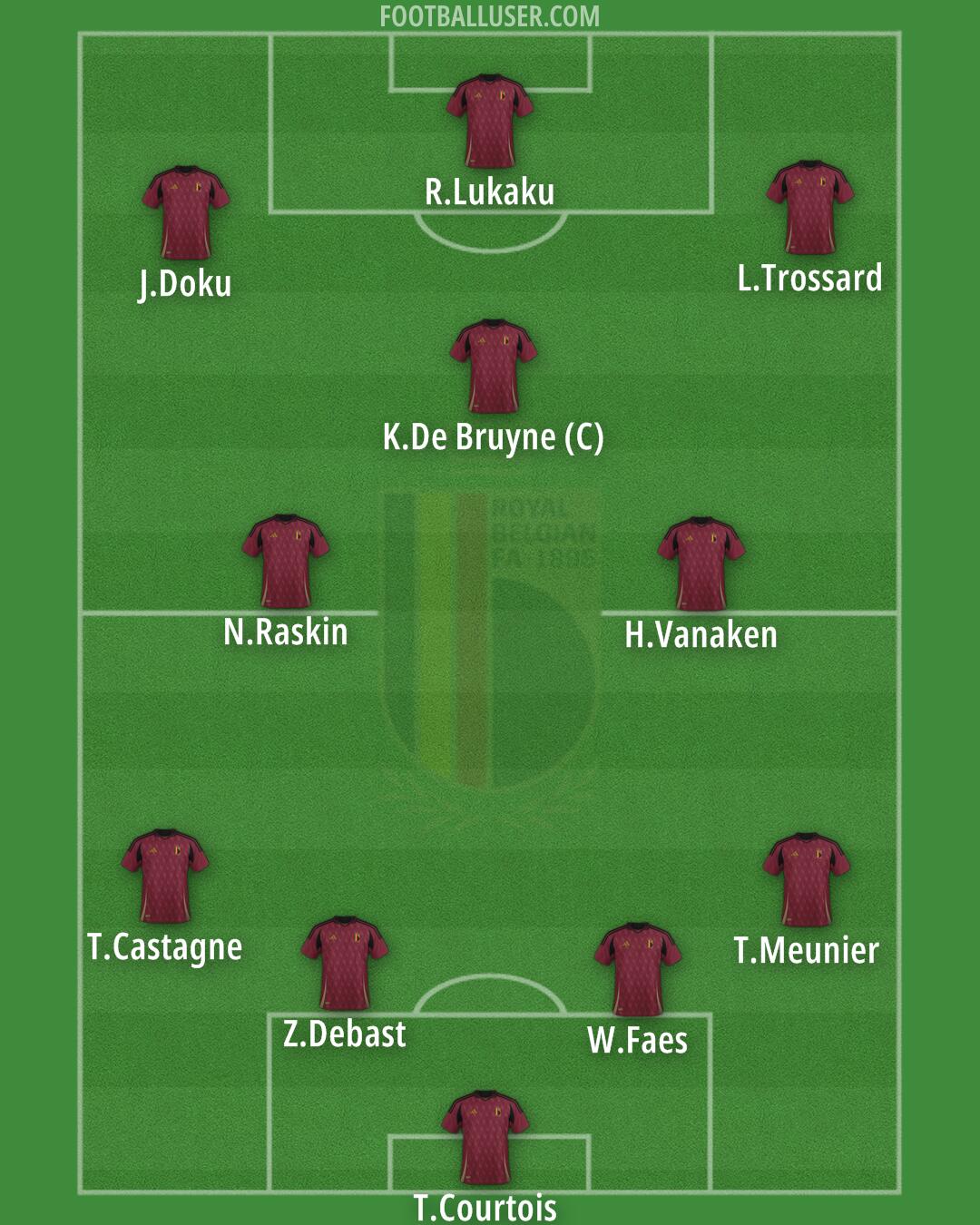

Belgium National Football Team Formation
 March 28, 2025
 bosan
bosan


Starting Lineup
T.Courtois · W.Faes · T.Castagne · Z.Debast · T.Meunier · J.Doku · K.De Bruyne (C) · R.Lukaku · L.Trossard · N.Raskin · H.VanakenA high press and rapid transition game defines this Belgium lineup in a 4-3-3. The Red Devils look to win the ball high up the pitch and move the ball forward with speed to catch opponents before they can settle. This formation is built to stretch the defence through wide players and use central quality to break the line.
Thibaut Courtois stands between the posts to provide a commanding presence. The back four works as a zonal line to maintain compactness. Timothy Castagne plays at left back to provide width, while Thomas Meunier operates at right back. In the center, Wout Faes and Zeno Debast form the pairing, with Faes acting as a ball playing defender to help play out from the back. Debast is tasked to cover the space behind when the full backs push high.
The midfield functions with a three-man setup to control the center of the pitch. Youden Raskin works to press aggressively to win the ball high and covers ground to support his teammates. Hans Vanaken acts as the connector who receives the ball to recycle possession and links the defensive and attacking lines. Captain Kevin De Bruyne plays as an attacking ten behind the striker, using his famous passing range to find runners. He is the main creator who looks to split the defence with a through ball.
The attacking front line is designed to create chaos in the final third. Romelu Lukaku acts as a pressing centre-forward and a target man to hold up the ball and bring others into play. On the flanks, Jeremy Doku operates as an inverted winger on the left to cut inside and drive at the defence with his dribbling style. Leandro Trossard plays on the right wing and looks to find space between the lines or whip it in from wide areas. Lukaku provides the central presence to attack the near post or far post when crosses arrive.
One major advantage for Belgium is the ability to press in coordinated waves to force a long ball from the opposition. The team also benefits from wide overloads when the full backs overlap the wingers to create two on one situations. This setup allows the players to switch play quickly to find isolated wide players in one on one battles.
This 4-3-3 formation relies on high energy and technical quality in the half spaces. It is best suited for games against teams that play a high line and can be caught on the transition.