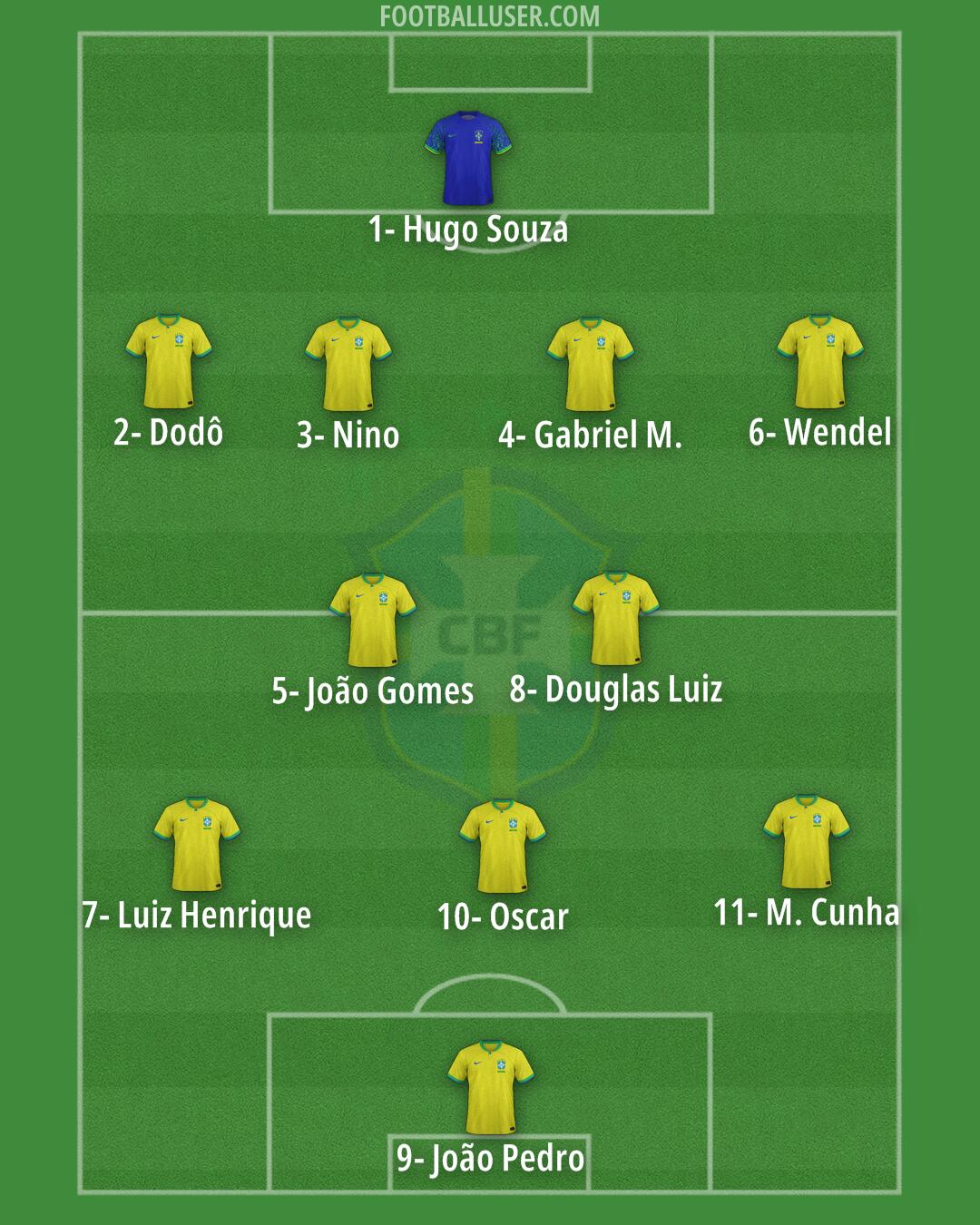

Brazil National Football Team Formation
 March 29, 2025


Starting Lineup
1- Hugo Souza2- Dodô
3- Nino
4- Gabriel M.
6- Wendel
5- João Gomes
8- Douglas Luiz
10- Oscar
9- João Pedro
7- Luiz Henrique
11- M. Cunha
Brazil aims to dominate through a compact mid-block and rapid transitions, utilizing a 4-5-1 formation. This lineup is built to control the central areas of the pitch before looking to hit teams in behind. The team looks to win the ball back high up the pitch or sit in a settled unit to absorb pressure before launching quick attacks.
Hugo Souza guards the goal while the defensive line holds a relatively high line to squeeze the space. Dodô acts as an attacking full back on the right to provide width, while Wendel works to cover the left flank. Nino and Gabriel M. form the central pairing, with Nino acting as a ball playing defender and Gabriel M. providing cover to sweep behind the line. The unit works to stay tight to deny any vertical passes between the lines.
The midfield operates as a five man block that can shift into various configurations. Douglas Luiz and João Gomes act as a double pivot to shield the defence, with Douglas Luiz looking to progress through the thirds with his passing range. M. Cunha and Luiz Henrique operate in the half spaces to connect the defensive and attacking lines. Oscar plays as the central playmaker to link the midfield to the front, looking to receive on the half-turn and find teammates.
João Pedro leads the line as a lone striker, acting as a focal point to hold up the ball. He works to pin the last defender and creates space for the midfielders to arrive late into the box. The wide midfielders, M. Cunha and Luiz Henrique, cut inside to create numerical superiority in the middle, while Dodô overlaps to provide crosses from deep. The team attacks in combinations to pull defenders out of position.
This formation offers significant strength through its compactness when defending in a mid-block. Brazil can use the double pivot of Douglas Luiz and João Gomes to win the second ball and stop counter attacks. Another advantage is the ability to create wide overloads when Dodô pushes forward to join the attack.
Brazil relies on a heavy midfield presence to control the tempo and transition quickly. This 4-5-1 formation is best suited for matches against teams that dominate possession and require a disciplined block.