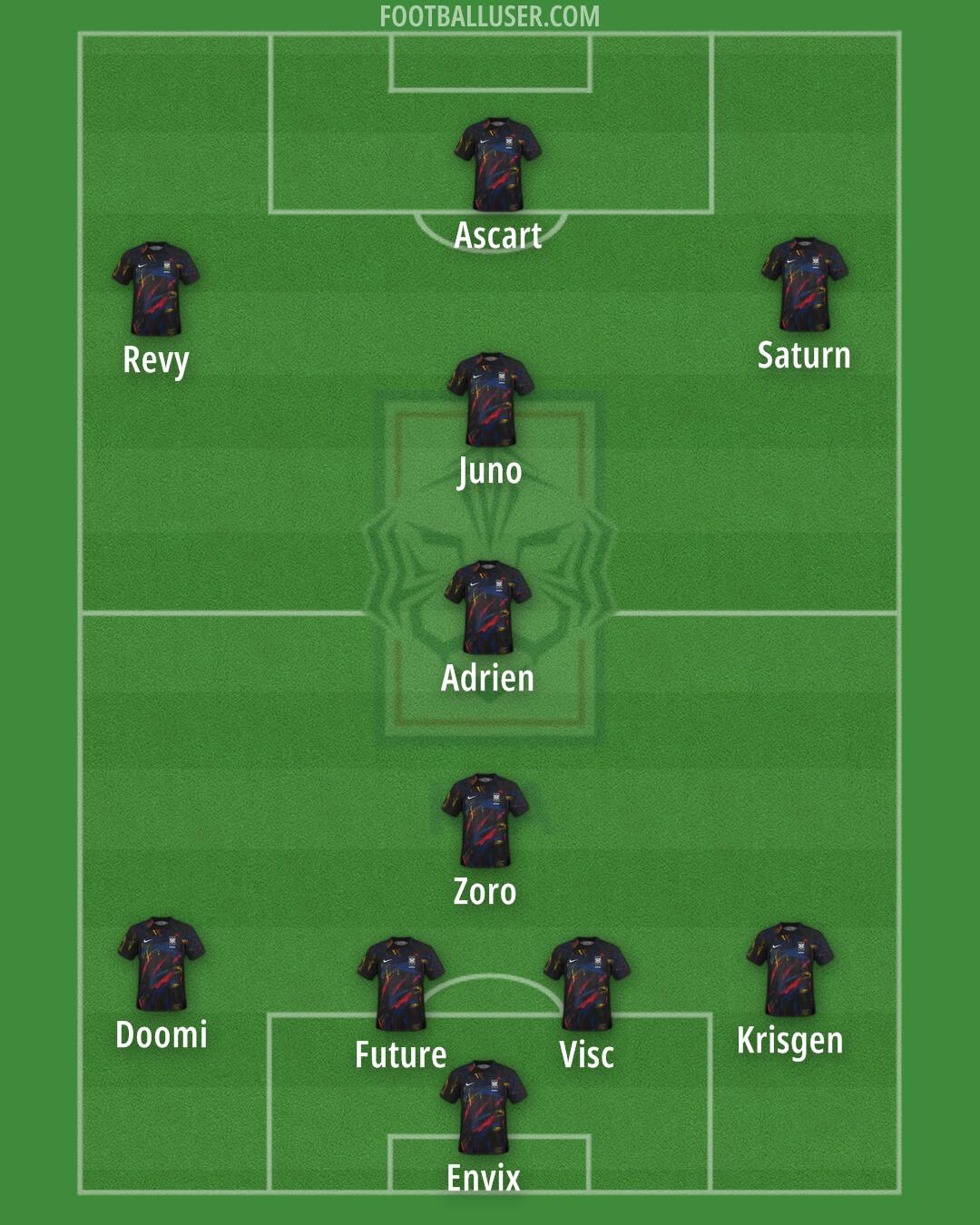

South Korea National Football Team Formation
 March 29, 2025


Starting Lineup
Envix · Doomi · Future · Visc · Krisgen · Zoro · Adrien · Juno · Ascart · Revy · SaturnSouth Korea focuses on a high press and quick verticality with a 4-3-3 formation. This lineup is built to win the ball high up the pitch and strike before the opposition can regroup. The team looks to squeeze the space in the attacking third to force mistakes and turn defense into attack instantly.
Envix sits between the posts to organize the defensive line. The back four operates as a flat line where Krisgen and Doomi provide width. Doomi acts as an attacking full back to push up the flank while Krisgen provides cover. In the center, Visc and Future form the partnership, with Visc acting as a ball playing defender to start attacks. Future is tasked to cover the space behind the full backs and win the second ball when the team presses high.
The midfield relies on a three man midfield with a carrier. Zoro plays as the single pivot to shield the defense and pick up runners. He sits deep to deny the pivot and recycle possession when under pressure. Adrien works as an inverted eight, driving forward with the ball to link the lines. Juno operates as the attacking ten behind the striker, looking to play through the lines and arrive late into the box to finish chances.
The attacking front line uses three attackers across the front to stretch the defense. Ascart plays as a pressing centre-forward, leading the line by trying to pin the last defender. On the wings, Revy and Saturn act as inverted wingers who cut inside to create central overloads. Revy looks to isolate a one-on-one wide, while Saturn moves into the half-spaces to support the central presence. This creates constant movement designed to hit in behind on the transition.
South Korea gains a major advantage through the ability to press high in coordinated waves. The combination of Juno and Ascart allows the team to trigger a press from the front. Another strength is the wide overloads created when Doomi overlaps the winger, forcing the opposition to shift their defensive block.
This 4-3-3 formation is built for a heavy pressing game that seeks to dominate through intensity. It is best suited for matches against teams that struggle to play out from the back.