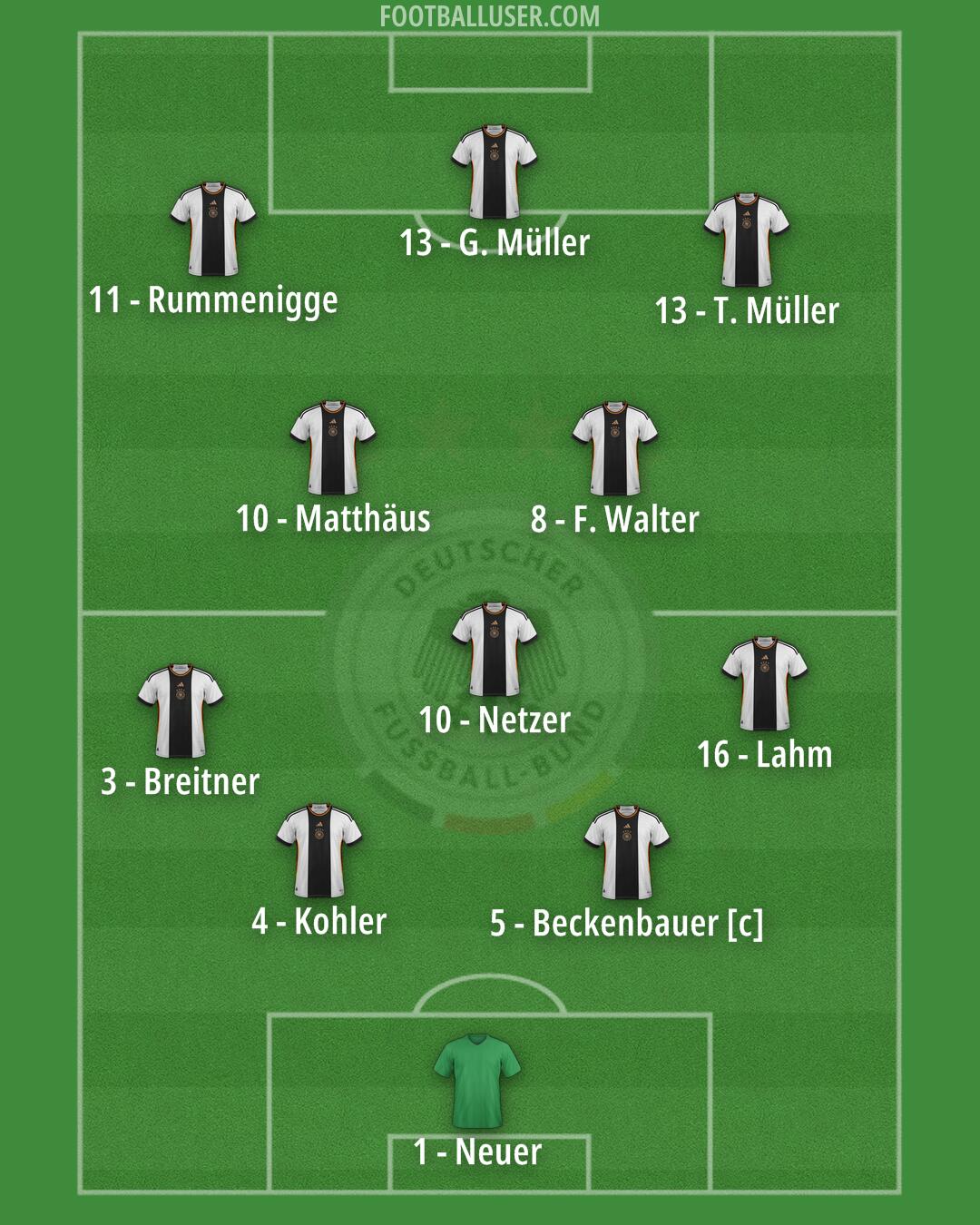

Germany National Football Team Formation
 March 31, 2025


Starting Lineup
11 - Rummenigge13 - G. Müller
13 - T. Müller
8 - F. Walter
10 - Netzer
10 - Matthäus
3 - Breitner
16 - Lahm
4 - Kohler
5 - Beckenbauer [c]
1 - Neuer
Germany looks to dominate through a high press and rapid verticality in this 5-2-3. This lineup is built to win the ball high up the pitch and strike immediately before the opposition can settle. The formation relies on a strong core to control the tempo while using wide players to stretch the opposition.
In goal, Neuer acts as a sweeper keeper to support the high defensive line. The back five is led by captain Beckenbauer, who serves as a ball playing defender capable of stepping into midfield. Netzer sits central to win headers and clear the lines, while Kohler provides cover to ensure the unit stays compact. On the flanks, Lahm operates as an attacking wing back to provide width, and Breitner pushes up the left side to join the attack. This defensive group works to squeeze the space and force long balls.
The midfield functions as a two man central engine. Matthäus plays as a carrier to drive forward with the ball and presses aggressively to win it back high up the pitch. Alongside him, F. Walter connects the defensive and attacking lines, often dropping deep to receive play from the back. This pair works to control the center of the pitch and ensure the team can transition from a defensive block into an attacking phase without losing control.
Germany employs three attackers across the front to pin the opposition back line. G. Müller acts as a pressing centre forward to harass defenders and hold up the ball for others. On the wings, Rummenigge and T. Müller act as inverted wingers who cut inside to create chances. These players aim to find the feet of the striker or deliver crosses from wide areas. The movement is designed to create runs in behind and allow the forwards to combine in tight spaces.
The tactical advantages of this Germany lineup include the ability to press high in coordinated waves to force turnovers. By using Lahm and Breitner, the team creates wide overloads that stretch the defence. There is also a significant threat in the speed of transition when the midfield duo quickly finds the front three.
This formation is a highly aggressive system built to overwhelm opponents through directness and high pressure. It is best suited for matches where Germany can control the tempo and exploit space behind a high defensive line.