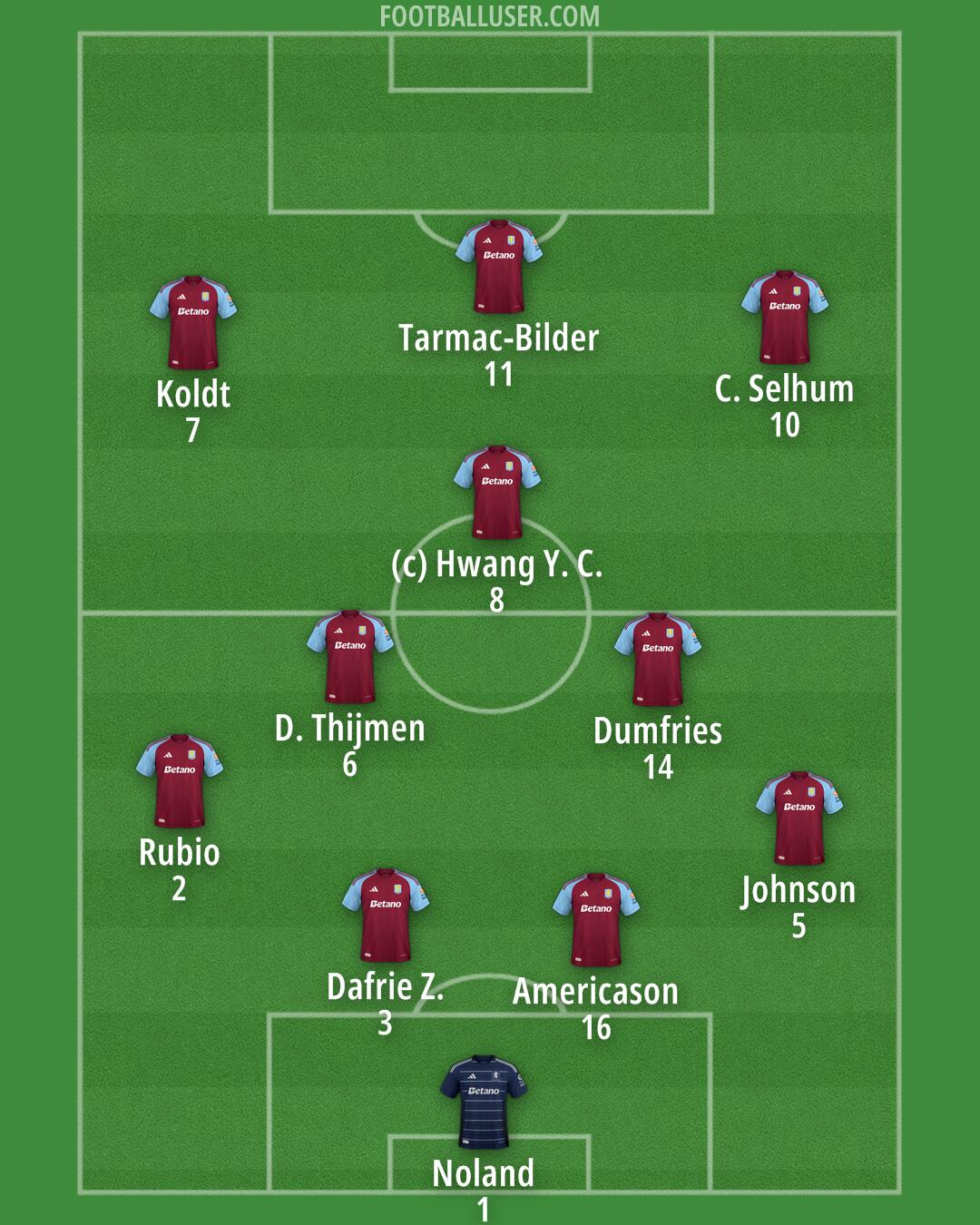
Aston Villa Football Formation
 April 4, 2025


Starting Lineup
Noland (1) · Johnson (5) · D. Thijmen (6) · Dumfries (14) · C. Selhum (10) · Tarmac-Bilder (11) · Koldt (7) · (c) Hwang Y. C. (8) · Americason (16) · Dafrie Z. (3) · Rubio (2)Aston Villa aims to dominate through high pressing and verticality in a 4-3-3. This formation works to win the ball high up the pitch and drive directly toward the opponent. The team looks to play with high intensity to squeeze the space and force errors in the opposition half.
Noland starts in goal to organize the defensive line. The back four functions as a zonal line with Johnson acting as the right back to provide width. Rubio plays as the left back to support the attack while Americason and Dafrie Z. occupy the central roles. Americason acts as a ball playing defender to help play out from the back. Dafrie Z. provides cover and looks to win the header when balls are sent long. This unit works to maintain a high line to keep the team compact.
The midfield consists of a three-man midfield with a carrier and a creative spark. Dumfries operates as the right sided midfielder to drive forward with the ball and provide energy. D. Thijmen plays on the left to connect the defensive and attacking lines. Captain Hwang Y. C. plays in the advanced role to create from deep and find the feet of the striker. Hwang Y. C. works to find pockets of space between the lines to link the play. This trio aims to control the tempo and press aggressively to win the ball back.
In the attacking third, Aston Villa uses three attackers across the front. Tarmac-Bilder operates as a pressing centre-forward to pin the last defender. Koldt and C. Selhum occupy the wide areas as wingers. Koldt looks to cut inside to create goal scoring chances while C. Selhum stays wide to stretch the defence. The wingers work to isolate a one on one wide or deliver early crosses. Tarmac-Bilder holds up the ball to allow the midfielders to arrive late into the box.
A key advantage for Aston Villa is the ability to press high in coordinated waves. The front three and the attacking midfielders trigger a press to disrupt the opponent. Another strength is the ability to create wide overloads when Johnson and Rubio push up to support the wingers. This movement forces the opposition to shift and creates gaps in the middle for Hwang Y. C. to exploit.
This 4-3-3 formation relies on high intensity and quick transitions to overwhelm the opposition. It is best suited for matches against teams that struggle to play out from the back under pressure.