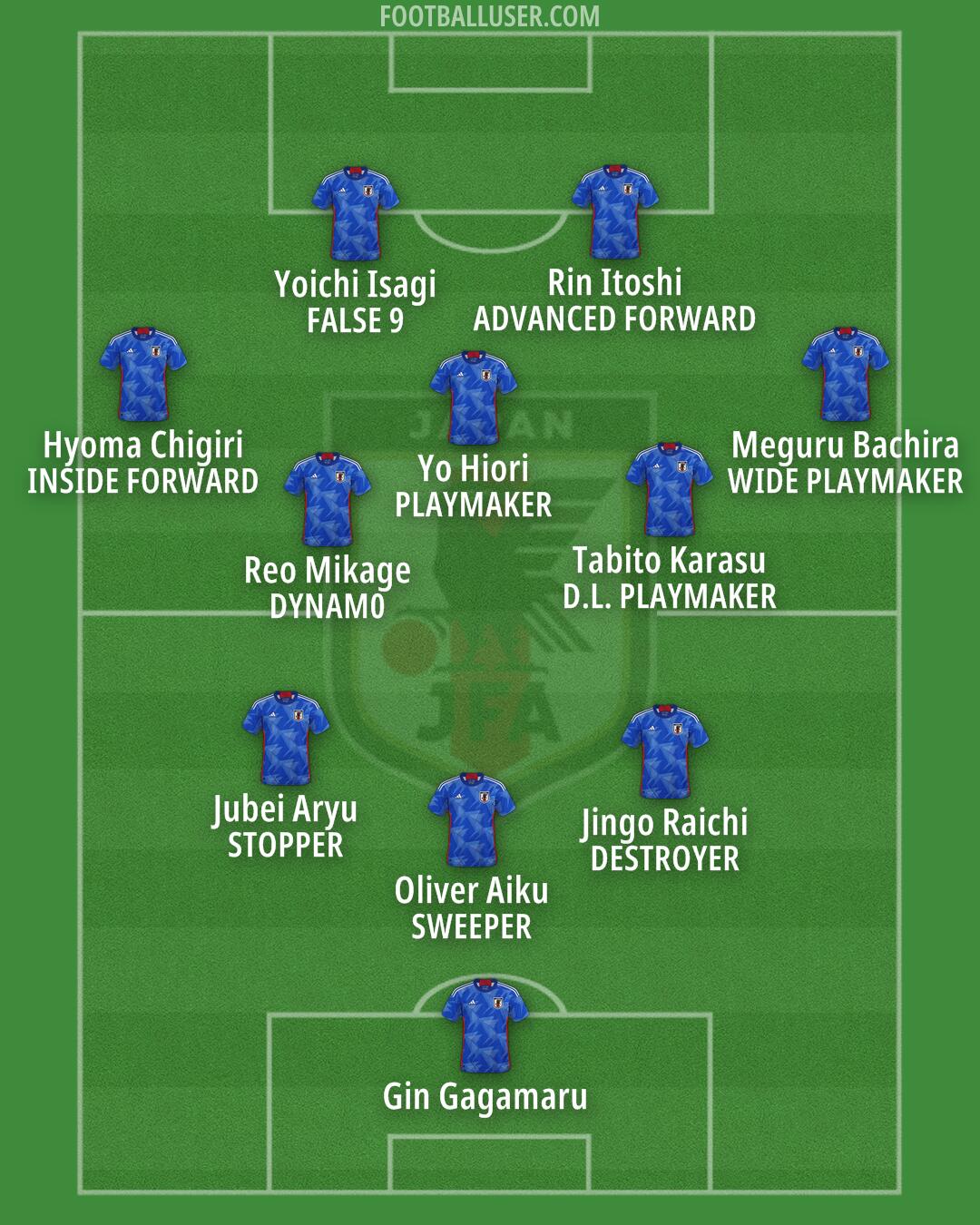

Japan National Football Team Formation
 April 5, 2025


Starting Lineup
Yoichi Isagi (FALSE 9) · Hyoma Chigiri (INSIDE FORWARD) · Meguru Bachira (WIDE PLAYMAKER) · Reo Mikage (DYNAM0) · Tabito Karasu (D.L. PLAYMAKER) · Yo Hiori (PLAYMAKER) · Rin Itoshi (ADVANCED FORWARD) · Jubei Aryu (STOPPER) · Oliver Aiku (SWEEPER) · Jingo Raichi (DESTROYER) · Gin GagamaruJapan plays with a heavy focus on high pressing and rapid transitions using a 3-5-2. This formation is built to squeeze the pitch and win the ball high up the pitch to catch opponents out of position. The goal is to use the extra bodies in the middle to control the tempo before launching direct attacks toward the two strikers.
Gin Gagamaru acts as the last line of defense behind a back three. Oliver Aiku leads the defensive line and uses his reading of the game to sweep behind the others. Jingo Raichi and Jubei Aryu operate as the wide center-backs, where they must be ready to step up into midfield or cover the space left by the wingers. This defensive unit stays compact to deny the turn to attackers and forces the opposition to play long.
The midfield relies on a central engine room to control the game. Reo Mikage and Tabito Karasu form a double pivot to shield the defense and win the second ball. Yo Hiori operates as a playmaker to connect the defensive and attacking lines, while Meguru Bachira and Hyoma Chigiri push higher to support the forwards. Bachira uses his dribbling style to carry the ball forward, while Hiori looks to find the feet of the striker with precise passing.
Japan uses two forwards in a partnership to stretch the opposition defense. Rin Itoshi and Yoichi Isagi work in close combinations to create runs in behind. Isagi focuses on finding space between the lines, while Itoshi acts as a primary goal threat who can drop deep to link up play. The attack relies on the wide midfielders to provide width and pull the defenders apart, creating gaps for the strikers to exploit through quick one-two passes.
This lineup offers significant tactical advantages through its central density. The double pivot of Mikage and Karasu provides stability, while the ability to press in coordinated waves makes it hard for opponents to build from the back. Japan also benefits from the speed of transition when Bachira or Chigiri win the ball and immediately drive toward the goal.
The 3-5-2 formation allows Japan to dominate the middle of the park through numerical superiority. It is a system best suited for matches where the team needs to suffocate an opponent in their own half.