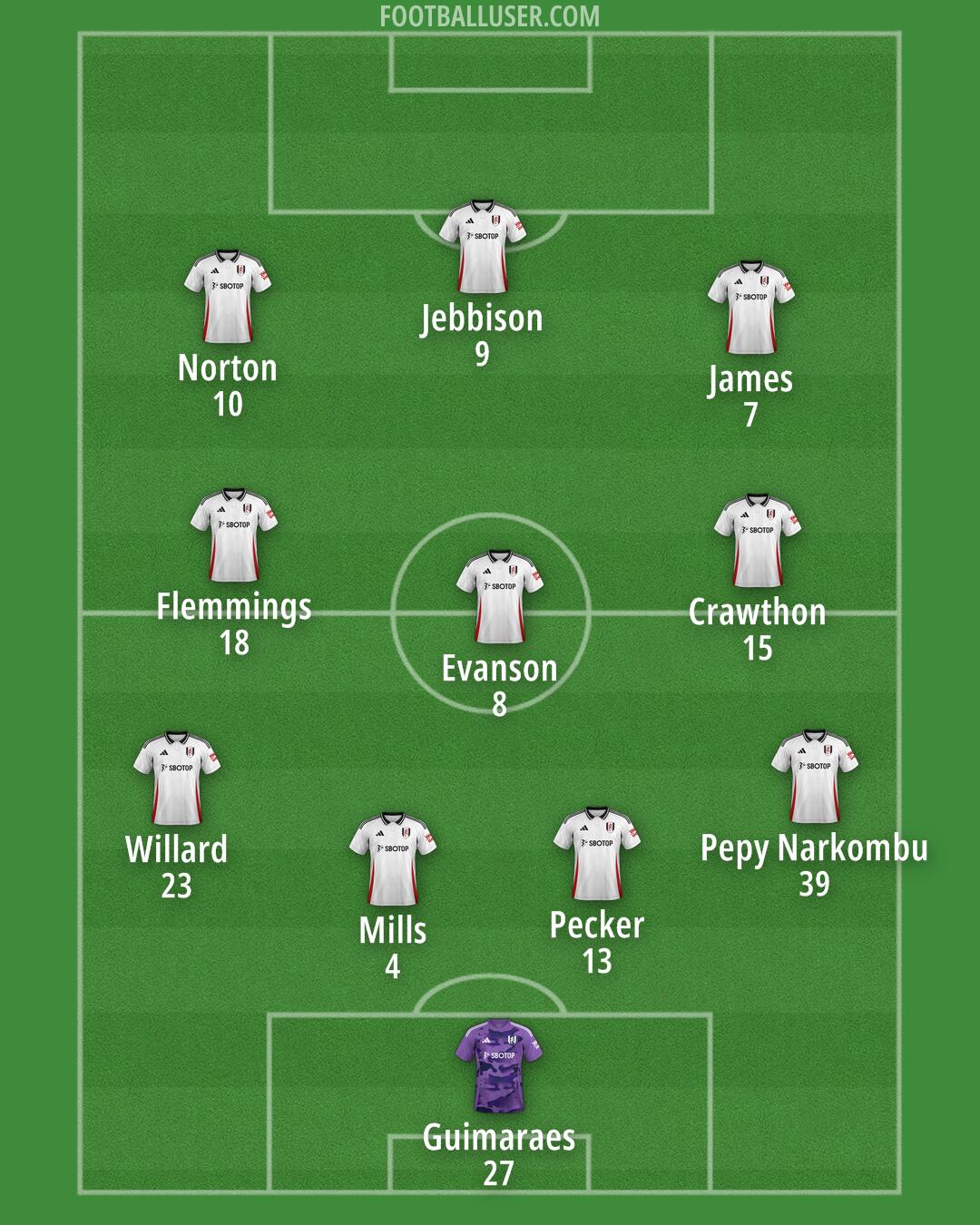
Fulham Football Formation
 April 6, 2025


Starting Lineup
Guimaraes (27) · Mills (4) · Pecker (13) · Pepy Narkombu (39) · Willard (23) · Evanson (8) · Flemmings (18) · Crawthon (15) · Jebbison (9) · James (7) · Norton (10)Fulham plays with a high press and a heavy focus on quick transitions in a 4-3-3. This lineup is built to press from the front and force a long ball from the opposition. The primary goal is to win it back high up the pitch to catch the opponent out of position during their build up.
Guimaraes acts as the last line of defence, while the back four maintains a high line to squeeze the space. Pecker and Mills form the central pairing, where Pecker marks the striker and Mills provides cover when the line steps up. Pepy Narkombu and Willard operate as full backs to provide width. Pepy Narkombu looks to overlap the winger to create overloads, whereas Willard is more cautious, often dropping into a mid-block to protect the flank.
In the middle of the pitch, the team uses a midfield trio with a carrier. Evanson holds the central position to shield the defence and recycle possession. Crawthon and Flemmings operate in the half-spaces as inverted eights. Flemmings is tasked to press aggressively to win the ball high, while Crawthon looks to carry the ball forward to break the line. This formation ensures the midfield can connect the defensive and attacking lines effectively.
The attacking unit consists of three attackers across the front. Jebbison leads the line as a pressing centre-forward to pin the last defender and win the second ball. Norton and James act as inverted wingers who cut inside to occupy central areas. James seeks to cut inside and drive at the defence, while Norton pulls wide to stretch the defence before making runs into the box. They use link-up play between the lines to find ways through the opposition.
One major advantage for Fulham is the ability to create wide overloads when Pepy Narkombu overlaps the winger to provide crosses. The team also benefits from the ability to press high in coordinated waves, which forces the opposition to play long and lose control of the ball. These movements create dangerous chances for quick attacks in transition.
This 4-3-3 formation relies on intense pressing and verticality to control games. It is most effective against opponents that attempt to play short from the back under heavy pressure.