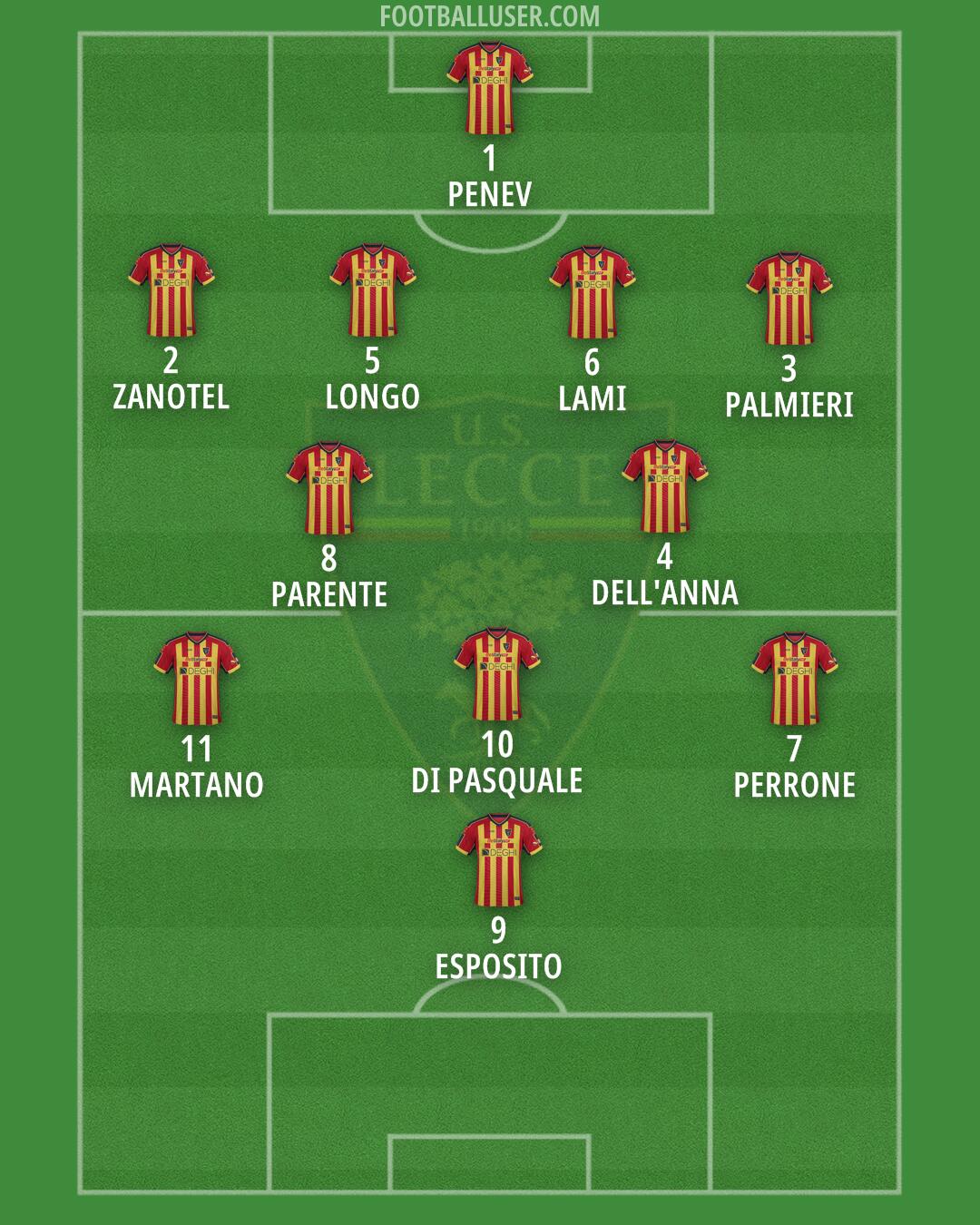

Lecce Football Formation
 April 7, 2025


Starting Lineup
1 (PENEV)2 (ZANOTEL)
5 (LONGO)
6 (LAMI)
3 (PALMIERI)
8 (PARENTE)
4 (DELL'ANNA)
7 (PERRONE)
10 (DI PASQUALE)
11 (MARTANO)
9 (ESPOSITO)
Lecce plays with a very direct intent to catch opponents off guard. They rely on a 4-2-4 formation to stay heavy in the attacking third. The goal is to win the ball high up the pitch and go direct to the forwards immediately. This lineup is built to push the opposition back and play with high intensity to force errors.
In goal, 1 stays behind a flat back four. The defenders 2, 5, 6, and 3 maintain a defensive line that must hold when under pressure. 2 and 3 act as full backs who can push up the pitch to support the wide attackers. In the middle, 5 and 6 must be ready to defend zonally and cover the space if the midfield is bypassed. They need to win the header in set piece situations and clear the lines when the pressure comes.
The midfield works as a double pivot with 4 and 8. These two players are tasked to shield the defence and win the second ball. 4 and 8 need to connect the back four to the front line by playing short from the back and moving the ball quickly. One player often drops to receive between the centre backs, while the other tries to carry the ball forward to support the attack. They must also track back to help the full backs when the team loses possession.
The attacking unit is heavy, featuring 7, 11, 10, and 9. 7 and 11 operate as wide wingers who want to stretch the defence and get to the byline. They look to cut inside or whip it in to the strikers. Up front, 10 and 9 work as a strike partnership to pin the last defender. One can act as a target man to hold up the ball, while the other looks to make runs in behind to hit in behind on the transition. This creates many options for cutbacks and through balls.
One clear advantage for Lecce is the ability to press from the front. With four attackers, they can trigger a press to win it back high up the pitch and force a long ball. They also find success by creating wide overloads when 2 and 3 overlap the winger. This creates space in the middle for 10 and 9 to combine in tight spaces and split the defence with a through ball.
This formation is designed for high pressure and rapid attacking transitions. It is best used against teams that play with a high line and struggle to defend in wide areas.