Liverpool Football Formation
 April 9, 2025


Starting Lineup
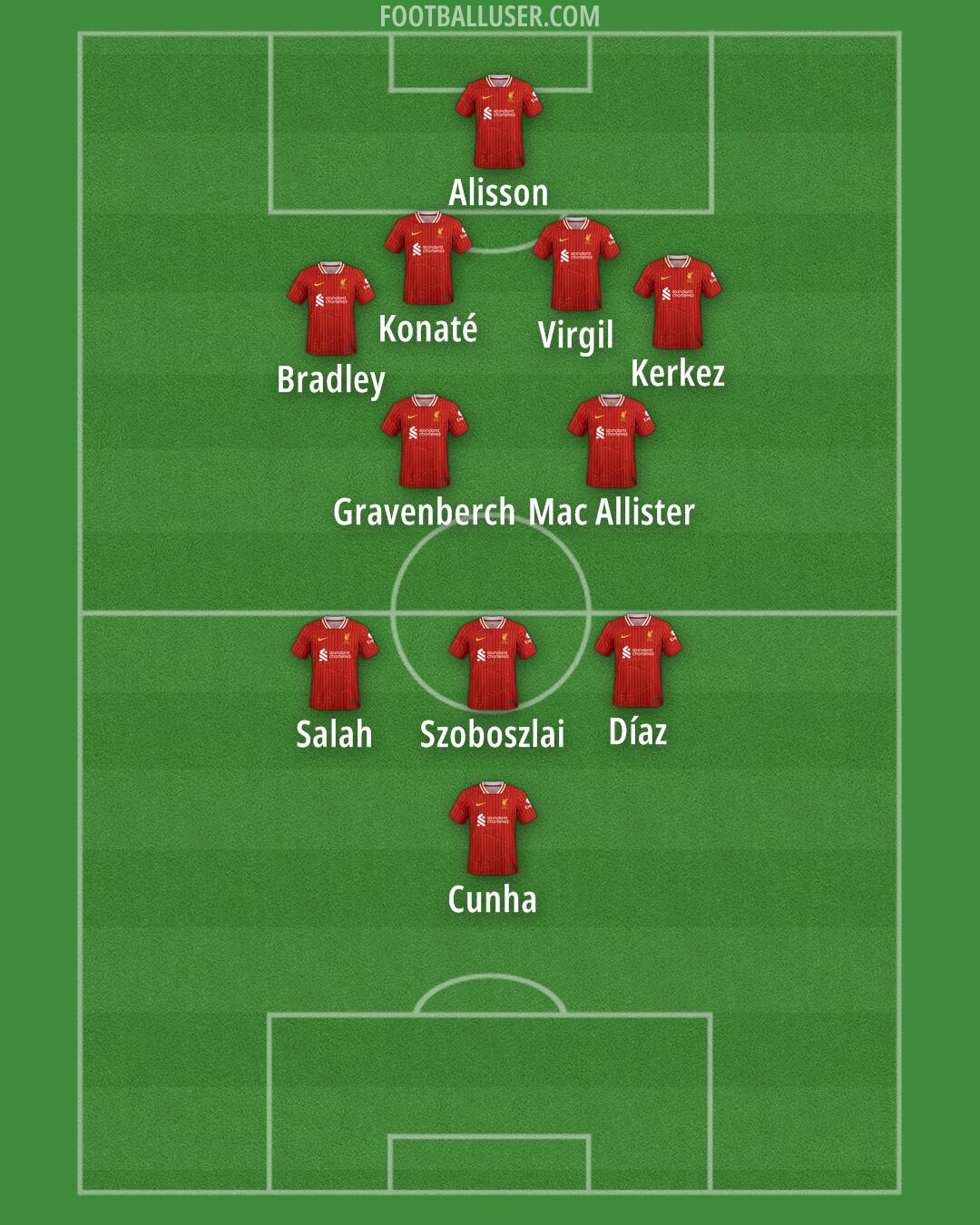
Kerkez · Cunha · Salah · Díaz · Bradley · Konaté · Virgil · Gravenberch · Szoboszlai · Alisson · Mac AllisterLiverpool aims to play with high intensity and verticality through a 4-2-4 formation. This lineup focuses on heavy metal football by using aggressive pressing and rapid transitions to catch opponents off guard. The goal is to push the ball forward quickly to catch the opposition in transition, using the width and speed of the front four to stretch the defense.
Alisson operates between the posts, playing out from the back to start attacks. The defensive unit sits in a high line, with Virgil acting as a ball playing center back who can step up to intercept passes. Konaté provides aerial strength and physicality alongside him to defend the central zone. Kerkez acts as an attacking wing back on the left to provide width, while Bradley functions as an overlapping full back on the right to support the midfield.
The midfield relies on a double pivot to manage the center of the pitch. Gravenberch acts as a carrier to drive the ball forward with his dribbling, while Mac Allister works to connect the defensive and attacking lines. Mac Allister often drops deep to receive the ball and recycle possession, helping to shield the defense when the team loses control. This pairing must work hard to cover the space left behind by the advancing full backs.
In the attacking phase, Liverpool uses two forwards in a partnership with two wide wingers. Salah works as an inverted winger on the right to cut inside and look for goal, while Díaz operates on the left to stretch the play. Szoboszlai and Cunha lead the line as two forwards, with Szoboszlai often finding space to arrive late into the box. The front four press from the front to force a long ball from the opposition, creating opportunities to win the ball high up the pitch.
This formation offers significant advantages in terms of speed of transition and wide overloads. By using Kerkez and Bradley to overlap the wingers, Liverpool can create numerical superiority in the final third. The ability to press in coordinated waves makes it very difficult for opponents to build play from the back, often forcing errors that lead to direct chances.
Liverpool relies on this heavy attacking setup to overwhelm opponents through sheer volume of pressure. This formation is best suited for games where the team wants to dominate through high intensity and quick transitions.