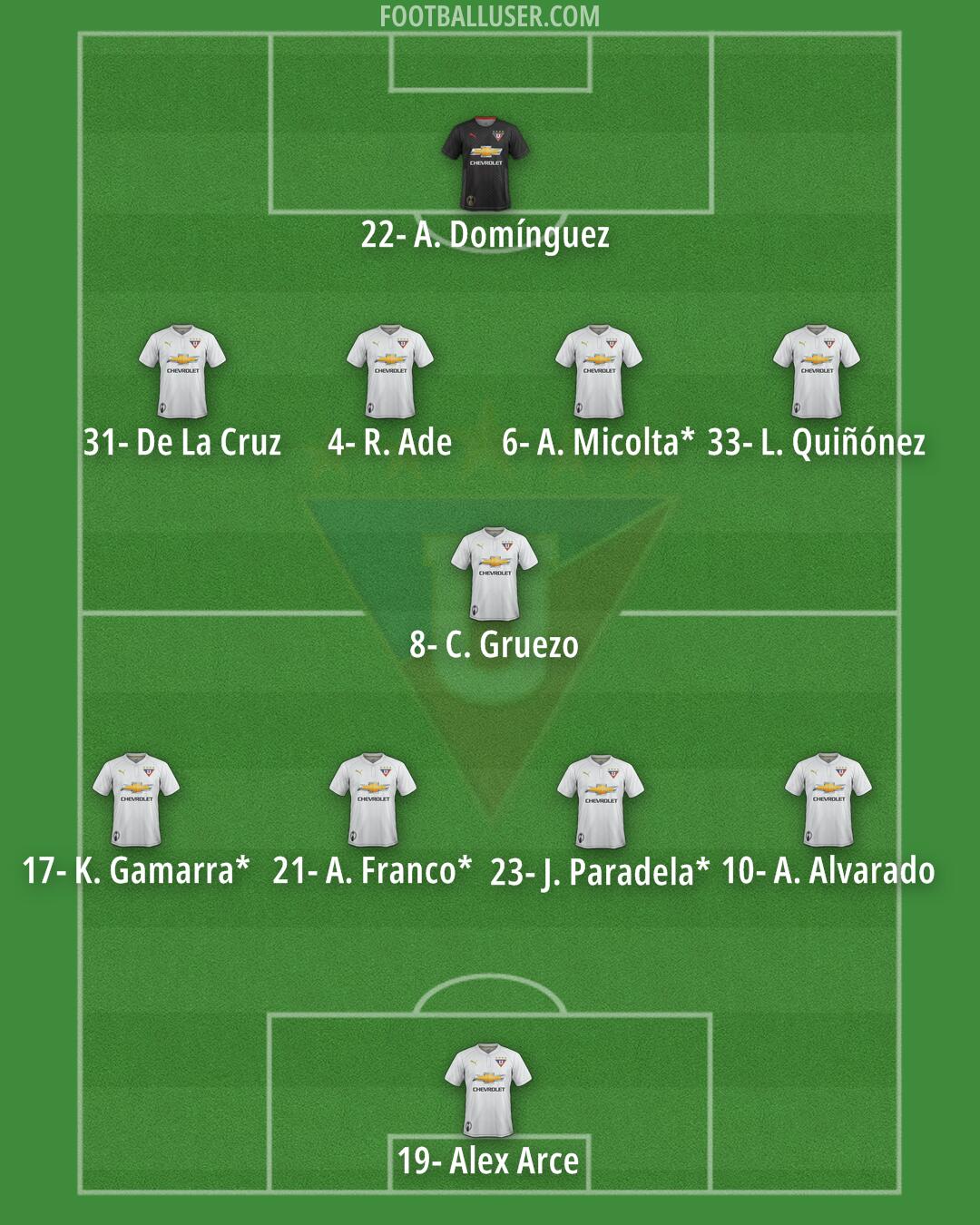

Liga de Quito Football Formation
 April 12, 2025


Starting Lineup
22- A. Domínguez31- De La Cruz
4- R. Ade
6- A. Micolta*
33- L. Quiñónez
8- C. Gruezo
21- A. Franco*
17- K. Gamarra*
19- Alex Arce
23- J. Paradela*
10- A. Alvarado
Liga de Quito relies on a defensive identity to control matches, utilizing a 5-4-1 formation. This lineup is built to sit deep and absorb pressure before hitting opponents on the break. The main goal for Liga de Quito is to stay compact and force the opposition into low percentage areas.
A. Domínguez guards the goal and manages the space behind the defense. The back line functions as a back five with C. Gruezo acting as the central man to organize the unit. He provides aerial strength while R. Ade and A. Micolta cover the spaces to his left and right. To add width, De La Cruz acts as a right wing back and L. Quiñónez works as a left wing back to track runners. This defensive group works to defend zonally and ensure no gaps appear between the lines.
The midfield operates in a flat four to squeeze the space in front of the defense. K. Gamarra plays as the left midfielder and A. Alvarado takes the right side to help track back when needed. In the center, J. Paradela and A. Franco form a pairing to control the middle. J. Paradela works to connect the defensive and attacking lines, while A. Franco protects the center to shield the defenders. They aim to win the second ball and recycle possession quickly once they regain control.
Alex Arce leads the line as a lone striker. He works to hold up the ball and wait for support from the midfield. The attacking plan involves the wing backs, De La Cruz and L. Quiñónez, pushing up to provide width. They look to deliver crosses into the box for Alex Arce to target. When the team wins the ball, they look to break quickly and find the striker in behind the opposition defense.
This formation offers significant compactness when defending in a mid-block. Liga de Quito creates numerical superiority in the central defensive areas, making it very hard to play through them. They also use the width of the wing backs to create wide overloads during transitions to stretch the defence.
This 5-4-1 formation is designed to be defensively solid and effective on the counter. It is best suited for games against teams that dominate possession and require a disciplined low block.