
Brazil National Football Team Formation
 April 14, 2025


Starting Lineup
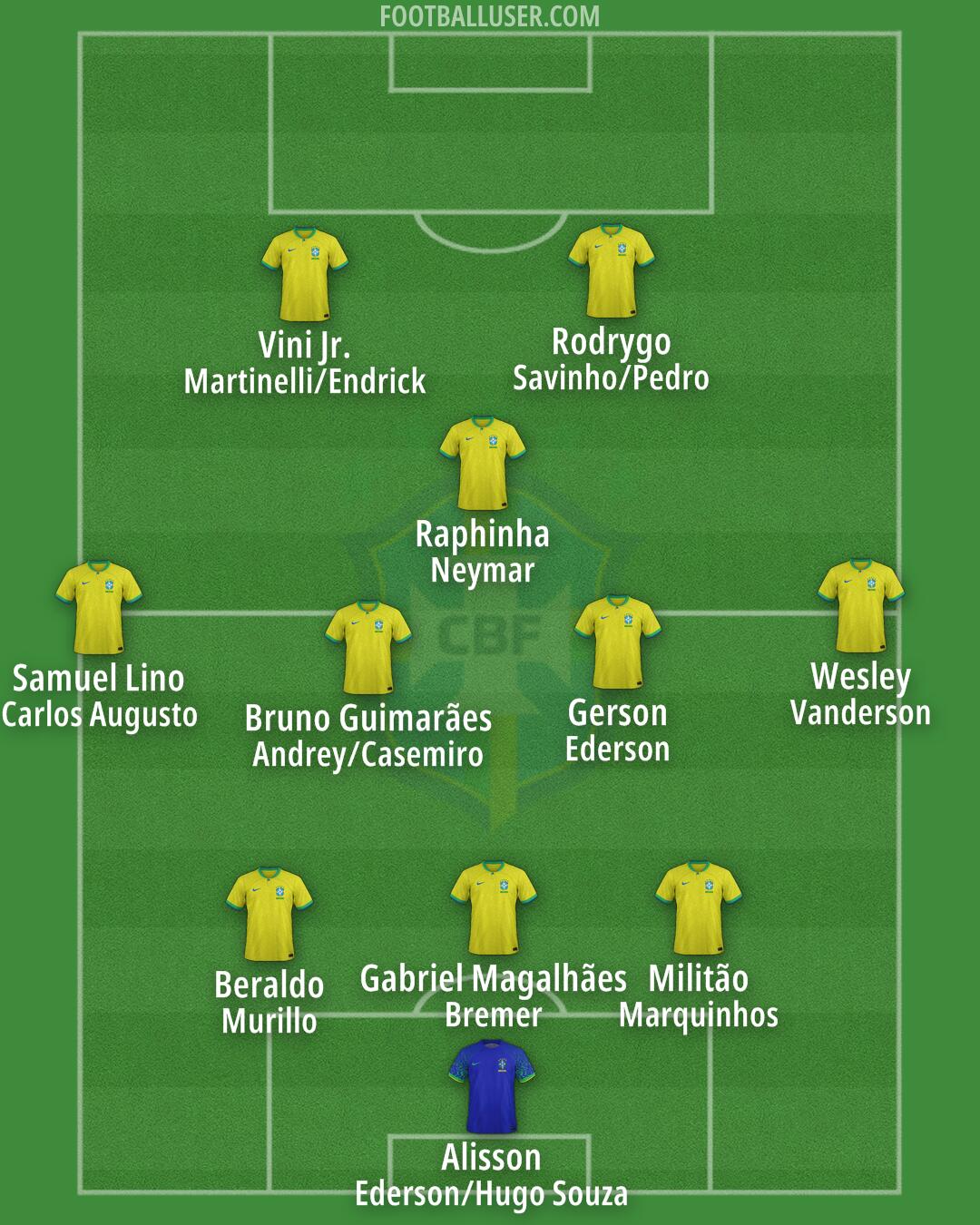
Samuel Lino (Carlos Augusto) · Wesley (Vanderson) · Beraldo (Murillo) · Gabriel Magalhães (Bremer) · Militão (Marquinhos) · Gerson (Ederson) · Bruno Guimarães (Andrey/Casemiro) · Raphinha (Neymar) · Rodrygo (Savinho/Pedro) · Vini Jr. (Martinelli/Endrick) · Alisson (Ederson/Hugo Souza)Brazil relies on a high press and rapid verticality with this 3-5-2. The Seleção focuses on winning the ball high up the pitch and using quick transitions to catch the opposition out of position. This formation is built to control the middle of the pitch while allowing wide players to stretch the defence.
Alisson operates between the posts, acting as a sweeper behind a high line. The back three consists of Gabriel Magalhães, Beraldo, and Militão. Gabriel Magalhães acts as the central anchor, while Militão and Beraldo provide cover and step up to intercept passes. This defensive unit works to squeeze the space and hold a high line to keep the team compact.
The midfield is a five man unit designed to control the center. Bruno Guimarães and Gerson form a central pairing, with Bruno Guimarães providing a passing range to progress through the thirds. Raphinha plays as an attacking ten behind the strikers, acting as the creative link. Samuel Lino and Wesley occupy the wide areas, operating as wing backs to provide width and track back when the team loses possession.
Up front, Brazil utilizes two forwards in a partnership. Vini Jr. and Rodrygo lead the line, looking to hit in behind on the transition. Vini Jr. uses his dribbling style to drive at defenders, while Rodrygo looks to find space between the lines. The wing backs, Samuel Lino and Wesley, provide constant support to allow the attackers to isolate one on one wide or receive the ball in central areas.
The tactical advantages of this Brazil lineup include numerical superiority in midfield and the ability to press high in coordinated waves. The presence of Raphinha in the hole creates an extra man to overload the central area. Additionally, the wing backs allow the team to shift between a narrow defensive block and a wide attacking formation to stretch the opposition.
This 3-5-2 is built for a team that wants to dominate through high intensity and quick ball movement. It is best suited for matches against opponents who play a high line and can be punished by speed in transition.