Custom Team Football Formation
 April 16, 2025


Starting Lineup
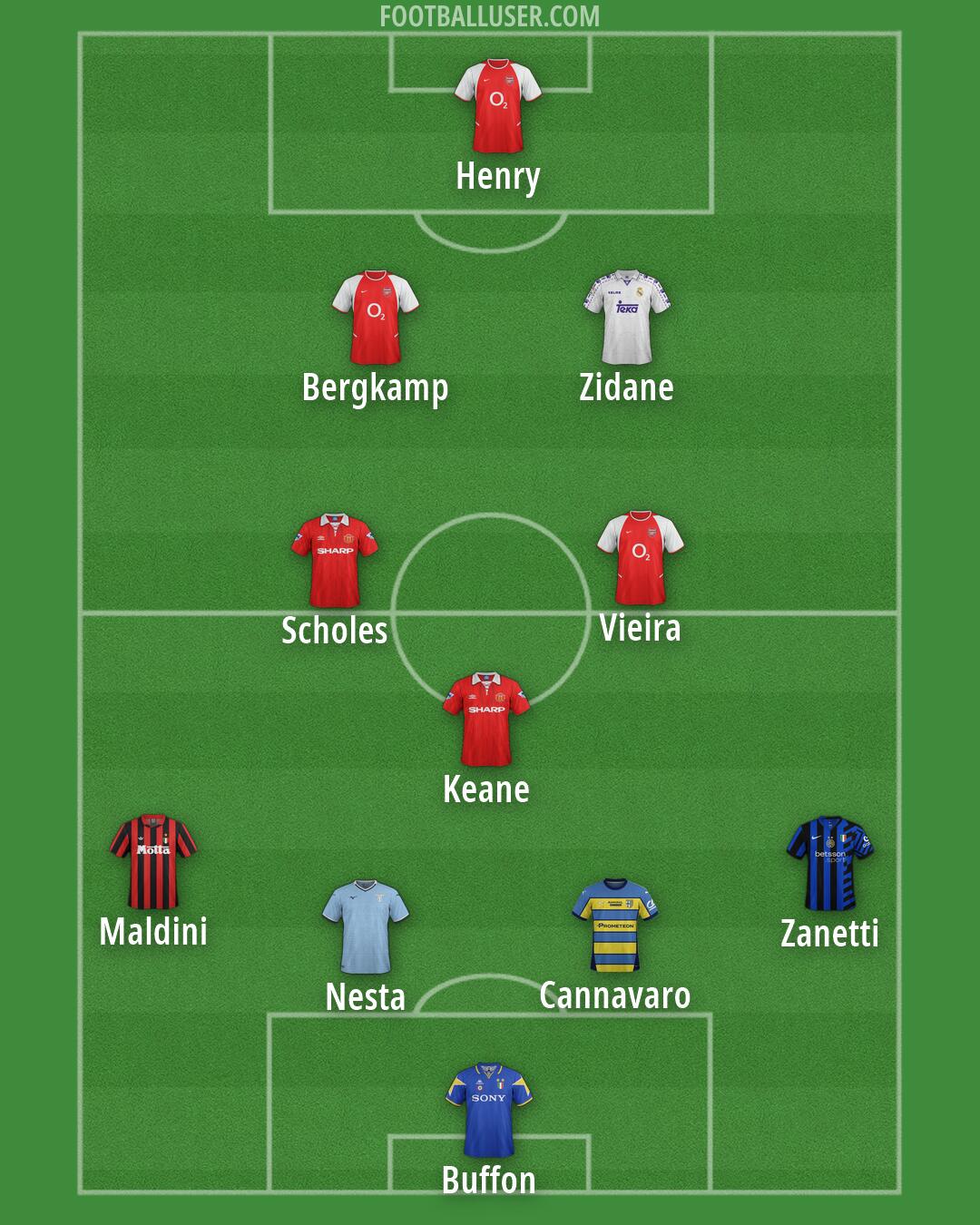
Buffon (Juventus) · Maldini (Milan) · Nesta (Lazio) · Cannavaro (Parma) · Zanetti (Inter) · Keane (Man Utd) · Vieira (Arsenal) · Scholes (Man Utd) · Zidane (Real Madrid) · Bergkamp (Arsenal) · Henry (Arsenal)A heavy emphasis on defensive solidity and quick transitions defines this lineup in a 5-2-3. The formation is built to sit deep and absorb pressure before launching direct attacks through talented individuals. This system aims to dominate the central areas while using extreme width to stretch the opposition once the ball is won back.
Buffon guards the goal and organizes the defensive unit. The back line operates as a narrow defensive block consisting of three central defenders. Keane sits at the heart of the defense to clear the lines and win the second ball. Nesta and Cannavaro operate alongside him to provide aerial strength and cover the space behind the wing backs. Maldini plays as a left wing back, often dropping back to form a flat back five when defending, while Zanetti acts as a right wing back to provide width and track back during transitions.
The midfield functions as a double pivot to control the center of the pitch. Vieira provides physical presence and drives forward with the ball to break the line, while Scholes looks to recycle possession and play through the lines with his passing range. These two players work to protect the defense and connect the back three to the attacking trio. They focus on squeezing the space in a mid-block to force a long ball from the opposition.
In the final third, the team uses three attackers to exploit space. Henry acts as the lone striker, using his pace to hit in behind on the transition. Bergkamp operates as a left winger who often cuts inside to find the feet of the striker, while Zidane plays on the right wing with his ability to carry the ball forward and create chances. This front line is designed to create runs in behind and isolate wide players in one on one situations when the team breaks quickly.
This formation offers significant tactical advantages through its compactness when defending and its ability to counter at pace. The presence of three central defenders ensures numerical superiority in the box, while the wing backs allow the team to switch play rapidly. By using a double pivot, the team can effectively deny the pivot of the opposition and keep the midfield compact.
This 5-2-3 formation relies on a strong defensive foundation and clinical finishing in transition. It is best suited for facing teams that hold high possession and leave space behind their defensive line.