Rangers Football Formation
 April 16, 2025


Starting Lineup
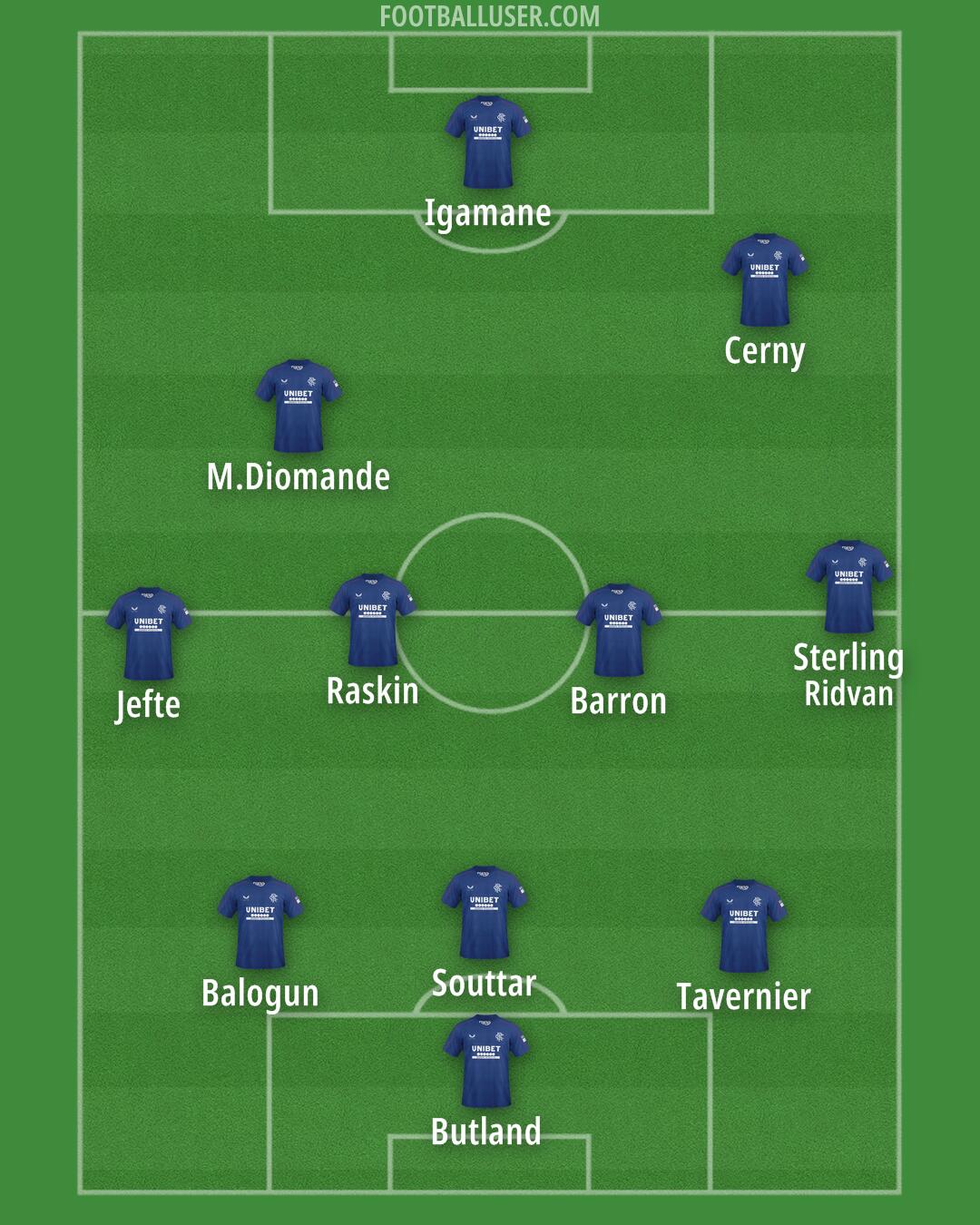
Butland · Tavernier · Souttar · Balogun · Sterling (Ridvan) · Jefte · Raskin · Barron · M.Diomande · Cerny · IgamaneRangers aims to dominate the pitch through high intensity and central density with a 3-6-1 formation. This lineup focuses on winning the ball high up the pitch and using a crowded midfield to suffocate opponents. The team looks to control the game by keeping players close together and moving as a unit to squeeze the space in the middle of the park.
Butland stays between the posts to organize the back line. A back three consisting of Souttar, Balogun, and Tavernier maintains a high line to keep the team compact. Souttar acts as the central anchor to win the header and command the area, while Balogun provides cover to sweep behind the line. Tavernier plays as a wide centre-back who can step into midfield to provide extra passing options or drive forward when the team has control.
The midfield is a massive engine room designed to control the tempo. Raskin and Barron operate in a double pivot to shield the defence and recycle possession. Raskin uses his driving style to carry the ball forward and bridge the gaps between the lines. M.Diomande operates in the left half-space as an attacking ten, looking to find pockets of space, while Cerny plays on the right to create chances. Jefte and Sterling provide the width as wide midfielders, with Sterling looking to spread wide and Jefte ready to overlap or track back to help the defense.
Igamane leads the line as a lone striker to pin the last defender. The attack is built through quick combinations in the middle, with M.Diomande and Cerny looking to play through the lines to find the striker. Igamane must hold up the ball to allow the runners from deep to arrive late into the box. The wide players, Jefte and Sterling, look to get to the byline and deliver early crosses or cut it back to the oncoming midfielders.
Rangers can use this formation to create numerical superiority in midfield, making it very hard for opponents to play through the center. The ability to press in coordinated waves allows the team to win the ball back high up the pitch and catch the opposition out of position. This lineup also provides great flexibility to shift into a defensive block when needed.
This 3-6-1 formation relies on heavy pressing and central dominance to control matches. It is best suited for games where Rangers need to overwhelm an opponent in the middle of the pitch.