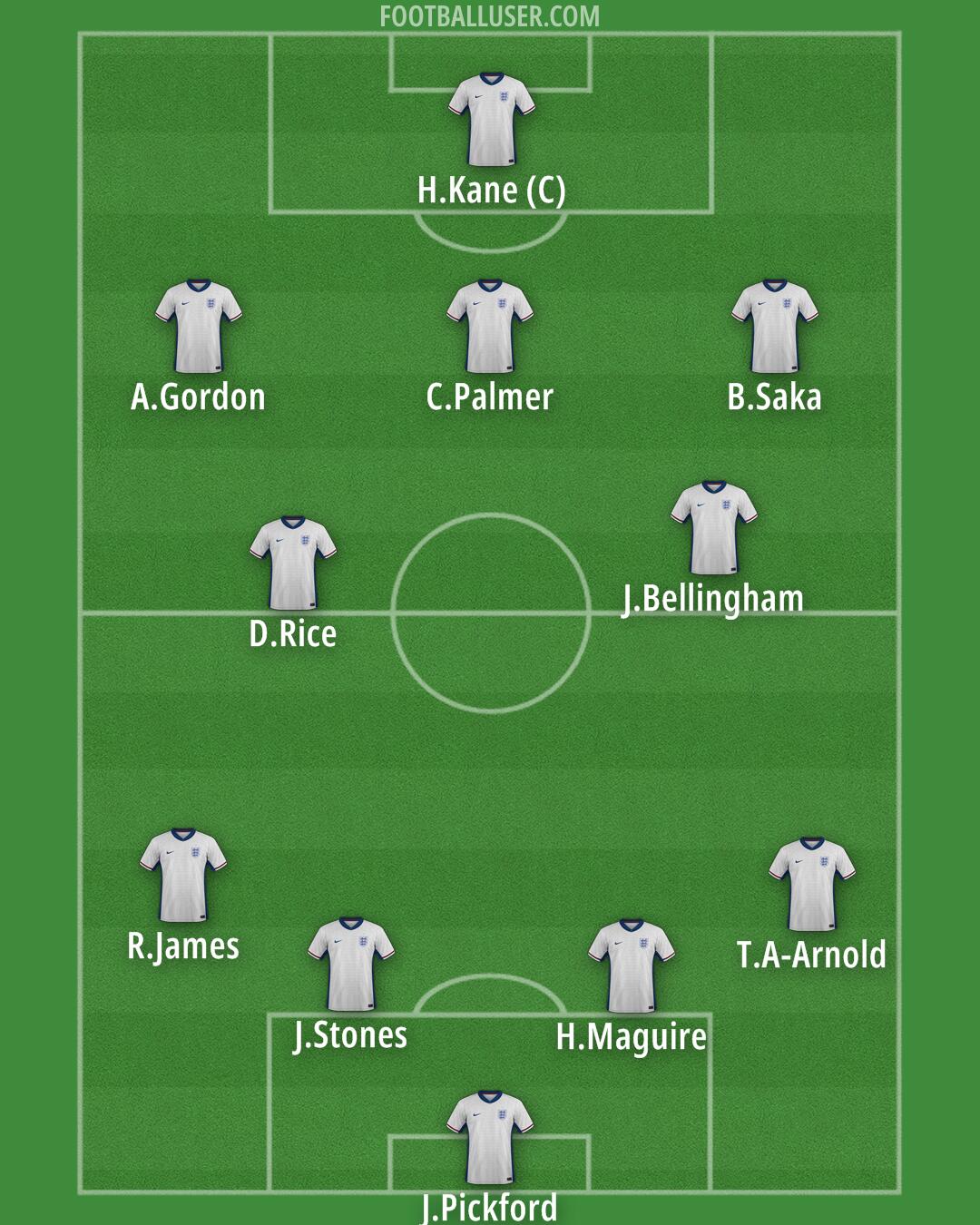
England National Football Team Formation
 April 22, 2025
 bosan
bosan


Starting Lineup
J.Pickford · J.Stones · H.Maguire · R.James · T.A-Arnold · D.Rice · J.Bellingham · C.Palmer · B.Saka · H.Kane (C) · A.GordonEngland relies on a high press and verticality through a 4-5-1 formation. This lineup is built to win the ball high up the pitch and quickly look to find the front line to exploit gaps in the opposition. The team aims to squeeze the space in the middle of the pitch while using aggressive runners to move the ball forward through the thirds.
J.Pickford acts as the last line of defense, playing out from the back to start attacks. The back four operates with a high line to keep the distance between the defensive unit and the midfield tight. H.Maguire and J.Stones form the central pair, with Stones acting as a ball playing defender and Maguire providing aerial strength and cover. T.A-Arnold plays as an attacking full back to provide width, while R.James acts as a defensive wing back to balance the left side. The defensive unit works to hold the line and catch opponents offside when the press is triggered.
The midfield functions as a five man unit that controls the tempo of the game. D.Rice sits as a single pivot to shield the defense and intercept passes. Alongside him, J.Bellingham acts as a carrier who drives forward with the ball to connect the lines. C.Palmer and B.Saka operate in the half spaces, where they can receive on the half-turn and play through the lines. A.Gordon provides extra energy on the left, pressing aggressively to win the ball high and helping to compress the midfield.
In the final third, the England attack is centered around a lone striker, H.Kane (C). As the captain, H.Kane operates as a target man who can hold up the ball or drop deep to link up play with the advancing midfielders. The wide players, B.Saka and A.Gordon, act as inverted wingers who cut inside to create shooting opportunities or deliver crosses. The team builds attacks by combining in tight spaces, often using third man runs to catch the defense out of position. This movement creates space for late arrivals into the box from J.Bellingham or C.Palmer.
One major advantage of this formation is the ability to press high in coordinated waves, making it difficult for opponents to build play from their own goalkeeper. England also gains numerical superiority in the middle of the pitch, which allows them to recycle possession effectively. The speed of transition from a mid block to a direct attack ensures that the opposition can rarely settle once the ball is won.
This 4-5-1 formation provides a balance between defensive solidity and attacking threat. It is best suited for matches against teams that play with a high defensive line or those that struggle to bypass a heavy midfield press.