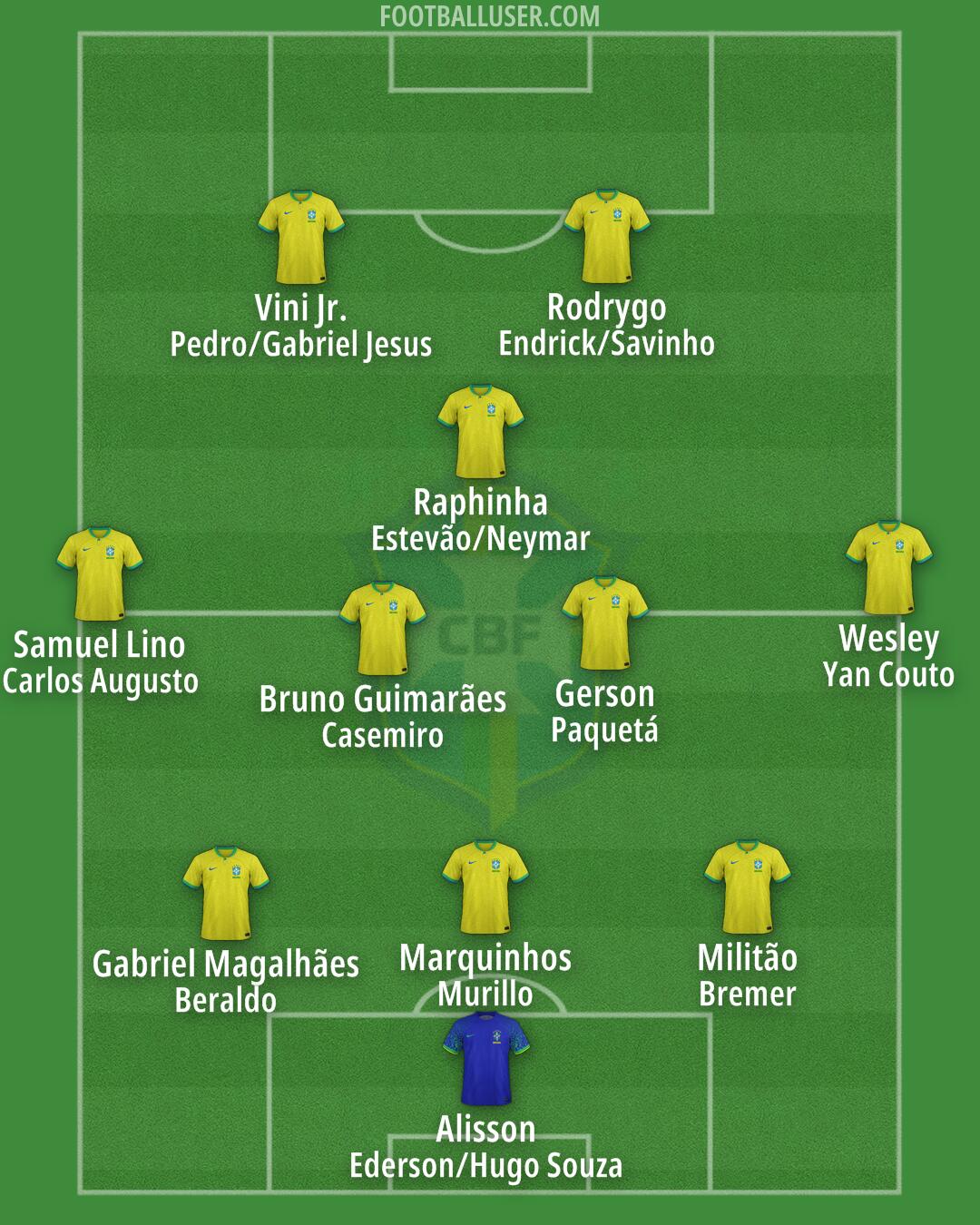

Brazil National Football Team Formation
 April 23, 2025


Starting Lineup
Alisson (Ederson/Hugo Souza) · Gabriel Magalhães (Beraldo) · Marquinhos (Murillo) · Militão (Bremer) · Samuel Lino (Carlos Augusto) · Wesley (Yan Couto) · Bruno Guimarães (Casemiro) · Gerson (Paquetá) · Raphinha (Estevão/Neymar) · Rodrygo (Endrick/Savinho) · Vini Jr. (Pedro/Gabriel Jesus)Brazil relies on a high press and quick transitions, utilizing a 3-5-2 formation to control the center of the pitch. This lineup is built to overwhelm opponents in the middle and use verticality to exploit space behind the opposition defense. The team aims to win the ball high up the pitch and move the ball forward with pace to catch teams out of position.
Alisson acts as the last line of defense, often playing as a sweeper behind a high line to clear long balls. The back three consists of Gabriel Magalhães, Marquinhos, and Militão, who form a compact unit. Marquinhos stays central to dominate in the air and organize the line, while Gabriel Magalhães and Militão provide cover and step up to intercept passes. The defensive unit works to squeeze the space and force a long ball, ensuring the team remains solid when defending zonally.
A busy midfield allows Brazil to control the tempo and connect the defense to the attack. Bruno Guimarães and Gerson operate as a double pivot to shield the defense and recycle possession. Bruno Guimarães uses his passing range to find teammates, while Gerson works to win the second ball and drive forward with the ball. Raphinha plays as an attacking ten behind the strikers, looking to play through the lines and find space between the lines. Samuel Lino and Wesley provide width from the flanks, acting as wing backs who cover the entire length of the pitch.
The attack features a partnership of two forwards, Vini Jr. and Rodrygo, who look to exploit one on one situations. Vini Jr. uses his explosive dribbling style to cut inside from the left, while Rodrygo works to find space in the channels and link up play. They press from the front to force errors from the opposition back line. The wing backs, Samuel Lino and Wesley, provide constant width, allowing the attackers to move centrally and pull wide defenders out of position. This movement creates runs in behind and allows for cutbacks from the byline.
This formation offers Brazil significant advantages, particularly the numerical superiority in midfield provided by the five players in the center. The team can also create wide overloads through the movement of the wing backs combined with the creative runs of Raphinha. The ability to press in coordinated waves makes it difficult for opponents to build play from the back.
Brazil uses this 3-5-2 to dominate possession and strike with speed on the break. It is a formation best suited for matches against teams that sit deep and struggle to track runners in the half-spaces.