
Inter Football Formation
 April 25, 2025


Starting Lineup
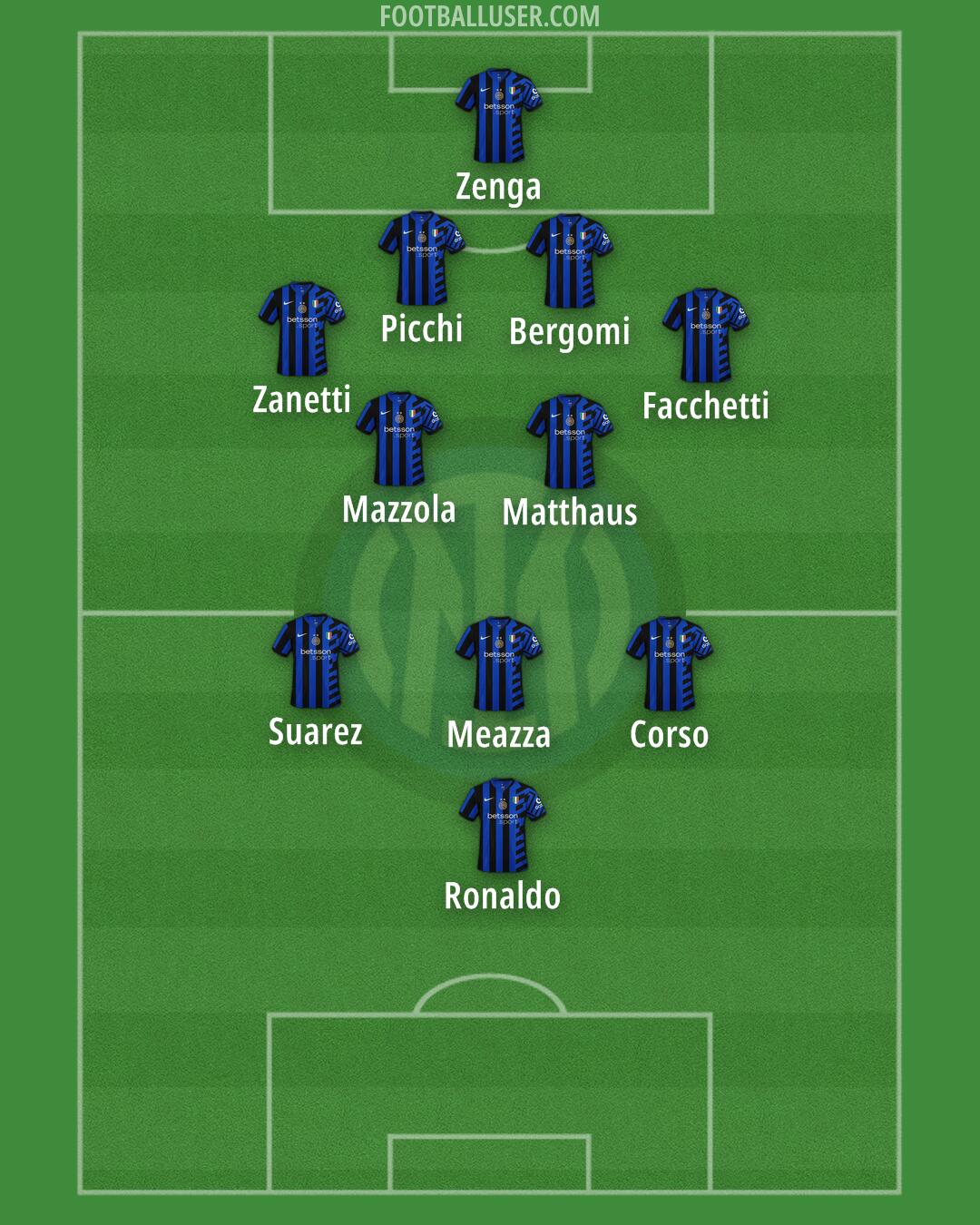
Zenga · Facchetti · Bergomi · Picchi · Zanetti · Corso · Matthaus · Mazzola · Suarez · Meazza · RonaldoInter focuses on a direct and vertical attacking intent using a 4-2-4. This formation aims to overwhelm the opposition through high offensive numbers and rapid transitions. The lineup is built to push the tempo and exploit spaces behind the opponent's defensive line as soon as possession is won.
Zenga operates between the posts to organize the defensive unit. The back line consists of a flat back four where Zanetti acts as a right back to provide width and cover the flank. Facchetti plays as the left back with the freedom to push forward and support the attack. In the center, Picchi and Bergomi defend the zone as central defenders, with Bergomi providing stability and Picchi acting as a ball playing defender to start play. The unit works together to hold the line and defend zonally against incoming threats.
The midfield relies on a double pivot consisting of Mazzola and Matthaus. Matthaus works as a carrier who drives forward with the ball and presses aggressively to win the ball high up the pitch. Mazzola connects the defensive and attacking lines, often dropping deeper to receive the ball and play through the lines. This duo is responsible for shielding the defense and ensuring the team can transition from a mid-block to an attacking stance quickly.
The attacking force features four players designed to stretch the defence. Meazza and Ronaldo operate as a central partnership, with Ronaldo acting as a pressing centre forward to force mistakes. On the flanks, Suarez plays as an inverted winger on the right to cut inside, while Corso stays wide on the left to provide width. The forwards press the opposition back line to win it back high up the pitch, looking to hit in behind on the transition or deliver crosses into the box for the central strikers.
Inter offers significant tactical advantages through its ability to create wide overloads and numerical superiority in the final third. The high numbers in the front line allow the team to press in coordinated waves, making it difficult for opponents to build play from the back. When the team wins the ball, the speed of transition allows them to exploit the space before the opposition can settle into a compact shape.
This 4-2-4 formation is a high risk, high reward system built for aggressive, offensive football. It is best suited for matches against teams that play a high line or struggle to manage rapid transitions in wide areas.