Custom Team Football Formation
 April 30, 2025


Starting Lineup
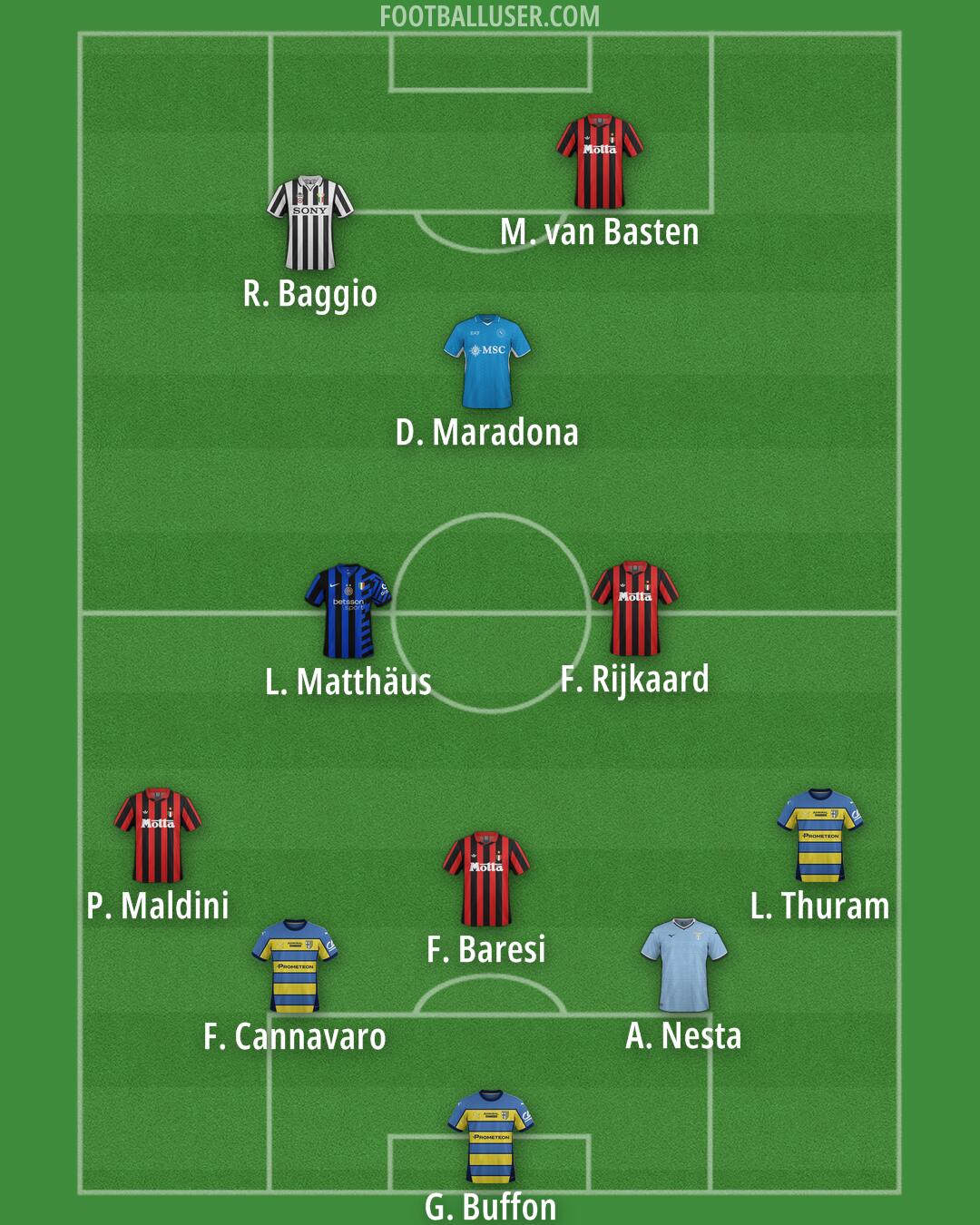
G. Buffon (Parma) · L. Thuram (Parma) · P. Maldini (Milan) · A. Nesta (Lazio) · F. Cannavaro (Parma) · F. Baresi (Milan) · F. Rijkaard (Milan) · L. Matthäus (Inter) · D. Maradona (Napoli) · R. Baggio (Juventus) · M. van Basten (Milan)A high press and heavy focus on winning the ball back high up the pitch defines this lineup, which operates in a 5-3-2 formation. This system is built to dominate central areas and use quick transitions to catch the opposition off guard. The team seeks to control the tempo by squeezing the space in the middle while remaining incredibly difficult to break down.
G. Buffon commands the area from goal as the last line of defense. The defensive unit utilizes a back three with F. Baresi acting as the central leader to sweep behind the line. F. Cannavaro and A. Nesta operate as wide centre-backs, where Cannavaro uses his immense aerial strength and Nesta provides cover to ensure the line stays tight. P. Maldini plays as an attacking wing back on the left, while L. Thuram provides width on the right. They function as a unit to defend zonally and protect the central zone.
The midfield works as a three-man midfield with a carrier and creative elements. F. Rijkaard acts as the shield to protect the defense, while L. Matthäus drives forward with the ball to link the lines. D. Maradona plays as an attacking ten behind the striker, looking to find pockets of space and play through the lines. This midfield unit is designed to press aggressively and win the second ball to keep the pressure on the opponent.
In the attacking third, the team utilizes two forwards in a partnership. M. van Basten acts as a target man to hold up the ball and win the header, allowing R. Baggio to play as a second striker in the hole. They combine in tight spaces to pull defenders out of position. The wing backs, P. Maldini and L. Thuram, provide the width by overlapping the winger positions to deliver crosses into the box. This movement creates runs in behind and allows the forwards to exploit gaps.
One main advantage of this formation is the ability to press high in coordinated waves. The team creates a compact shape that is hard to penetrate once the ball is lost. Another strength is the numerical superiority in the central corridor, which allows the players to intercept passes and win possession quickly. The presence of such strong individual ball winners allows the team to transition from defense to attack with great speed.
This 5-3-2 formation relies on a heavy press and a rock solid defensive foundation. It is best suited for games against teams that want to play with possession, as it can squeeze the space and strike on the break.