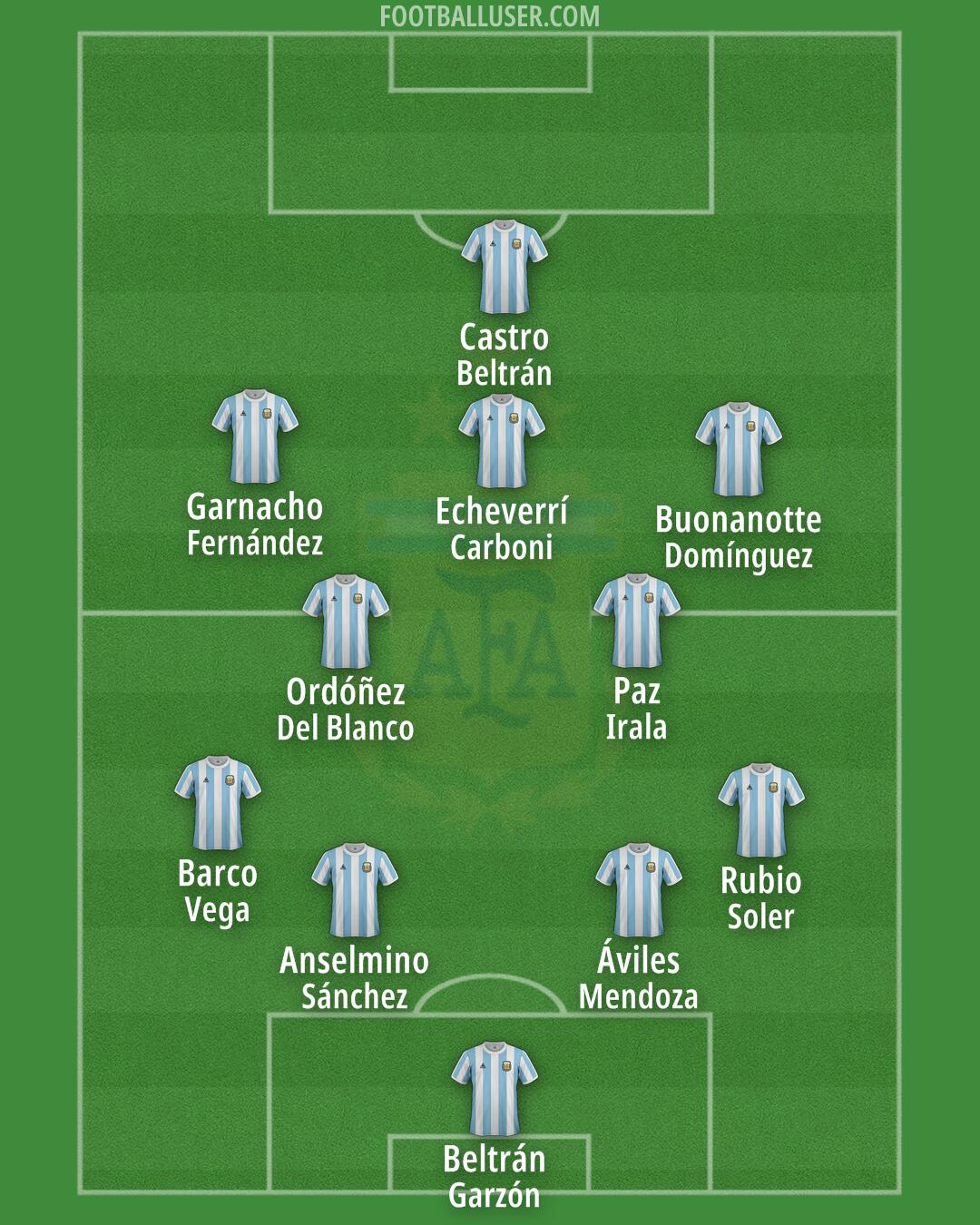

Argentina National Football Team Formation
 May 1, 2025


Starting Lineup
Echeverrí (Carboni) · Garnacho (Fernández) · Paz (Irala) · Castro (Beltrán) · Ordóñez (Del Blanco) · Buonanotte (Domínguez) · Áviles (Mendoza) · Anselmino (Sánchez) · Rubio (Soler) · Barco (Vega) · Beltrán (Garzón)Argentina focuses on a high intensity game built to hit teams hard on the break. The lineup is a 4-2-4 that prioritizes attacking numbers and quick transitions. This formation works to stretch the defence and use the pace of the front four to overwhelm the opposition.
Beltrán stands between the posts to command the area. The defensive unit consists of a back four where Rubio plays at right back and Barco plays at left back. Áviles and Anselmino occupy the central positions as the two centre-backs. Rubio and Barco are expected to push up the flanks to provide width and overlap the winger. These defenders must cover the space behind them and defend zonally to manage the opposition strikers. They are required to hold the line and step up to set the offside trap when the team presses high.
A double pivot forms the engine room with Ordóñez and Paz. Ordóñez and Paz must work hard to shield the defence and win the second ball. These players connect the defensive and attacking lines by receiving the ball from the centre-backs and playing through the lines. They are tasked to press aggressively in a mid-block to win it back high up the pitch. When the team loses possession, they must quickly drop to occupy the center and deny the turn to opponents while they recycle possession.
The front line is heavy with four attackers. Garnacho and Buonanotte act as wide wingers who look to cut inside and find space. Echeverrí and Castro lead the line as a partnership of two forwards. Both wingers can pull wide to spread wide before looking to get to the byline and cut it back. The central duo works together to find the feet of the striker or knock it in behind the defence. They press the opposition back line to force a long ball and win possession back quickly in transition.
This 4-2-4 formation offers significant tactical advantages. Argentina can create wide overloads from the combination of the wingers and full backs. The front four can isolate wide players in one on one situations when they win the ball high up the pitch. Additionally, the team benefits from the ability to press high in coordinated waves to catch the opponent out of position.
This formation is built for aggressive and vertical football. It is best suited for games where the team needs to chase a result or play against a team that sits deep.