
Pisa Football Formation
 May 2, 2025
 ForzaPisa


Starting Lineup
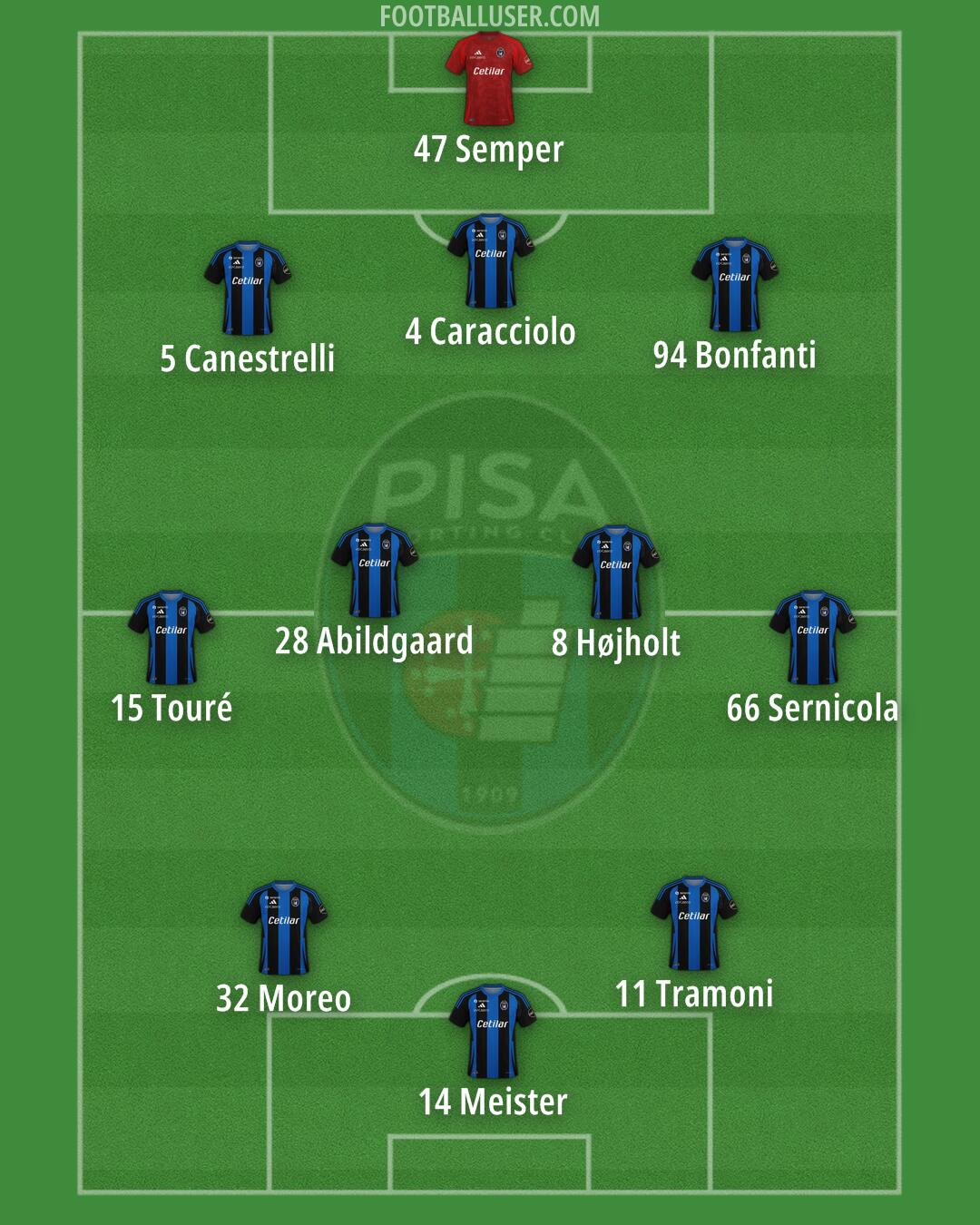
47 Semper5 Canestrelli
4 Caracciolo
94 Bonfanti
15 Touré
8 Højholt
28 Abildgaard
66 Sernicola
11 Tramoni
32 Moreo
14 Meister
Pisa focuses on a vertical style of play with a 3-4-3 formation. This lineup seeks to win the ball high up the pitch and move quickly toward the opposition goal. The team looks to stretch the defence through wide players while keeping a compact central presence to control the game.
Semper plays in goal to lead the defensive unit. A back three consisting of Bonfanti, Caracciolo, and Canestrelli defends the central areas. Bonfanti acts as the left wide centre-back to cover the space behind the wing-back, while Canestrelli operates as the right wide centre-back. Caracciolo sits in the middle to win the header and anchor the back line. The unit stays close together to squeeze the space between the lines.
The midfield operates as a flat four with two central players and two wide midfielders. Abildgaard and Højholt occupy the central roles to shield the defence and connect the lines. Abildgaard works to win the second ball and recycle possession, while Højholt carries the ball forward to drive the team into the final third. Sernicola and Touré act as wing-backs, providing width and tracking back to help the three defenders when out of possession.
Pisa uses three attackers to pin the last defender and create chances. Meister operates as a pressing centre-forward to lead the line and find the feet of the striker in tight spaces. Tramoni and Moreo play as wide forwards, with Tramoni cutting inside from the left and Moreo stretching the play from the right. This front line looks to make runs in behind and use combinations to split the defence with a through ball.
A major tactical strength of this Pisa lineup is the ability to press high in coordinated waves. The front three and the wide midfielders work together to trigger a press and win it back high up the pitch. Another advantage comes from the wide overloads when Sernicola and Touré push up to overlap the wingers, creating numerical superiority in the wide areas.
This formation relies on high energy and quick transitions to overwhelm the opponent. It is best suited for games where Pisa can exploit space behind a high defensive line.