Custom Team Football Formation
 May 3, 2025


Starting Lineup
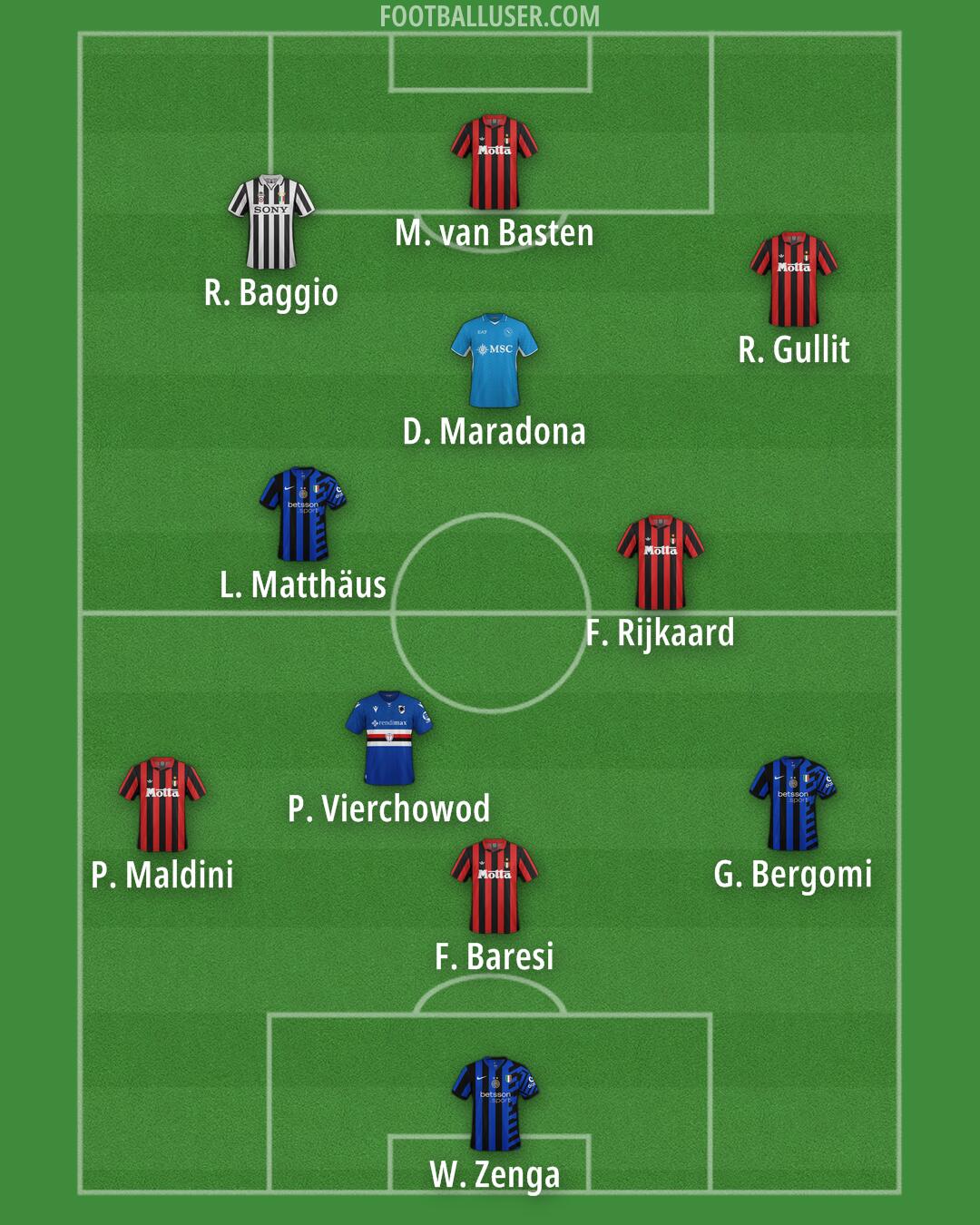
W. Zenga (Inter) · F. Baresi (Milan) · G. Bergomi (Inter) · P. Maldini (Milan) · P. Vierchowod (Sampdoria) · L. Matthäus (Inter) · F. Rijkaard (Milan) · D. Maradona (Napoli) · R. Baggio (Juventus) · R. Gullit (Milan) · M. van Basten (Milan)A high press and aggressive verticality define this lineup in a 4-3-3 formation. This team aims to win the ball high up the pitch and strike quickly before the opposition can settle. The players are expected to drive forward with intent, using quick passes to break the lines and create constant pressure on the opponent.
W. Zenga stays between the posts to organize the back line. The defense operates with a flat back four that can push up to set the offside trap. P. Maldini plays as an attacking left back, often looking to overlap the winger to provide width. G. Bergomi acts as a defensive right back to secure the flank, while F. Baresi and P. Vierchowod form a central pairing. Baresi is known for his reading of the game and ability to sweep behind a high line, while Vierchowod uses his pace to cover space and man-mark a target striker.
The midfield functions as a three-man midfield with a carrier and a creative hub. F. Rijkaard acts as the single pivot to shield the defence and recycle possession. L. Matthäus operates as an inverted eight, using his immense work rate to press aggressively and drive forward with the ball. D. Maradona plays as an attacking ten behind the striker, finding pockets of space to create through balls and link the midfield to the front three. This unit is designed to squeeze the space in the middle and win the second ball.
The attack uses three attackers across the front to stretch the defence. R. Baggio and R. Gullit act as inverted wingers who cut inside to occupy the half-spaces, leaving room for the full backs. M. van Basten operates as a lone striker and target man, known for his clinical finishing and ability to hold up the ball under pressure. The forwards press from the front to force a long ball, allowing the defensive unit to intercept and start a counter at pace.
This formation offers a major advantage through its ability to press high in coordinated waves. The team can also create wide overloads by combining the work of the wingers and the full backs. Because the midfield is so strong, they often find themselves in situations of numerical superiority in the center of the pitch, allowing them to control the tempo when needed.
This 4-3-3 setup is built for dominance and rapid transitions. It is best suited for facing teams that try to play out from the back and leave space behind their midfield.