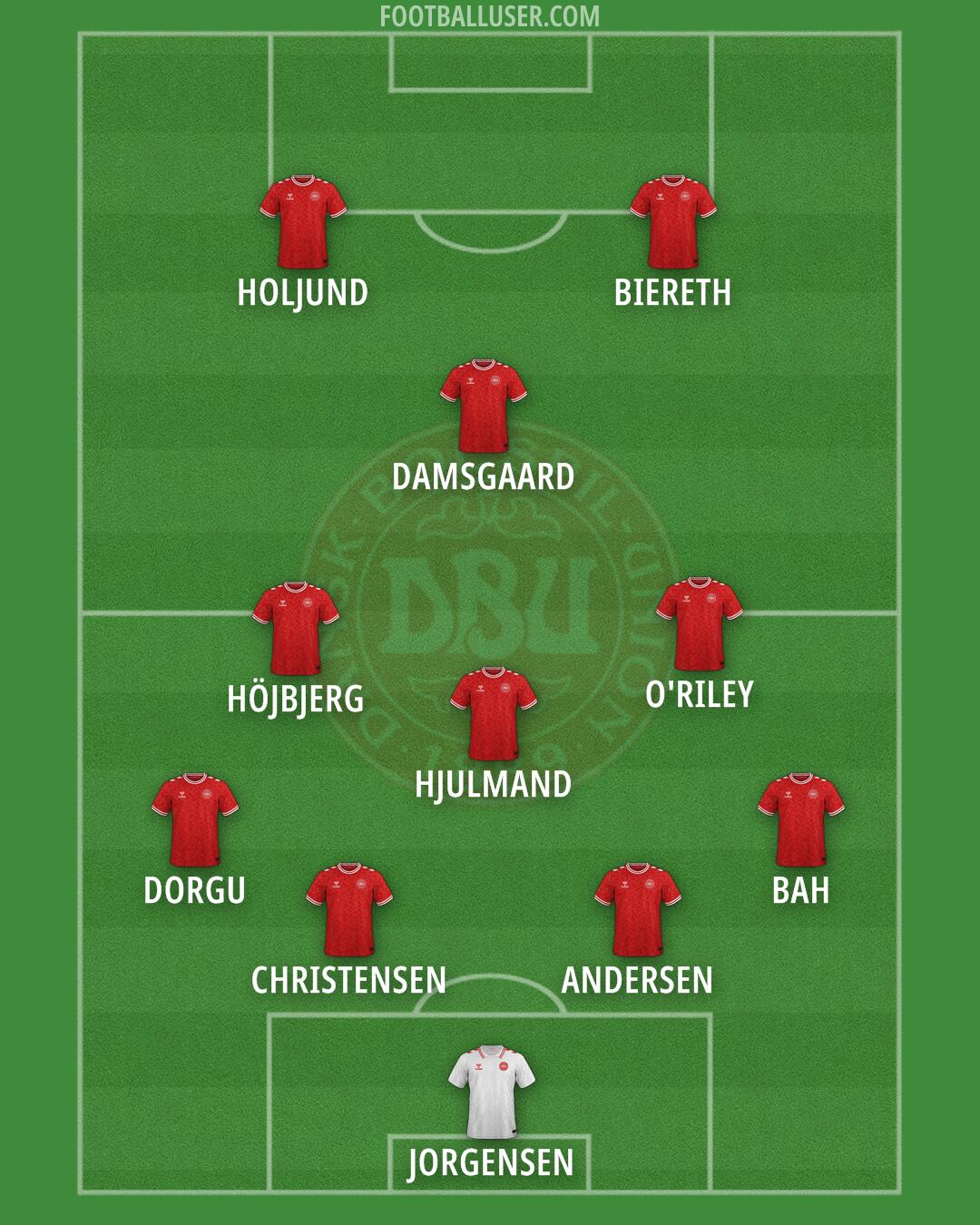

Denmark National Football Team Formation
 May 5, 2025


Starting Lineup
HJULMAND · HOLJUND · ANDERSEN · DORGU · DAMSGAARD · O'RILEY · HÖJBJERG · BIERETH · JORGENSEN · CHRISTENSEN · BAHDenmark relies on a direct identity to catch opponents on the break, utilizing a 4-4-2 formation. This lineup is built to play with verticality, looking to move the ball quickly from defense to the forward line. The Danish side aims to use a compact block to win the second ball and strike with pace.
JORGENSEN guards the goal while the back four maintains a high line to squeeze the space. CHRISTENSEN and ANDERSEN form the central pairing, with ANDERSEN acting as a defender who is dominant in the air. CHRISTENSEN works to cover and pick up runners as the ball moves behind them. BAH pushes forward as an attacking full back to provide width, while DORGU stays back to defend zonally. The unit moves together to hold a compact formation and keep the lines tight.
The midfield consists of four players working to control the center of the pitch. HJULMAND sits as a single pivot to shield the defense. HÖJBJERG uses his passing range to connect the defensive and attacking lines, while O'RILEY drives forward with the ball to break the line. DAMSGAARD operates as the most advanced midfielder in the quartet, looking to arrive late into the box and create from deep. This group works to recycle possession and find the feet of the striker.
In the attacking third, Denmark uses two forwards in a partnership to pin the last defender. HOLJUND works as a pressing centre-forward with high pressing intensity to force a long ball from the defenders. BIERETH plays as a second striker, making runs in behind to exploit any gaps. They combine in tight spaces to create chances, often using HOLJUND to hold up the ball before laying it off to BIERETH. The movements are designed to create cutbacks from the byline and isolate wide players in one on one situations.
This formation provides several tactical advantages, specifically numerical superiority in midfield. By crowding the center, HJULMAND, HÖJBJERG, and O'RILEY can win the second ball and control the tempo. The team also benefits from great speed of transition once they win it back high up the pitch. Furthermore, the ability of BAH and DORGU to overlap the winger creates wide overloads that stretch the defence.
The 4-4-2 formation is a robust choice for Denmark when they need to maintain control. It is most effective against teams that struggle to bypass the midfield or play through the lines.