
Real Madrid Football Formation
 May 5, 2025


Starting Lineup
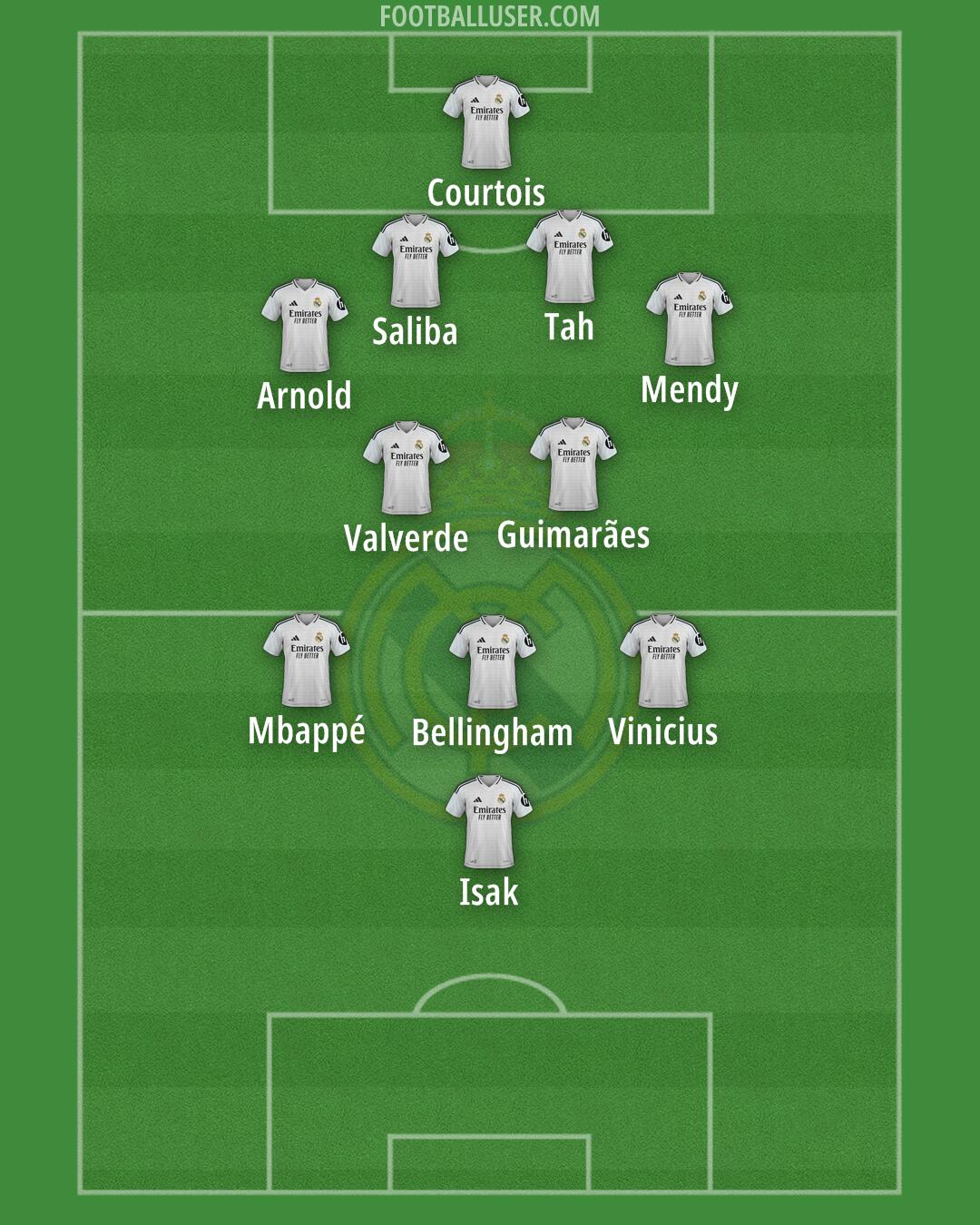
Arnold · Saliba · Isak · Bellingham · Tah · Mbappé · Courtois · Vinicius · Valverde · Guimarães · MendyReal Madrid focuses on a heavy defensive presence and quick transitions within a 5-4-1 formation. This lineup is built to sit deep and wait for the opposition to commit too many men forward before launching attacks. The intention is to remain difficult to break down while remaining ready to hit the opposition on the transition.
Isak sits between the posts to provide the final line of defense. The back line operates as a back five that can shift to protect the center or stretch to cover the flanks. Guimarães and Valverde act as the central defenders, with Guimarães providing coverage and Valverde acting as a ball playing defender to help play out from the back. Vinicius acts as an attacking wing back on the right, while Mbappé operates as an attacking wing back on the left to provide width. Bellingham plays as a wide centre back to help manage the space in front of the defensive unit.
The midfield functions as a flat four that works to squeeze the space in the middle. Saliba and Tah form the central pairing, with Saliba looking to intercept passes and Tah helping to win the second ball. Arnold occupies the left side of the midfield to help deliver crosses, while Mendy sits on the right to provide balance. This midfield unit works to protect the back five and is tasked to press in a mid-block to force a long ball from the opposition.
Courtois acts as a lone striker and a target man to hold up the ball during transitions. The attacking movement relies on the wing backs, Vinicius and Mbappé, to push high and provide width to stretch the defence. When Real Madrid wins the ball, the goal is to find the feet of the striker or hit in behind on the transition. The front line must press from the front to prevent the opposition from building play easily.
One major advantage of this Real Madrid lineup is the ability to maintain compactness when defending. The back five and the midfield four create a narrow defensive block that is hard to penetrate through the middle. Another strength is the speed of transition, as the wing backs can quickly carry the ball forward to support the lone striker.
This formation is designed to absorb pressure and strike with clinical efficiency. It is best suited for matches against teams that dominate possession and leave space behind their defensive line.