Custom Team Football Formation
 May 7, 2025


Starting Lineup
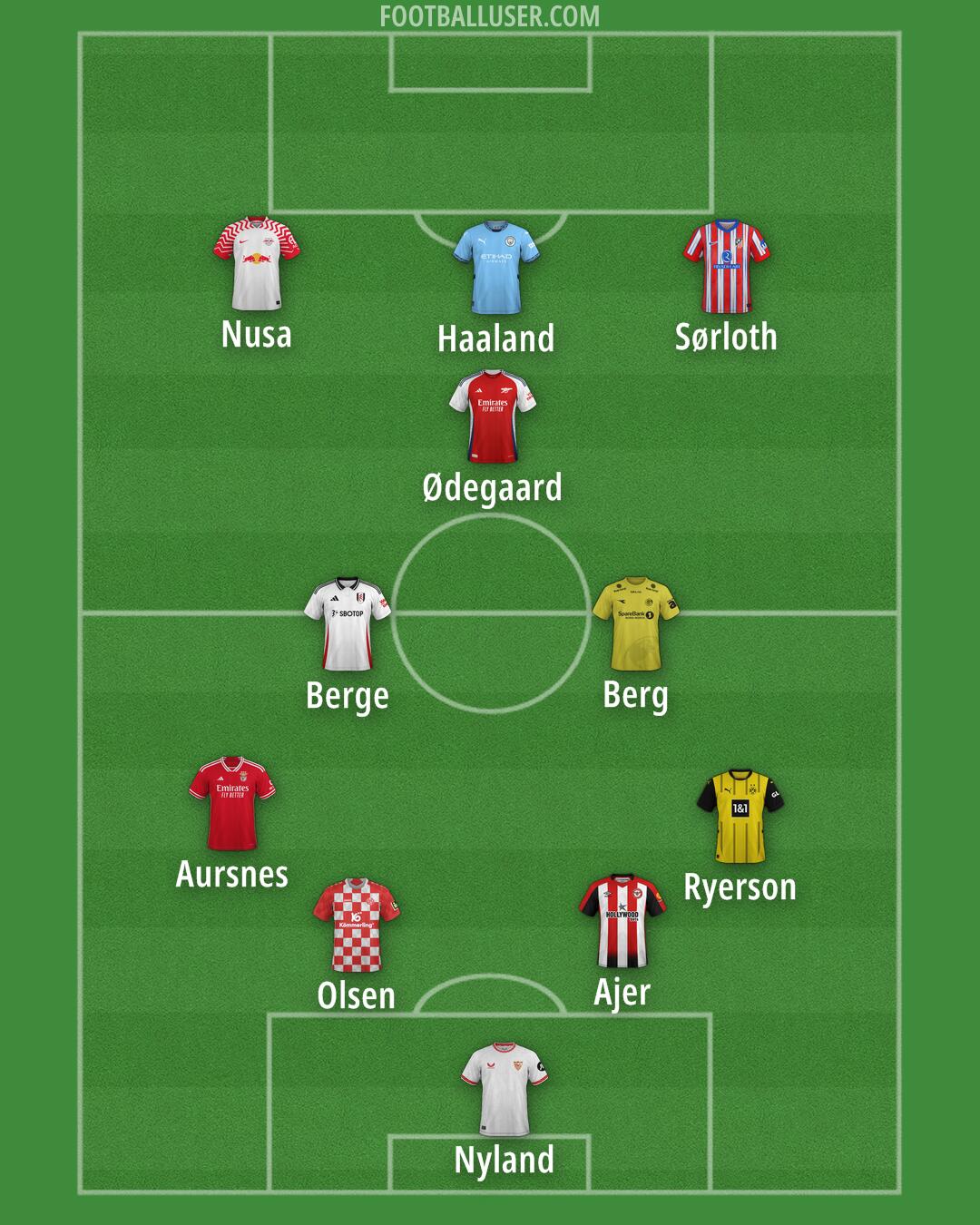
Ryerson (Borussia Dortmund) · Nusa (RB Leipzig) · Berg (Bodø/Glimt) · Sørloth (Atlético) · Berge (Fulham) · Haaland (Man City) · Ødegaard (Arsenal) · Olsen (Mainz) · Ajer (Brentford) · Aursnes (SL Benfica) · Nyland (Sevilla)A focus on defensive solidity and quick transitions defines this lineup, which operates in a 5-4-1 formation. This team is built to sit deep and absorb pressure before hitting opponents on the break. By utilizing a heavy defensive block, the team looks to deny space between the lines and wait for the right moment to exploit gaps in the opposition.
Nusa stays on the line to act as the last line of defense. The defensive unit functions as a back five, with Berg and Ødegaard acting as the central defenders. Haaland provides strength in the middle of the back three to win headers, while Ødegaard covers the space behind. On the flanks, Berge plays as a right wing back to provide width, while Sørloth operates as the left wing back to help defend the wide areas. The defensive unit works together to hold the line and force the opponent into wide areas where they can be doubled up on.
The midfield operates as a flat four to keep the team compact. Ajer plays as a right central midfielder to shield the defense and win the second ball, while Olsen sits as the left central midfielder to help recycle possession. On the wings, Ryerson plays as the right midfielder to help Berge, and Aursnes plays as the left midfielder to support Sørloth. This midfield line works to compress the space in the center and press in a mid-block to prevent the opposition from playing through the lines.
The attacking plan relies on a lone striker, Nyland, who acts as a target man to hold up the ball. Nyland must work to pin the last defender and create space for others. When the team wins the ball, the wing backs Berge and Sørloth push high to provide width and delivery. The goal is to move the ball quickly to the flanks or find Nyland to play a one-two with the oncoming midfielders. The attackers press from the front to trigger a press and force the opposition to play long balls.
This formation offers great compactness when defending and makes it difficult for opponents to find gaps in the middle. By using the wing backs, the team can also create wide overloads to stretch the defense during transitions. The ability to transition from a deep block to a wide attacking stance allows for quick breaks.
The 5-4-1 formation relies on discipline and strength in the central areas. It is a setup best suited for facing teams that dominate possession and require a team to defend deep and counter at pace.