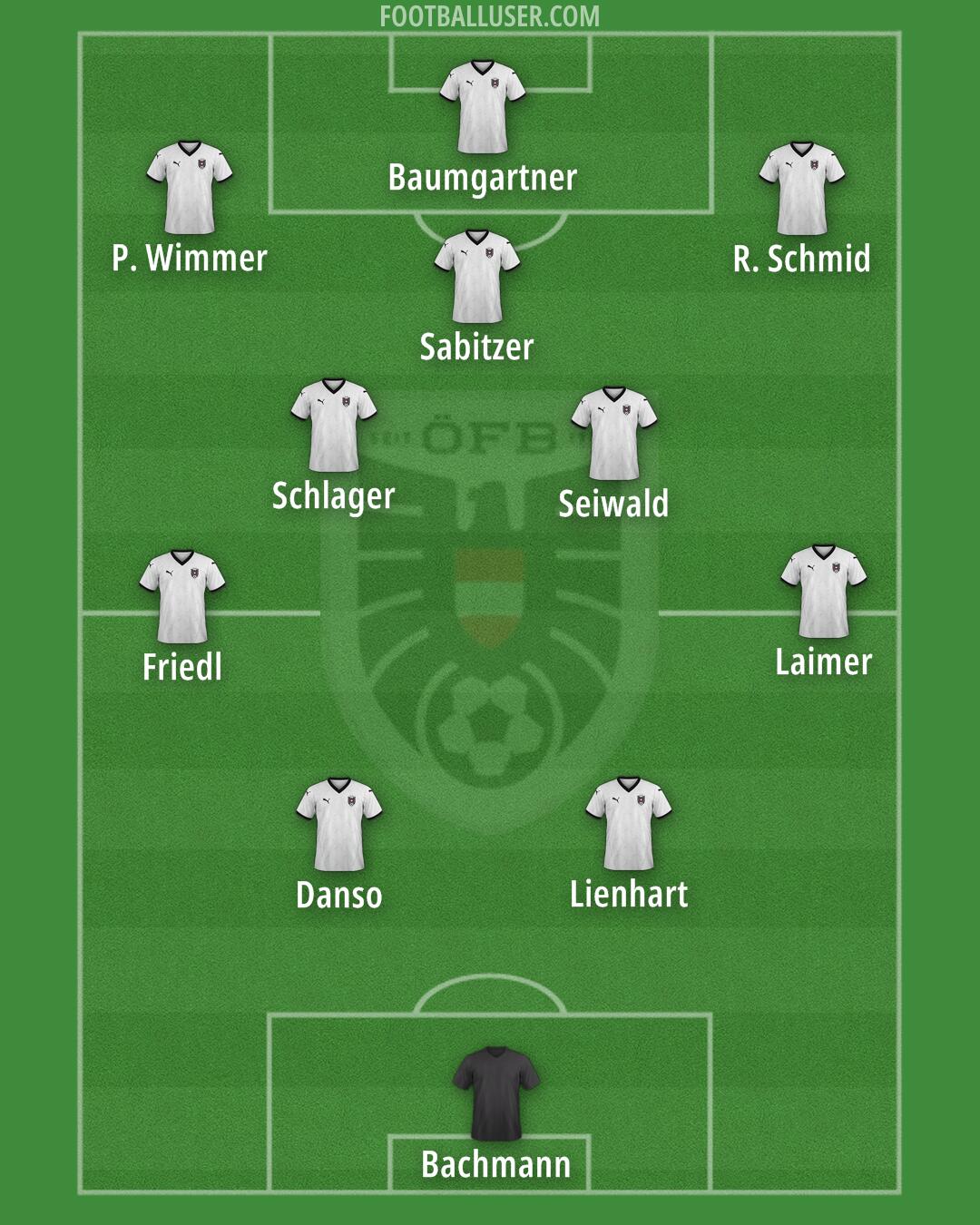

Austria National Football Team Formation
 May 8, 2025


Starting Lineup
P. Wimmer · Baumgartner · R. Schmid · Sabitzer · Schlager · Seiwald · Laimer · Friedl · Danso · Lienhart · BachmannThe Austrian national team plays a high pressing and vertical style of football. The team operates with a 2-5-3 formation. This lineup focuses on winning the ball high up the pitch and attacking with speed to catch the opposition off guard.
Bachmann stays between the posts to command the area. The defensive unit functions with a back two consisting of Danso and Lienhart. Danso uses his aerial strength to win the header while Lienhart acts as a ball playing defender to play short from the back. They play with a high line to squeeze the space and keep the team compact. Because the defense is narrow, they must work together to cover runners and prevent balls from breaking the line.
The midfield is the engine of this Austria lineup. It uses a five man unit with a double pivot of Friedl and Laimer. Laimer uses his pressing intensity to disrupt the opponent while Friedl works to shield the defense. Seiwald and Schlager occupy the half spaces to control the center. Sabitzer plays as an attacking ten behind the striker, using his passing range to find teammates in dangerous areas. This group connects the defense to the attack by playing through the lines.
The front line uses three attackers to stretch the defense. Baumgartner plays as a pressing centre-forward to win the ball high and pin the last defender. P. Wimmer and R. Schmid act as wide wingers who look to isolate one-on-one situations or cut inside to create chances. The team builds the attack through quick combinations and looks to hit in behind on the transition. These movements create space for Sabitzer to arrive late into the box and support the striker.
A major advantage is the numerical superiority in the middle of the pitch. By crowding the center, the team can win the second ball and recycle possession quickly. Another strength is the ability to press in coordinated waves. The high position of the front three and the midfield creates a trap that forces a long ball. This allows the team to regain control and move the ball forward with pace.
This formation is designed to dominate the central zones through heavy pressure. It is best suited for games against teams that want to play out from the back and struggle under high intensity.