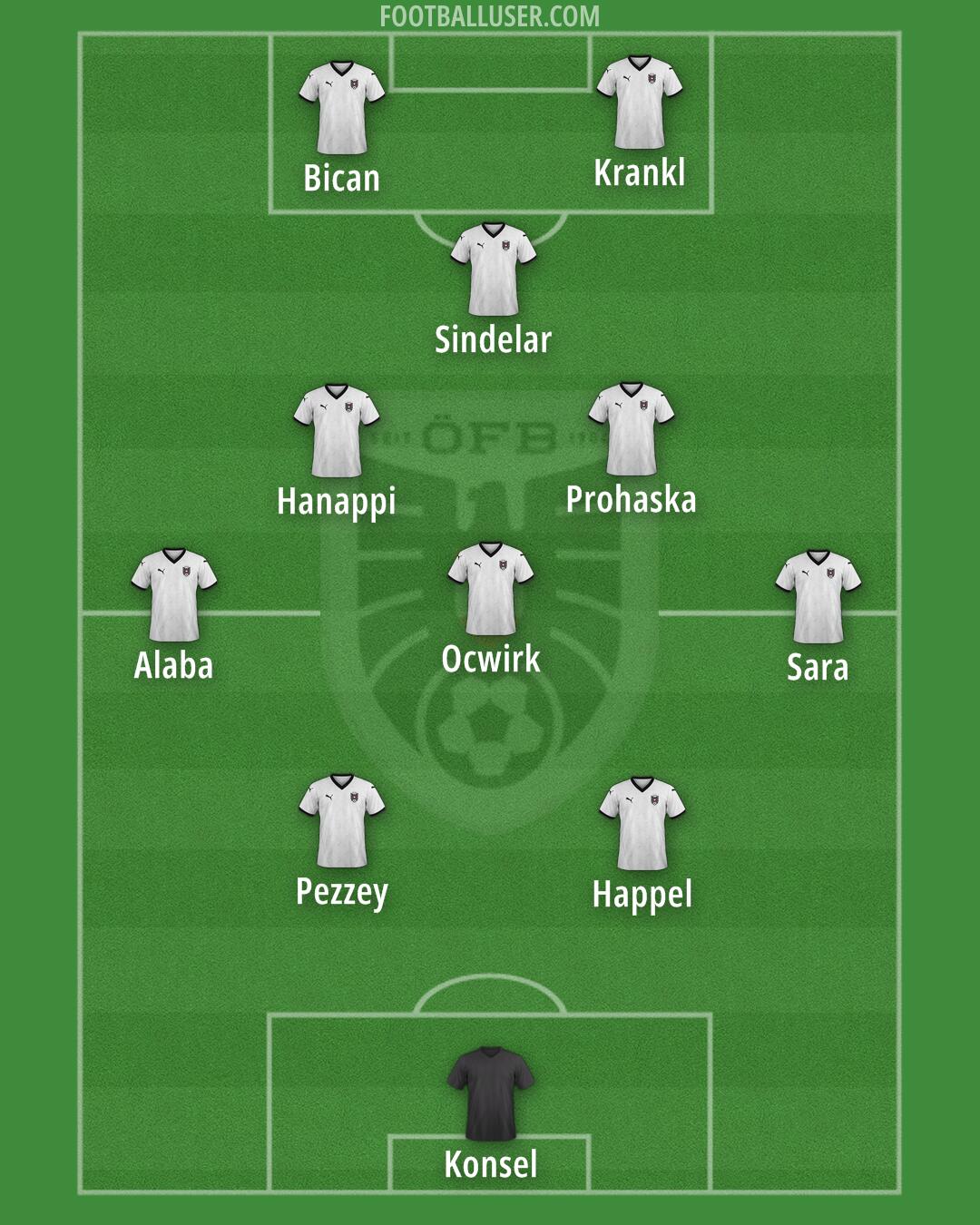

Austria National Football Team Formation
 May 9, 2025


Starting Lineup
Krankl · Bican · Pezzey · Alaba · Hanappi · Sara · Sindelar · Happel · Ocwirk · Prohaska · KonselAustria plays with a heavy central presence using a 2-6-2 formation. This lineup focuses on controlling the middle of the pitch through a massive concentration of players. The goal is to dominate possession and overwhelm the opposition by occupying every central lane. This is a vertical style designed to squeeze the space in the center and force opponents into wide areas they cannot easily exploit.
Franz Konsel guards the goal in this narrow formation. The defensive unit consists of a back two with Rudolf Happel and Ernst Pezzey. Since there are only two central defenders, they must remain very compact and stay close to each other to defend zonally. Both Happel and Pezzey need to be dominant in the air and ready to cover large amounts of grass if the opposition hits in behind. They must stay disciplined to avoid being split by a through ball.
The midfield is a massive six man block that acts as the engine of the team. David Alaba sits deep to act as a deep lying playmaker, using his passing range to drive the team forward. Sara and Walter Ocwirk play alongside him to shield the defense and win the second ball. In front of them, Friedrich Hanappi, Herbert Prohaska, and Matthias Sindelar push into higher positions. Prohaska works to break the line with his passing, while Sindelar uses his movement to find pockets of space. This group connects the defense to the attack by constantly moving and recycling possession.
The attacking unit uses a two man partnership consisting of Ernst Bican and Hans Krankl. There are no wide wingers, so the width must come from the midfielders pushing out. Hans Krankl acts as a clinical presence in the box, while Ernst Bican works to hold up the ball and link up play between the lines. The two forwards press from the front to prevent the opposition from playing out from the back. They look to combine in tight spaces to create quick chances.
One major advantage is the extreme numerical superiority in the central zone. This makes it incredibly difficult for any opponent to play through the middle without being doubled up on. The team also benefits from the ability to press in a mid block with six players ready to trigger a press. This formation allows the players to quickly switch play to the flanks when the center becomes too crowded.
This 2-6-2 formation is built for absolute central dominance. It is best suited for matches where Austria can sit in a compact unit and squeeze the midfield to win the ball high up the pitch.