
Inter Football Formation
 May 11, 2025


Starting Lineup
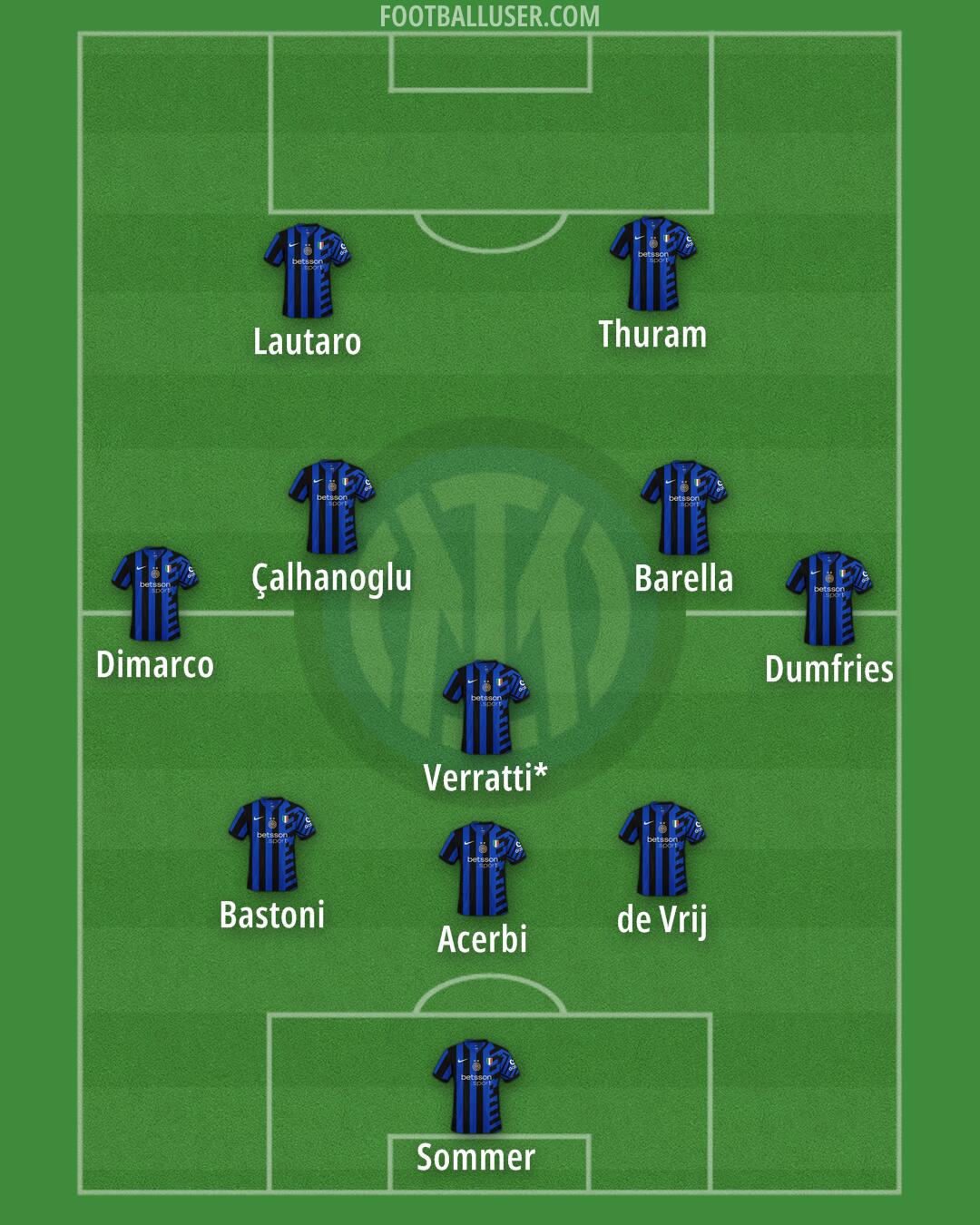
Sommer · Verratti* · Çalhanoglu · Barella · Dimarco · Dumfries · Acerbi · Bastoni · de Vrij · Lautaro · ThuramInter seeks to control the game through central dominance and verticality using a 3-5-2 formation. This lineup focuses on winning the ball high up the pitch and using rapid transitions to exploit spaces between the opposition lines. The team builds play through a dense midfield, aiming to dominate the ball and dictate the tempo of the match.
Yann Sommer starts in goal to organize the defensive unit from the back. The back three consists of Acerbi, de Vrij, and Bastoni, who act as a cohesive block. Acerbi and de Vrij provide strength in the air and physical presence, while Bastoni operates as a ball playing defender who can carry the ball forward into the middle third. The defensive unit works to squeeze the space between the lines, with the wide defenders dropping back to form a five when defending deep to deny runners in the channels.
The midfield core is built around a single pivot role occupied by Verratti, who sits in front of the defense to intercept passes and recycle possession. Beside him, Dumfries and Dimarco function as attacking wing backs who provide immense width. Barella and Çalhanoglu operate in the half spaces, where they can drive forward with the ball or switch play to the flanks. Barella uses his high pressing intensity to win the ball back, while Çalhanoglu uses his passing range to find teammates deep in the final third. This group links the defense and attack by moving the ball quickly through the thirds.
In the final third, Inter utilizes two forwards in a partnership consisting of Lautaro and Thuram. Lautaro acts as a pressing centre forward who works to pin the last defender, while Thuram provides a physical presence to hold up the ball and link play. The attack relies on the wide runs from Dimarco and Dumfries to create overloads on the wings. This movement allows the strikers to find space in the box or receive lay offs as the team attacks in combinations.
One major advantage for Inter is the numerical superiority in midfield, which makes it difficult for opponents to bypass the central block. The team also benefits from the ability to create wide overloads as the wing backs push high, forcing the opposition to defend deep. The speed of transition is another strength, as the players are capable of breaking quickly once the ball is won.
This 3-5-2 formation is a highly effective way for Inter to dominate central areas and exploit width. It is best suited for games against teams that play with a narrow midfield, allowing the wing backs to find space.