FC Porto Logo

FC Porto Football Formation

Creation DateMay 14, 2025

Starting Lineup

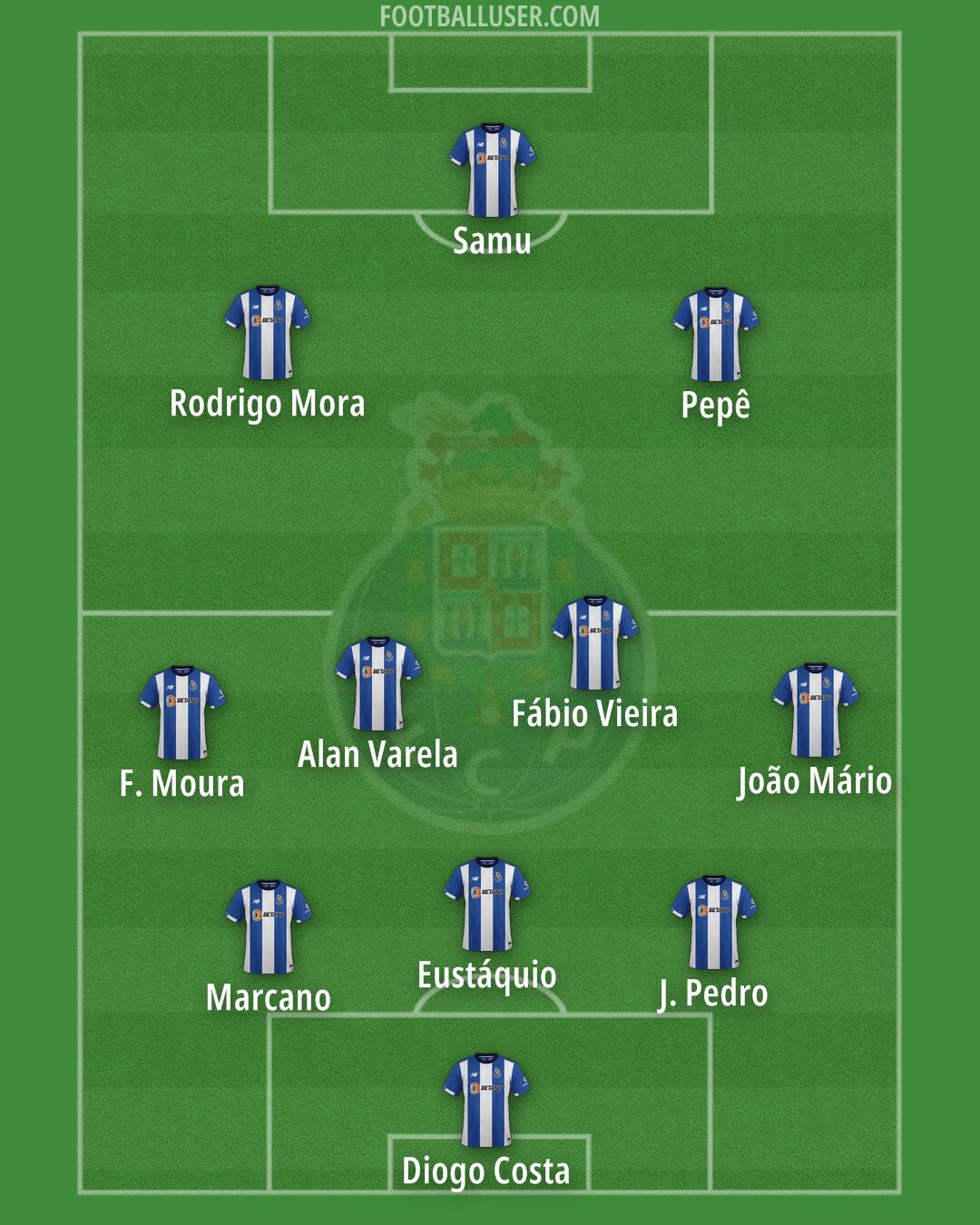
Rodrigo Mora · Samu · F. Moura · Diogo Costa · Marcano · Alan Varela · Fábio Vieira · Eustáquio · J. Pedro · João Mário · Pepê

FC Porto focuses on a heavy verticality with a high press, utilizing a 2-4-4 formation to overwhelm the opponent. This lineup aims to pin the defense back and win the ball high up the pitch to create instant scoring chances. The system is built to exploit the transition and force mistakes in the opposition half through relentless pressure.

Samu guards the goal as the last line of defense. In front of him, Rodrigo Mora and Pepê operate as a narrow pair of central defenders in a back two. They must stay compact to cover the huge amount of space behind them when the team pushes up. Rodrigo Mora acts as a ball playing defender to start attacks, while Pepê provides aerial strength to defend long balls. They rely on staying close together to prevent the opposition from playing through the center.

The midfield works in a box to control the center and provide width. Alan Varela sits as the single pivot to shield the two central defenders and disrupt play. Beside him, Fábio Vieira acts as a carrier to move the ball from deep to the attacking line. João Mário operates on the right side to provide width, while F. Moura occupies the left to stretch the play. This midfield group is tasked to press in pairs to win the ball back quickly and support the front line.

A powerful front four stays high to pin the last defender. Diogo Costa and Eustáquio work as a strike partnership in the center, with Diogo Costa acting as a target man to hold up the ball. On the flanks, J. Pedro cuts inside from the left as an inverted winger, while Marcano operates on the right to deliver crosses. This front line is designed to create runs in behind and use combinations to break the line. They press the opposition back line aggressively to force a long ball.

The main advantage of this FC Porto lineup is the ability to create wide overloads and numerical superiority in the attacking third. By using four attackers, the team can isolate wide players in one on one situations. The coordination between the midfield box and the front four allows them to press high in coordinated waves, making it very hard for opponents to build play from the back.

This formation is a high risk, high reward system built for aggressive attacking football. It is best suited for games where the team needs to break down a low block through sheer numbers and constant pressure.