
Brazil National Football Team Formation
 May 14, 2025


Starting Lineup
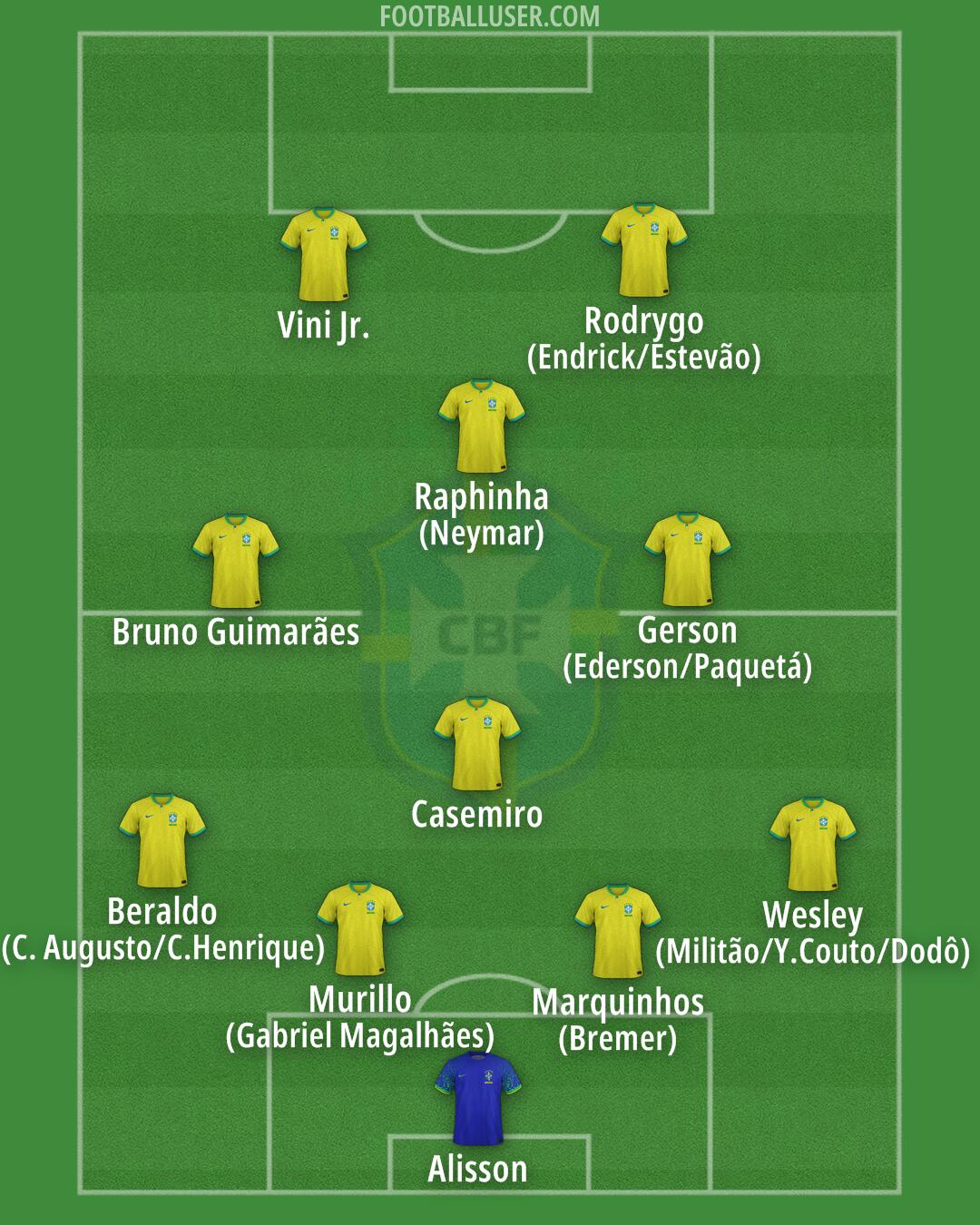
Alisson · Murillo (Gabriel Magalhães) · Marquinhos (Bremer) · Beraldo (C. Augusto/C.Henrique) · Gerson (Ederson/Paquetá) · Rodrygo (Endrick/Estevão) · Vini Jr. · Raphinha (Neymar) · Bruno Guimarães · Casemiro · Wesley (Militão/Y.Couto/Dodô)Brazil relies on a quick transition game built around a heavy defensive base in this 5-3-2. The lineup focuses on absorbing pressure and hitting the opposition with speed once the ball is won. This formation is built to play a vertical style of football that uses the pace of the forwards to punish teams that commit too many players forward.
Alisson sits between the posts to organize the back line and command his area. The defense functions as a back three composed of Casemiro, Marquinhos, and Murillo. Casemiro acts as the central anchor, using his physical strength and tackling ability to stop attacks. Marquinhos and Murillo work together to cover the space behind the wide players, with Marquinhos often playing as a ball playing defender to start attacks. Wesley and Beraldo operate as attacking wing backs, pushing high to provide width while the central defenders hold the line.
The midfield works as a three man midfield with a carrier. Bruno Guimarães sits in the left channel to drive forward with the ball and connect the lines. Gerson plays in the right channel to help recycle possession and keep the unit compact. Raphinha operates as an attacking ten behind the two forwards, looking to play through the lines and find the attackers in the box. This trio works to squeeze the space in the center and support the defenders when the team sits deep.
The attacking unit utilizes two forwards in a partnership to stretch the defence. Vini Jr. plays as a left striker, using his explosive dribbling and pace to run in behind the opposition back line. Rodrygo plays as the right striker, looking to cut inside and link up play. The wing backs, Wesley and Beraldo, provide the width by overlapping the wingers to whip it in. This combination creates movement where the forwards can swap sides or drop deep to find the feet of the striker.
This formation offers several concrete advantages for Brazil. The team gains defensive stability through a dense block that is hard to pass through. The ability to press in a mid-block allows the players to win the ball and immediately launch an attack. Finally, the speed of transition is a major threat, as the wing backs and the attacking ten can quickly push the team from a deep position into a dangerous attacking phase.
This 5-3-2 formation provides a solid base for a team that wants to defend deep and strike on the break. It is best suited for games against opponents that hold high lines and leave gaps in behind.