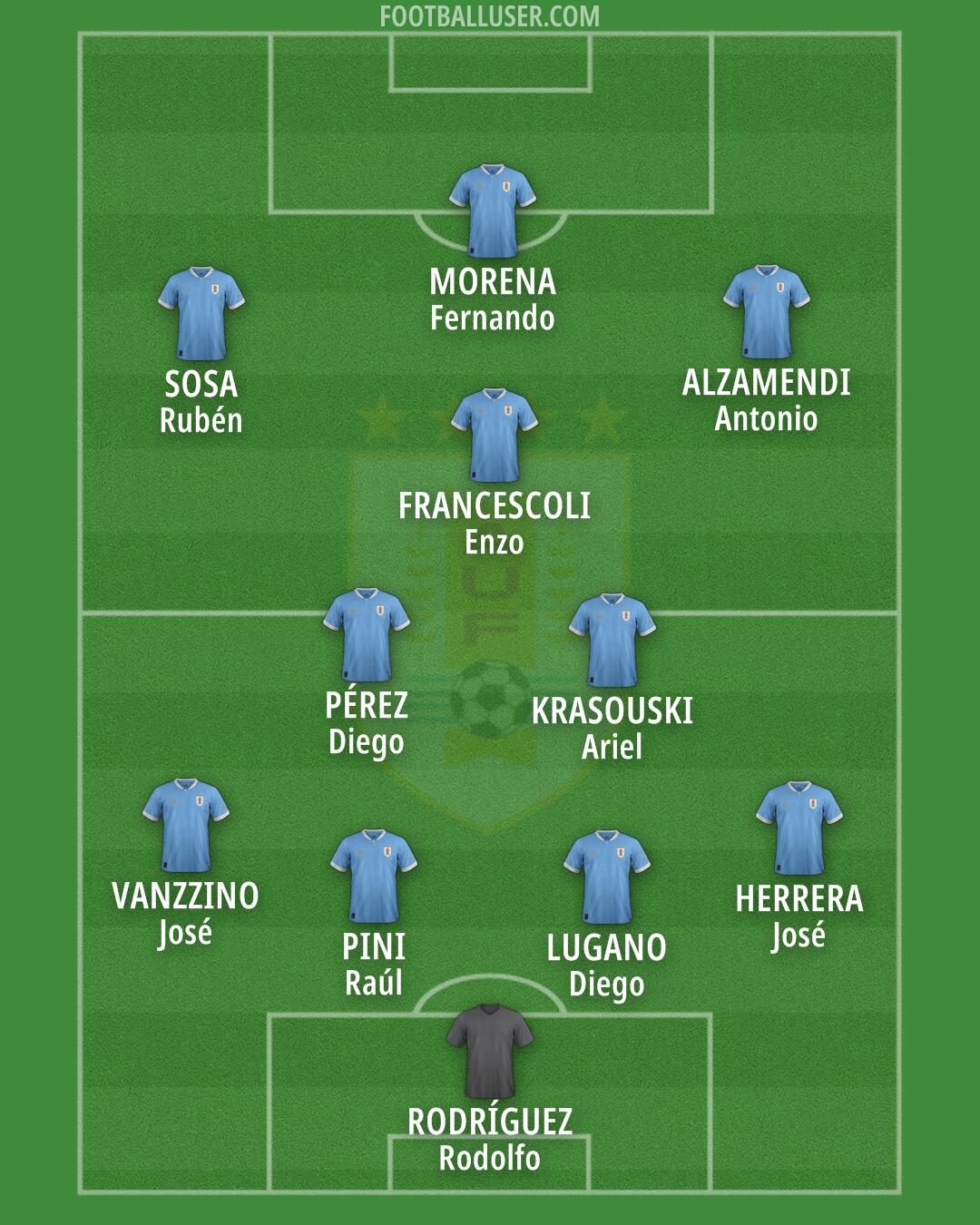

Uruguay National Football Team Formation
 May 16, 2025


Starting Lineup
FRANCESCOLI (Enzo) · SOSA (Rubén) · ALZAMENDI (Antonio) · MORENA (Fernando) · HERRERA (José) · PINI (Raúl) · PÉREZ (Diego) · RODRÍGUEZ (Rodolfo) · KRASOUSKI (Ariel) · VANZZINO (José) · LUGANO (Diego)Uruguay aims to play a high press and win the ball back high up the pitch to catch teams on the break. This aggressive identity is built around a 4-3-3 formation that seeks to squeeze the space in the opponent half. The team looks to win it back quickly and use verticality to catch the defense off balance, looking to break quickly once possession is regained.
RODRÍGUEZ guards the goal while the defense sits in a flat back four. HERRERA acts as the right back to provide width, while VANZZINO covers the left flank. In the center, LUGANO and PINI form the defensive line. LUGANO uses his aerial strength to win the header in defensive situations and clear the lines. The back four works to hold the line and shift together to block the runner and defend zonally.
The midfield works with an attacking ten behind the striker, supported by two players acting as a double pivot. FRANCESCOLI plays as the advanced midfielder to find the feet of the striker and play through the lines. KRASOUSKI and PÉREZ sit in front of the defense to protect the center. KRASOUSKI works to cover the space and intercept passes, while PÉREZ helps to recycle possession and connect the defensive and attacking lines.
In the final third, the team uses three attackers across the front. MORENA works as a lone striker to hold up the ball and pin the last defender. SOSA and ALZAMENDI operate as wide attackers to stretch the defence. SOSA often looks to get to the byline and whip it in, while ALZAMENDI can cut inside to create chances in tight spaces. The front line must press from the front to force a long ball from the opponent and win the second ball.
This Uruguay lineup offers clear tactical advantages, such as the ability to press high in coordinated waves to win the ball in dangerous areas. The positioning of KRASOUSKI and PÉREZ allows for compactness when defending a lead. Furthermore, the presence of FRANCESCOLI creates a numerical advantage in the half-spaces, which helps the team to play short from the back and progress through the thirds with precision.
Uruguay relies on a high pressing 4-3-3 to dominate games through intensity and quick transitions. This formation is best suited for facing teams that try to build from the back and struggle under pressure.