Leeds Football Formation
 May 17, 2025


Starting Lineup
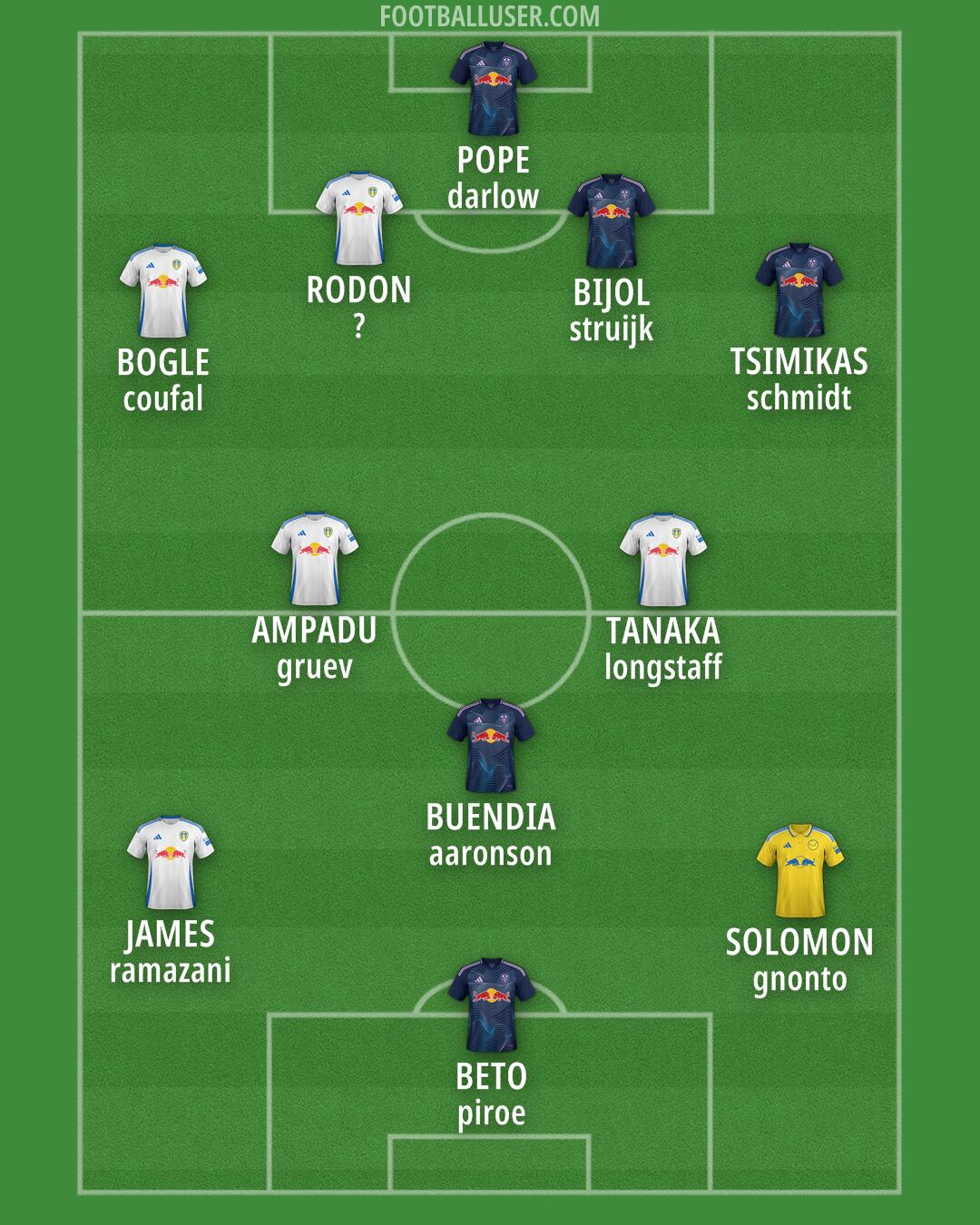
POPE (darlow) · BOGLE (coufal) · BETO (piroe) · SOLOMON (gnonto) · JAMES (ramazani) · RODON (?) · AMPADU (gruev) · TANAKA (longstaff) · BIJOL (struijk) · TSIMIKAS (schmidt) · BUENDIA (aaronson)Leeds focuses on a high press and direct attacking play through a 4-3-3. This formation is built to win the ball high up the pitch and move it forward with pace to exploit gaps in the opposition defense. By using a vertical style, Leeds looks to punish teams in transition and keep the play moving toward the goal.
Pope operates between the posts to organize the defensive unit. The back line consists of a flat back four where Bogle acts as an attacking full back to provide width on the right. On the left, Tsimikas pushes forward to overlap and deliver crosses. In the middle, Rodon and Bijol form a central pairing where Rodon provides aerial strength and Bijol covers the space behind him. This defensive unit works to squeeze the space and force long balls.
A three man midfield controls the center of the pitch. Ampadu plays as a single pivot to shield the defense and intercept passes. Tanaka works as a carrier to drive forward with the ball and link the back line to the attack. Buendia operates in the pocket behind the striker, acting as an attacking ten who can find pockets of space and play through the lines. This midfield group works to press aggressively to win the ball back in the middle third.
The attacking front line uses three attackers to stretch the defense. Beto acts as a lone striker to hold up the ball and pin the last defender. On the wings, Solomon and James provide width and threat. Solomon is an inverted winger who cuts inside to shoot, while James stays wider to isolate his man one on one. The goal is to create runs in behind and use cutbacks from the byline to find runners in the box.
Leeds offers several tactical advantages with this lineup. The team can create wide overloads from the overlapping runs of Bogle and Tsimikas. There is also the ability to press high in coordinated waves to force mistakes near the opponent goal. The speed of transition allows the players to hit in behind on the transition before the opposition can settle.
This 4-3-3 formation relies on intense pressing and quick movement in the final third. It is best suited for matches against teams that struggle to play out from the back under pressure.