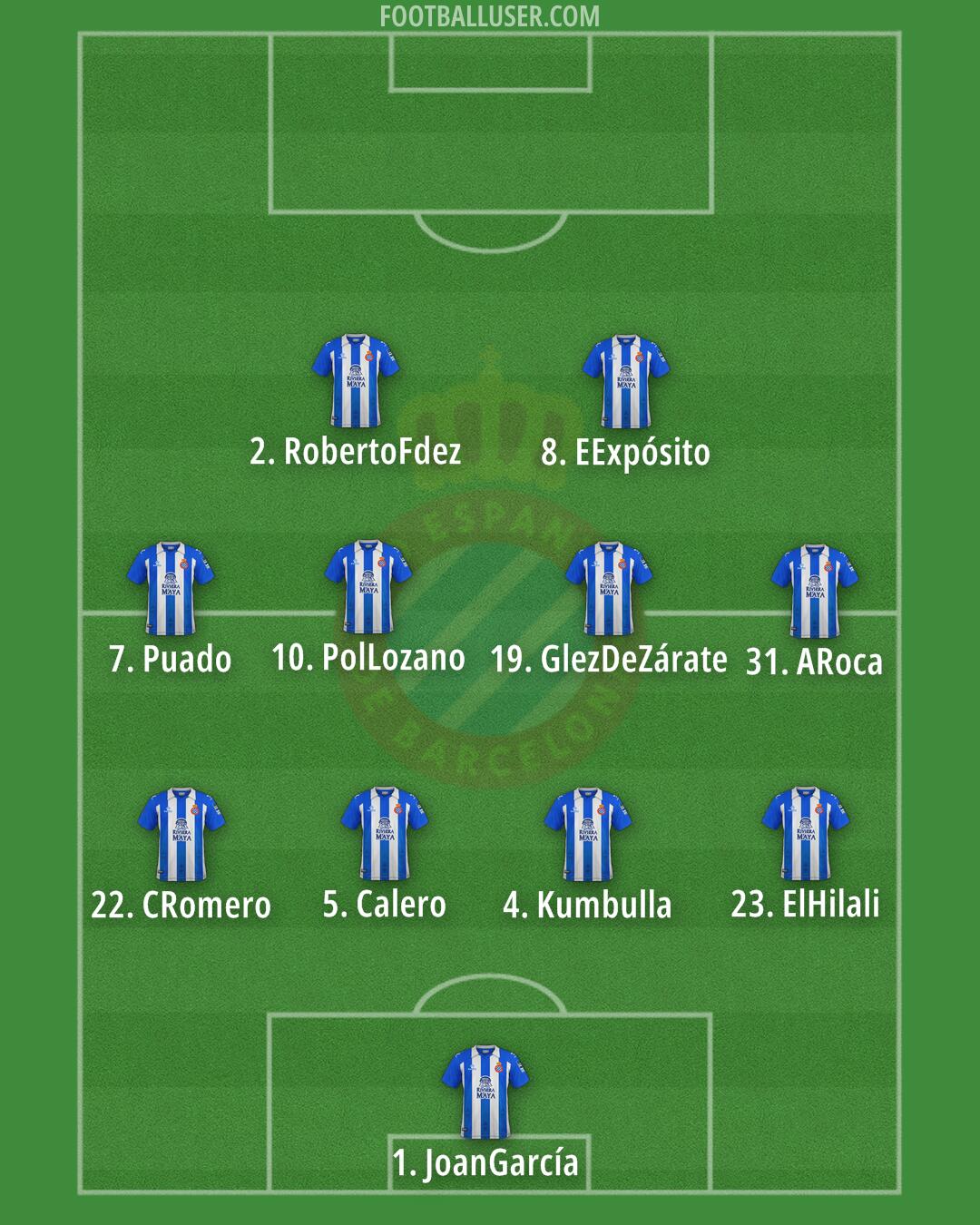

Espanyol Football Formation
 May 18, 2025


Starting Lineup
1. JoanGarcía23. ElHilali
4. Kumbulla
5. Calero
22. CRomero
31. ARoca
19. GlezDeZárate
10. PolLozano
7. Puado
8. EExpósito
2. RobertoFdez
Espanyol relies on a direct and vertical style of play, operating in a 4-4-2 formation. This lineup is built to win the second ball and strike quickly when the opposition loses possession. The aim is to stay compact and use the width of the pitch to stretch the defence.
JoanGarcía acts as the last line of defence in goal. The back four uses a zonal line with Calero and Kumbulla acting as the central pairing. Calero and Kumbulla focus on winning headers and covering for each other, while ElHilali and CRomero function as full backs to protect the wide areas. They stay close together to prevent crosses and force the opposition wide.
The midfield relies on a central pairing of GlezDeZárate and PolLozano to control the middle. GlezDeZárate works to shield the defence and win the ball, while PolLozano looks to receive on the half-turn and play through the lines. ARoca and Puado provide the width on the wings. They must track back to help the full backs and also look to spread wide during transitions.
Up front, EExpósito and RobertoFdez operate as a two-man forward line. They often work in combinations to link up play between the lines. EExpósito can hold up the ball to bring others into the game, while RobertoFdez focuses on making runs in behind to exploit space. Puado and ARoca often cut inside, creating space for ElHilali and CRomero to overlap and deliver crosses into the box.
One major advantage for Espanyol is the ability to maintain a compact unit when defending in a mid-block. This makes it difficult for opponents to find gaps between the lines. Furthermore, the team can exploit the speed of transition, using the directness of the strikers to hit the opposition on the break. This allows them to win the ball high and catch the defence out of position.
The 4-4-2 formation provides a reliable way to maintain balance and defensive solidity. It is most effective when facing teams that dominate possession but struggle to defend against quick counters.