
Real Madrid Football Formation
 May 20, 2025


Starting Lineup
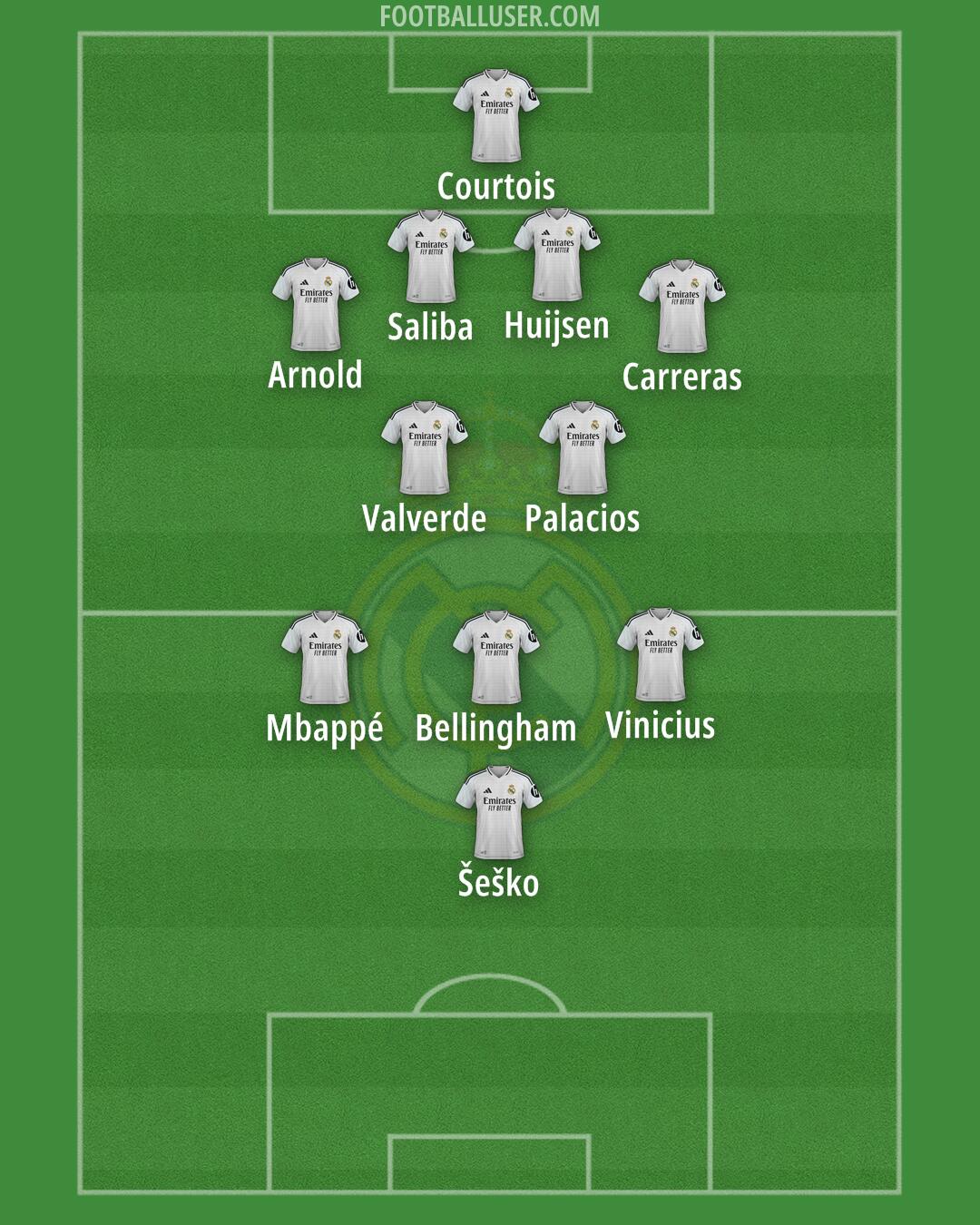
Carreras · Arnold · Saliba · Huijsen · Valverde · Mbappé · Vinicius · Courtois · Palacios · Bellingham · ŠeškoReal Madrid relies on a high tempo, vertical game built to catch opponents on the break, utilizing a 4-2-4 formation. This lineup prioritizes speed in transition and heavy pressure in the final third to overwhelm the opposition defense. By playing with four attackers, the team seeks to stretch the pitch and create chaos through direct runs and quick combinations.
Thibaut Courtois guards the goal and acts as the first line of defense when playing out from the back. The back line operates as a flat back four where Arnold acts as an attacking full back to provide width. Saliba and Huijsen form the central pairing, with Saliba using his recovery speed to cover for the high line while Huijsen defends zonally. Carreras plays as a left back to balance the width, ensuring the defensive unit stays compact when sitting deep to prevent long balls.
The midfield relies on a double pivot consisting of Valverde and Palacios to control the central area. Valverde uses his immense stamina to drive forward with the ball and press aggressively to win it back high up the pitch. Palacios works to shield the defense and connect the defensive line to the attacking quartet. This duo must work hard to cover the large spaces left behind when the full backs push up, ensuring they can intercept passes and recycle possession quickly.
A heavy attacking force sits ahead of the midfield with two center forwards in a partnership. Bellingham operates as a pressing center forward who works to pin the last defender and create space for his teammates. Alongside him, Šeško provides a physical presence to win the second ball and hold up the ball. On the flanks, Vinicius and Mbappé act as inverted wingers who cut inside to threaten the goal. Vinicius uses his explosive dribbling style to beat his marker, while Mbappé looks to hit in behind on the transition to exploit space.
This formation offers significant advantages in terms of speed of transition and wide overloads. By pushing Arnold and Carreras high, Real Madrid can create numerical superiority in the final third. The team is also able to press in coordinated waves, using the four forwards to force the opposition into mistakes. This creates many opportunities for one on one situations for the wide players to exploit.
Real Madrid employs this high risk, high reward lineup to dominate games through sheer attacking volume. It is best suited for facing teams that play a high line and can be punished by quick, direct movement.