Liverpool Football Formation
 May 20, 2025


Starting Lineup
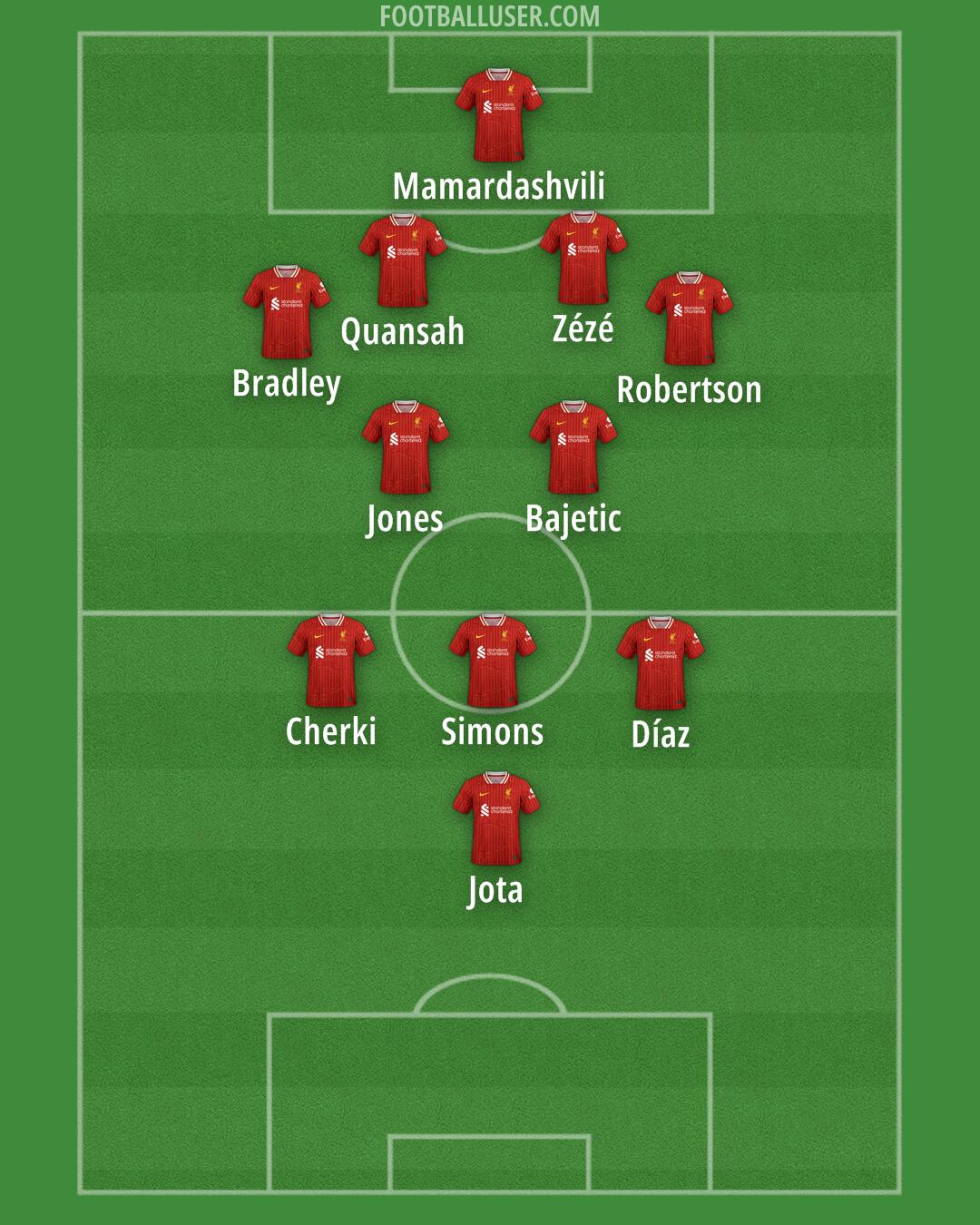
Mamardashvili · Zézé · Quansah · Bradley · Robertson · Cherki · Simons · Díaz · Jota · Jones · BajeticLiverpool aims to play a high press and strike with extreme verticality using a 4-2-4. This formation is built to overwhelm the opposition by keeping four players high up the pitch to pressure the ball and pin the defenders back. The lineup focuses on quick transitions and constant pressure in the final third to force mistakes from the opponent.
Mamardashvili operates between the posts, acting as a shot stopper with great reach. In front of him, a flat back four provides the foundation, with Robertson and Bradley acting as wide defenders. Robertson pushes high to support the attack, while Bradley provides width from the right. Quansah and Zézé form the central pairing, where Quansah is dominant in the air and Zézé acts as a covering defender to sweep behind a high line. This defensive unit works to keep the team compact when the ball is lost.
The midfield relies on a double pivot to control the center of the pitch. Jones and Bajetic occupy the two central roles, tasked with shielding the defense and winning the second ball. Jones works to connect the defensive and attacking lines, while Bajetic focuses on recycling possession and protecting the space in front of the center backs. This duo must work hard to cover the large gaps left when the team pushes forward, ensuring they can recover and transition quickly.
Liverpool utilizes a front four to stretch the defense and create constant threats. Simons and Jota operate as two forwards in a partnership, with Jota looking to find the feet of the striker and Simons making runs in behind. On the flanks, Díaz and Cherki act as inverted wingers who cut inside to create chances. Díaz uses his dribbling style to beat men, while Cherki looks to play through the lines. This attacking group is designed to create overlaps from wide and isolate defenders in one on one situations.
A primary tactical advantage for Liverpool is the ability to press high in coordinated waves, making it difficult for opponents to build out from the back. The heavy presence of four attackers allows for immediate pressure the moment possession is lost. Additionally, the team can create wide overloads when the full backs join the wingers, forcing the opposition to defend large amounts of space.
This 4-2-4 formation creates a highly aggressive identity centered on rapid transitions and attacking volume. It is best suited for games where the team needs to break down a deep block or catch a high line on the break.