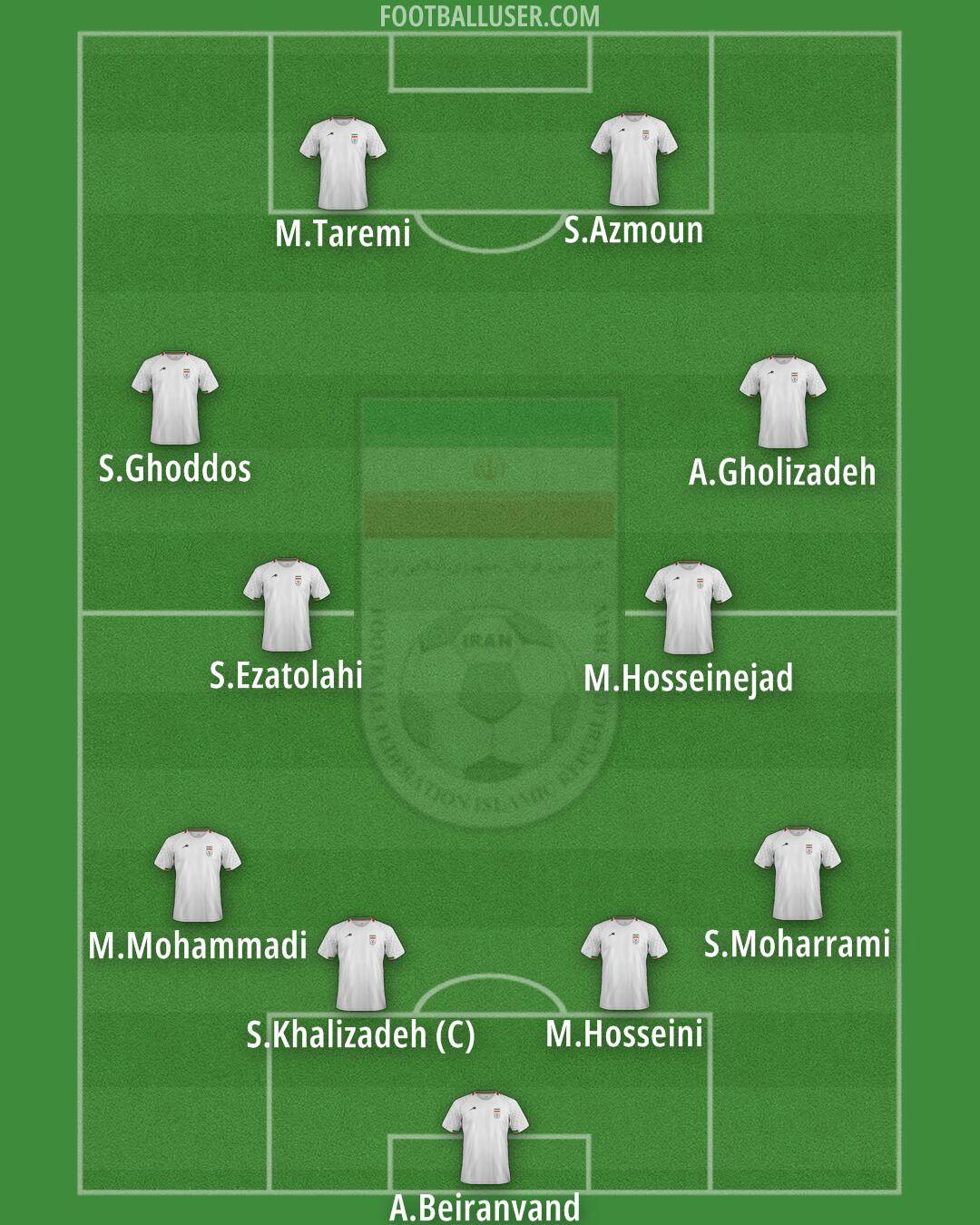

Iran National Football Team Formation
 May 21, 2025
 bosan
bosan


Starting Lineup
A.Beiranvand · S.Khalizadeh (C) · M.Hosseini · M.Mohammadi · S.Moharrami · S.Ezatolahi · A.Gholizadeh · M.Hosseinejad · S.Ghoddos · M.Taremi · S.AzmounIran relies on a direct and high pressing style of play through a 4-4-2 formation. This lineup aims to win the ball high up the pitch and transition quickly to catch opponents out of position. The team works to control large areas of the pitch by maintaining compact distances between the defensive and attacking units.
A.Beiranvand stays between the posts to organize the back line. The defensive unit operates as a flat back four that can shift as a single block. S.Khalizadeh (C) acts as the leader in the center, providing aerial strength and organizing the line, while M.Hosseini covers the space beside him. On the flanks, S.Moharrami and M.Mohammadi occupy the full back roles, looking to hold the line or push up when the team has control. The whole unit works to squeeze the space between the lines to prevent easy passes.
A double pivot in the center provides the foundation for the midfield. S.Ezatolahi and M.Hosseinejad work to shield the defence, with S.Ezatolahi often dropping to pick up runners or disrupt play. They connect the defense to the rest of the team by recycling possession and finding the wide players. In front of them, A.Gholizadeh and S.Ghoddos operate in the half spaces, looking to create chances or press the opposition midfield. These two wide midfielders are tasked with winning the ball back high up the pitch to start attacks.
The attack features two forwards working in a partnership. M.Taremi and S.Azmoun act as a mobile front two, often making runs in behind the defensive line to stretch the opposition. M.Taremi is known for his ability to hold up the ball and link play, while S.Azmoun uses his movement to find pockets of space. They press the opposition back line to force mistakes and direct the play towards the wings. The team uses the width provided by the wide midfielders to deliver crosses or cutbacks into the box.
This formation offers Iran several tactical advantages. The double pivot provides a strong central block that makes them hard to play through. They also create a high press in coordinated waves, using the front two and the wide midfielders to squeeze the opponent. This can lead to quick turnovers and high-quality chances in transition.
Iran uses this 4-4-2 to maintain defensive solidity while looking to strike on the break. It is a setup best suited for matches against teams that dominate possession but leave space behind their midfield.