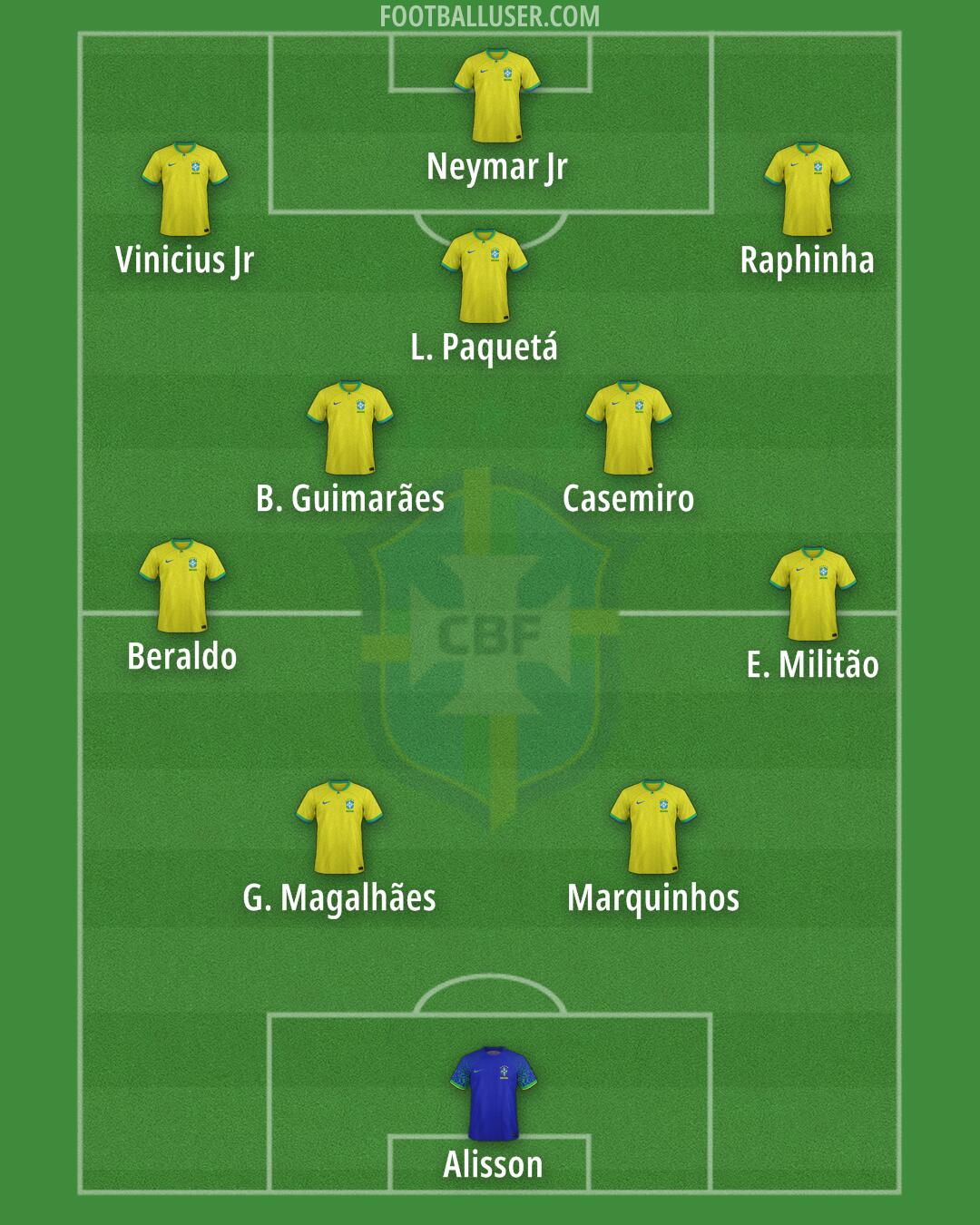

Brazil National Football Team Formation
 May 23, 2025


Starting Lineup
Neymar Jr · Vinicius Jr · Casemiro · Beraldo · E. Militão · G. Magalhães · Marquinhos · B. Guimarães · L. Paquetá · Raphinha · AlissonBrazil focuses on an aggressive, vertical style of play using a 2-5-3 formation. This lineup is built to overwhelm the opposition by committing many players into the attacking third and winning the ball back high up the pitch. The goal is to control the center and create constant chaos in the opponent's defensive line through heavy pressing and quick transitions.
Alisson acts as the last line of defense, often playing as a sweeper behind a high line to cover the space left by the defenders. Marquinhos and G. Magalhães form the central defensive duo, where Marquinhos uses his reading of the game to intercept passes while G. Magalhães provides aerial strength. This small back line requires extreme discipline to hold the line and prevent runners from getting behind them.
The midfield is a crowded engine room designed to dominate the center of the pitch. Casemiro sits deep to shield the defense and break up play, while Beraldo and E. Militão work to protect the two central defenders. B. Guimarães and L. Paquetá operate further forward to connect the defensive unit to the attack, with Guimarães driving forward with the ball to drive the team into the final third. Paquetá acts as the main creative hub, looking to play through the lines and find teammates in pockets of space.
In the attacking phase, Brazil uses three forwards to stretch the opposition. Neymar Jr leads the line as a striker who drops into midfield to link up play and create mismatches. On the flanks, Vinicius Jr and Raphinha act as inverted wingers who cut inside to threaten the goal. Vinicius Jr uses his explosive dribbling style to beat defenders, while Raphinha looks to whip it in from wide areas or make runs in behind. The width comes from the midfielders pushing high to support the front three.
The main advantages of this Brazil formation include numerical superiority in the midfield and the ability to press high in coordinated waves. By crowding the middle, the team can squeeze the space and force a long ball from the opponent. This also allows for incredible speed of transition once the ball is won, as the front three are already positioned to attack the space.
This setup is a high risk, high reward system that relies on winning the ball in advanced areas. It is best suited for matches where Brazil wants to pin an opponent in their own half and dictate the tempo through constant pressure.