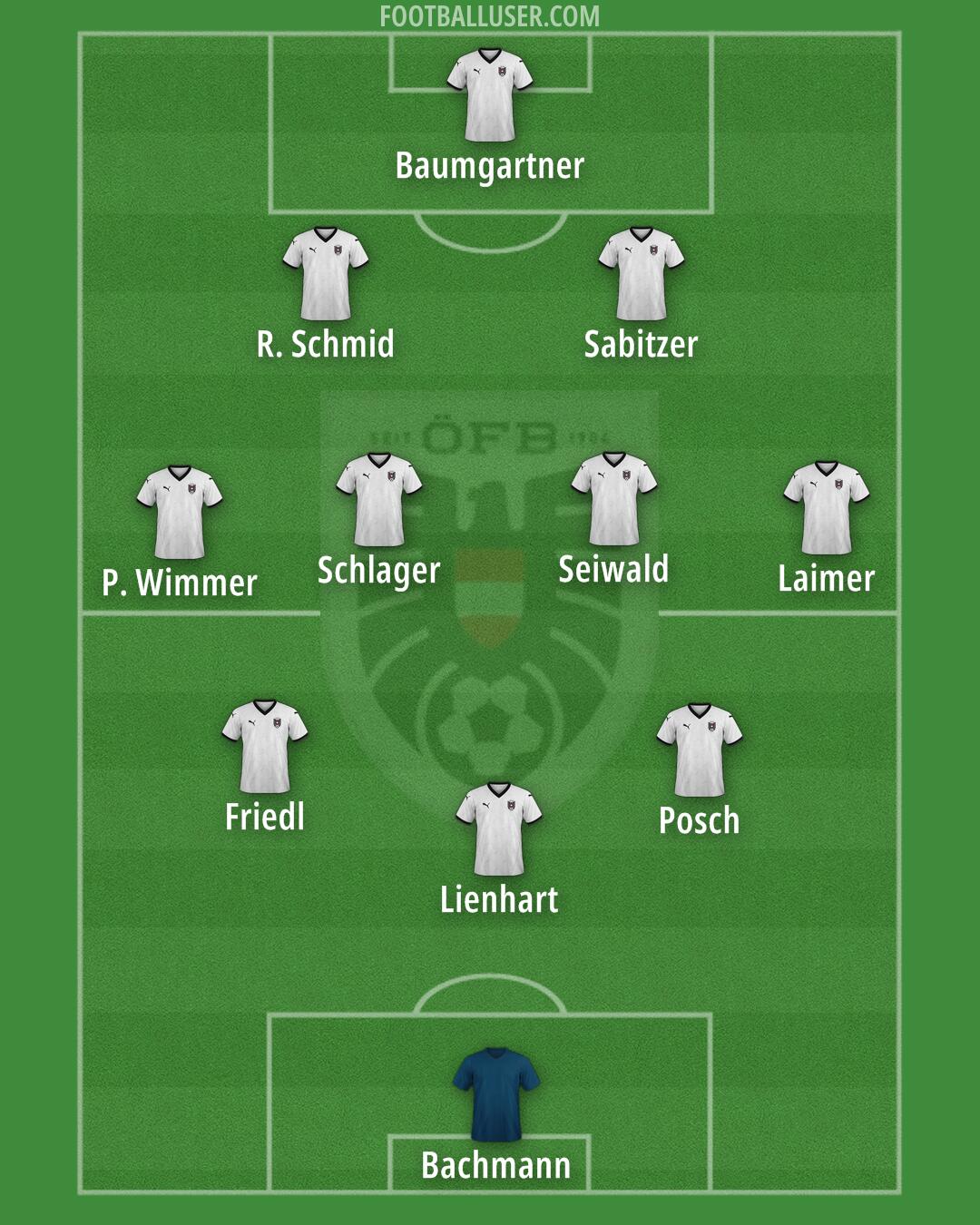

Austria National Football Team Formation
 May 23, 2025


Starting Lineup
Baumgartner · Sabitzer · Seiwald · P. Wimmer · R. Schmid · Schlager · Laimer · Posch · Lienhart · Bachmann · FriedlAustria plays a high press and vertical game with a 3-4-3 formation. Players focus on winning the ball high up the pitch and moving the ball quickly toward the goal. The aim is to suffocate the opposition in their own half and use rapid transitions to score.
Bachmann plays in goal behind a back three. Lienhart acts as the central defender, often stepping into midfield to break the line. Posch and Friedl operate as the wide centre-backs in a high line. While Posch is known for his defensive work rate and ability to cover space, Friedl provides aerial strength. This defensive unit works to squeeze the space and set the offside trap.
The midfield consists of a central pairing of Schlager and Seiwald with two wide midfielders. Seiwald acts as a carrier who drives forward with the ball, while Schlager works to win the second ball and protect the center. P. Wimmer and Laimer occupy the wide areas. Laimer is known for his pressing intensity and ability to cover ground, helping to connect the defensive and attacking lines. This group aims to compress the midfield and force a long ball from the opponent.
Up front, Austria uses three attackers. Baumgartner acts as a pressing centre-forward, looking to run in behind the defense. Sabitzer and R. Schmid play as wide attackers. Moving in from the right, Sabitzer often cuts inside to create chances, using his passing range to play through the lines. R. Schmid provides width on the left, looking to get to the byline and deliver early crosses. This front three presses from the front to disrupt the opposition back line.
This formation offers specific advantages like the ability to press high in coordinated waves. The presence of three attackers and two central midfielders allows the team to win it back high up the pitch. Additionally, the team can create wide overloads when the wide midfielders push forward to support the wingers. Such movements force the opponent to defend deep and create space for the central players to combine in tight spaces.
The 3-4-3 formation defines a direct and aggressive way of playing. It is best suited for games against opponents who struggle to play short from the back under pressure.