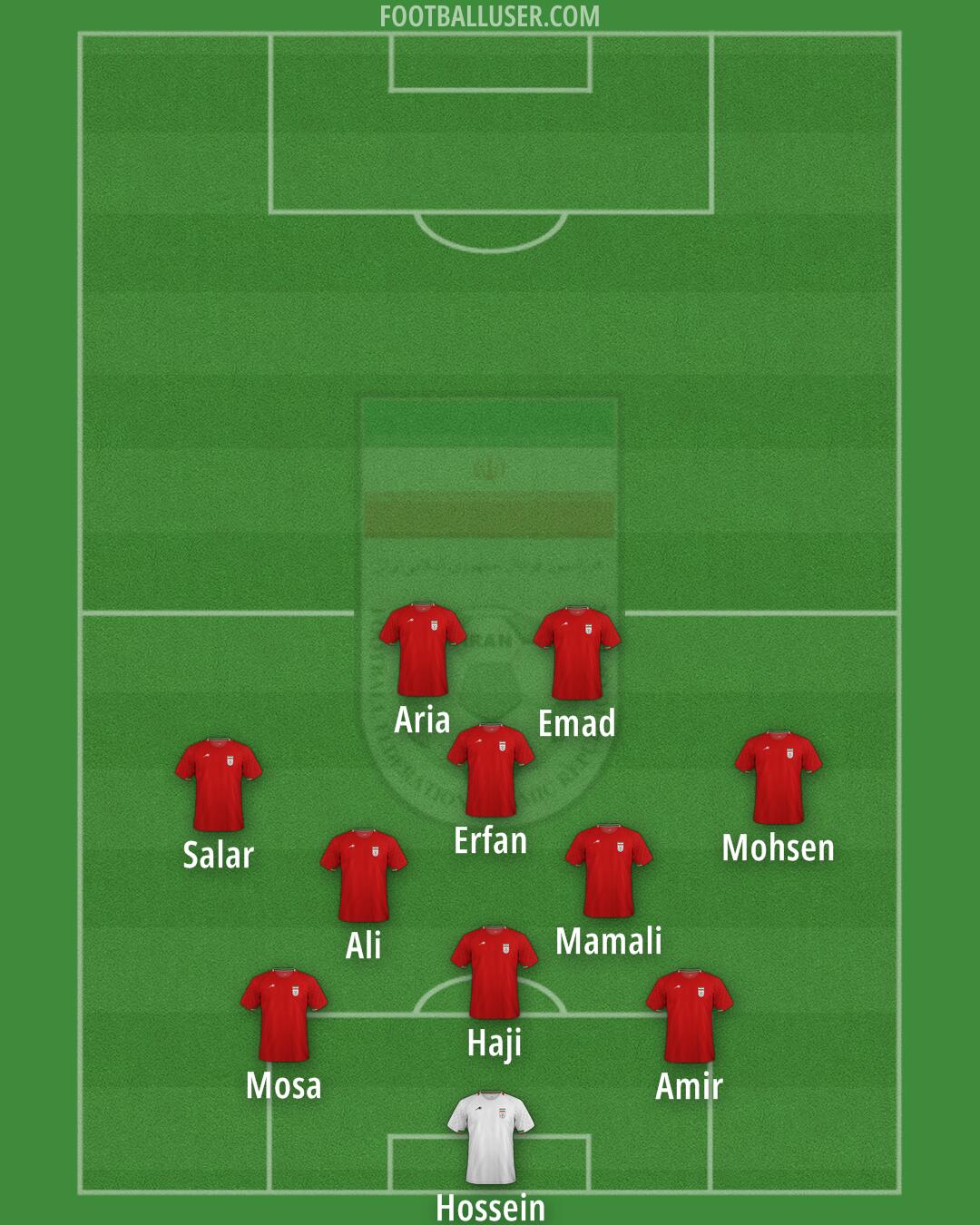

Iran National Football Team Formation
 May 23, 2025


Starting Lineup
Hossein · Amir · Haji · Mosa · Mamali · Ali · Erfan · Salar · Mohsen · Aria · EmadFocusing on a high press and quick transitions, Iran utilizes a 3-5-2 formation. This lineup is built to control the center of the pitch and win the ball high up the pitch to launch rapid attacks. The team aims to use a compact defensive block to force turnovers before catching the opposition out of position.
Hossein stays between the posts to oversee the defensive unit. Behind him, Haji sits as the central defender in a back three, acting as the main presence to win the header and clear the lines. To his sides, Amir plays as the right center back while Mosa occupies the left center back role. This trio works to defend zonally and ensure the defensive line remains tight. When the team pushes up, the width is provided by the midfielders rather than traditional wing backs, requiring the central trio to stay narrow and cover the space behind the midfield.
The midfield is a crowded three man midfield with a carrier and two central operators. Ali and Mamali act as a double pivot to shield the defence and win the second ball in front of the back three. They provide the foundation for the team to recycle possession and protect the central zone. Salar and Mohsen operate in the half spaces to connect the defensive and attacking lines. Erfan plays as a central midfielder to help control the tempo and move the ball through the thirds. This group works to compress the midfield and deny the turn of opposing playmakers.
Up front, Iran employs two forwards in a partnership to stretch the defence. Aria and Emad work together to press from the front and pin the last defender of the opposition. Aria often looks to find the feet of the striker or make runs in behind to exploit gaps. Emad acts to hold up the ball and allow the midfielders to join the attack. The two attackers move in combinations to create space, often pulling wide to create passing lanes for the late runners arriving from the midfield.
This formation offers significant tactical advantages through its ability to create numerical superiority in midfield. By packing the central area, Iran can win the second ball and control the game tempo. The team also benefits from the compactness when defending, making it very difficult for opponents to play through the middle. The transition from a mid block to an attacking stance is quick, allowing the team to hit in behind on the transition.
Iran relies on a central dominance to dictate the rhythm of the match. This 3-5-2 formation is best suited for games against teams that prefer to play through the center and struggle with high intensity pressing.