
Real Madrid Football Formation
 May 24, 2025


Starting Lineup
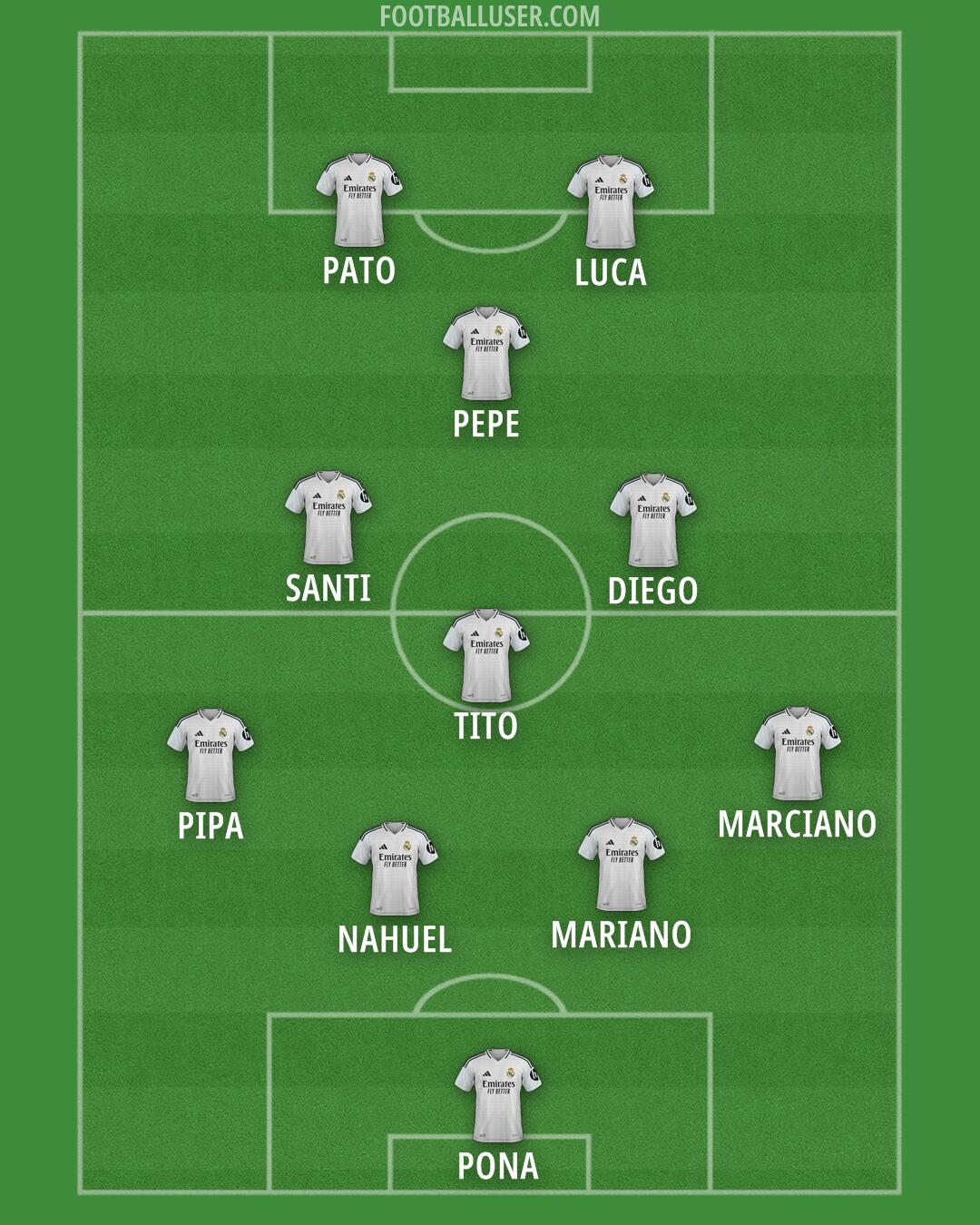
PONA · MARCIANO · MARIANO · NAHUEL · PIPA · DIEGO · TITO · SANTI · PEPE · PATO · LUCAReal Madrid focuses on a direct and defensively solid identity through a 5-3-2 formation. This lineup is built to play with a strong defensive base while looking to break quickly when they win the ball. The team aims to remain compact and use the width of the pitch only when in possession.
Pona starts in goal to organize the unit from the back. The defense uses a back five with Tito acting as the central figure to anchor the line. Nahuel and Mariano operate as the wide centre-backs to provide cover and help the team defend zonally. Pipa and Marciano serve as attacking wing backs to provide width during transitions. This unit is designed to sit deep and squeeze the space when the opposition has the ball to prevent through balls.
The midfield works in a trio to control the center of the pitch. Diego and Santi form the engine room, where Diego acts as a carrier to drive forward with the ball while Santi looks to connect the defensive and attacking lines. Pepe plays as an attacking ten behind the strikers to link play and find the feet of the forwards. This trio aims to win the second ball and protect the back five by pressing in a mid-block.
Real Madrid utilizes two forwards in a partnership to lead the press. Pato and Luca work together as the front two, with Pato acting as a pressing centre-forward to force the opposition back line into mistakes. Luca looks to run in behind or hold up the ball to allow Pepe and the midfielders to join the attack. The wing backs, Pipa and Marciano, provide width to stretch the defence, allowing for cutbacks from the byline or crosses to reach the strikers in the box.
One major advantage of this Real Madrid lineup is the compactness when defending in a low block. The narrow defensive block makes it very hard for opponents to play through the lines. Another strength is the ability to hit in behind on the transition through the pace of the front two and the overlapping runs of the wing backs. This creates numerical superiority in wide areas once the team moves from a defensive formation into an attacking one.
This 5-3-2 formation provides a balanced platform for teams that prefer to defend deep and strike on the break. It is best suited for matches against high possession teams where the goal is to absorb pressure and exploit spaces in transition.