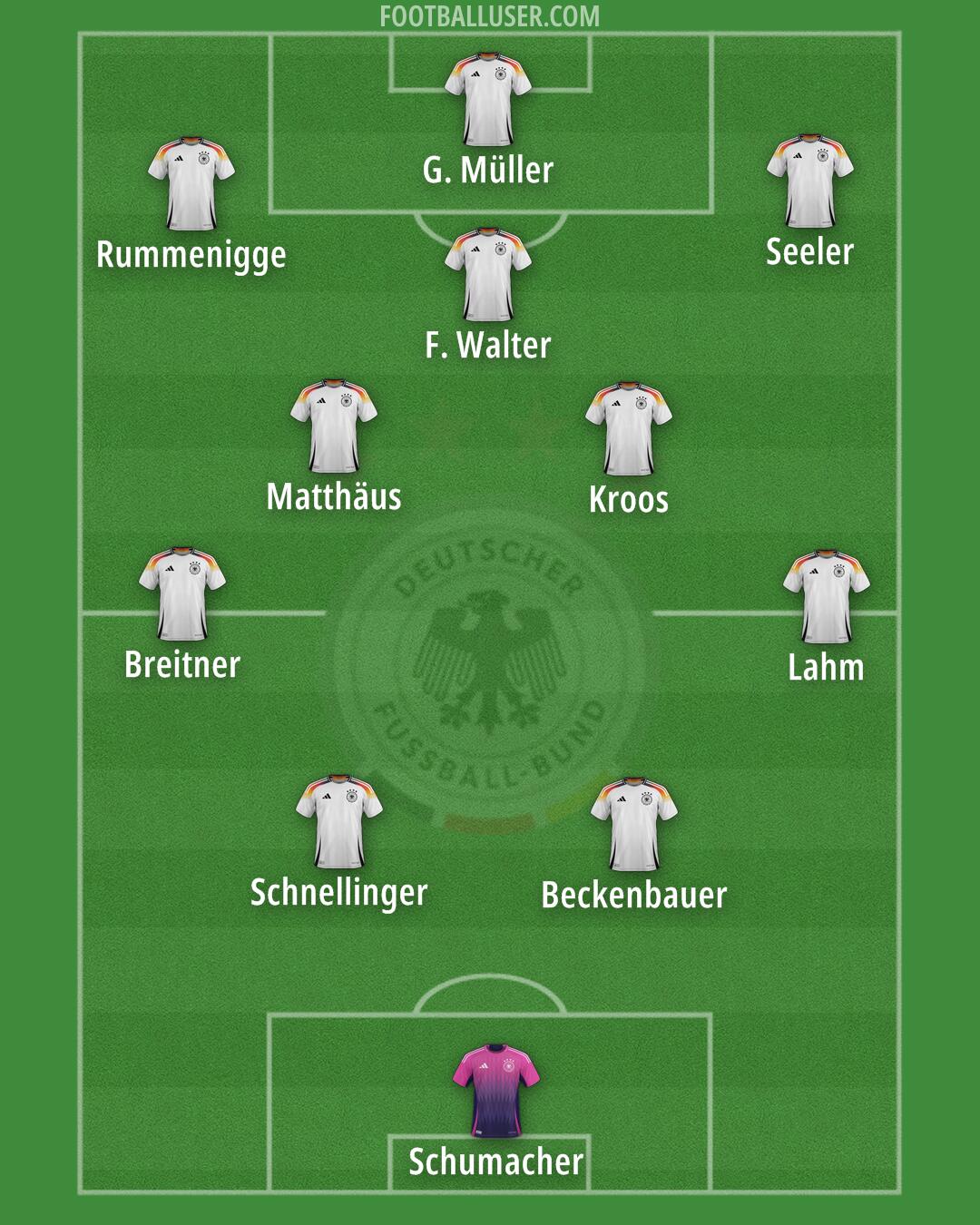

Germany National Football Team Formation
 May 25, 2025


Starting Lineup
G. Müller · Rummenigge · F. Walter · Seeler · Matthäus · Kroos · Breitner · Schnellinger · Beckenbauer · Lahm · SchumacherGermany focuses on controlling the center of the pitch with a high density of players in the middle. The Nationalmannschaft utilizes a 2-5-3 formation to overwhelm the opponent in central areas. This lineup is built to dominate possession and use a heavy midfield presence to dictate the tempo of the match.
Schumacher plays between the posts as the goalkeeper. The defense consists of a narrow back two made up of Beckenbauer and Schnellinger. Beckenbauer acts as a ball playing defender who can step into midfield to progress the ball and break the line. Schnellinger focuses on covering the space and winning headers to maintain a solid base. This small defensive unit must remain compact and rely on the midfield to track back and help protect the area against long balls.
The midfield is the engine room of this Germany side. Lahm and Breitner act as a deep pivot to shield the defense and recycle possession. Kroos uses a wide passing range to switch play and find teammates, while Matthäus carries the ball forward to drive the team into the final third. F. Walter plays in the hole as an attacking ten to connect the midfield and the attack by finding pockets of space. This five man midfield can squeeze the space and win the second ball effectively to keep the pressure high.
In the final third, the team employs three attackers to stretch the opposition. Rummenigge plays as an inverted winger on the left who will cut inside to attack the near post. Seeler stays wide on the right to stretch the defense and deliver crosses. G. Müller operates as a clinical striker who finds space in the box to finish moves and hold up the ball. These forwards press from the front to force the opposition to go direct and win the ball back high up the pitch.
The main advantage is the numerical superiority in the center. With five players in the middle, the team can easily win the second ball and control the tempo of the game. Another strength is the ability to transition quickly. When the ball is won, the midfield can immediately play through the lines to find the attackers in space or deliver early balls to the wings.
This 2-5-3 formation is built for teams that want to dominate the ball and control the game centrally. It is most effective against opponents who sit deep and lack the ability to bypass a crowded midfield.