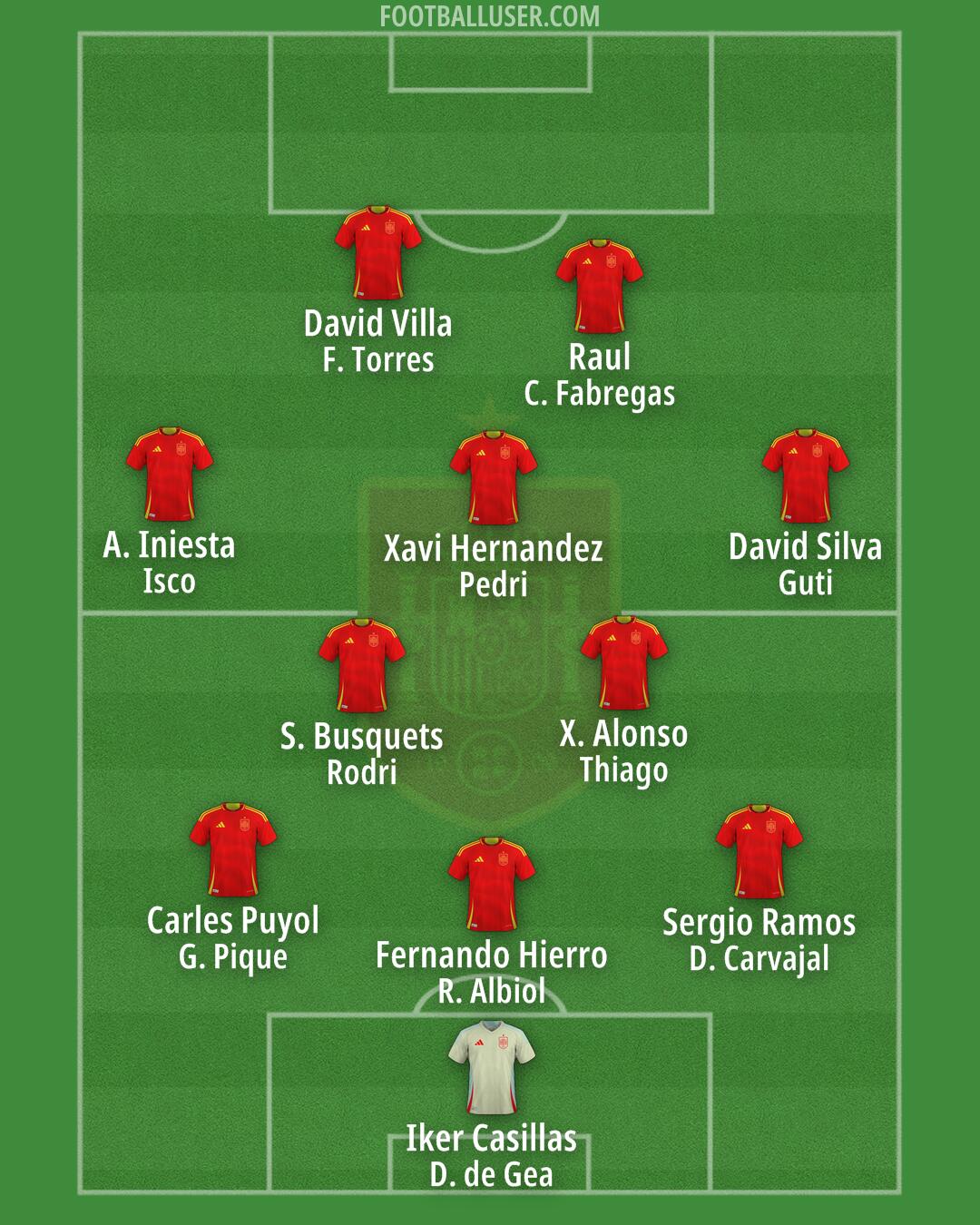

Spain National Football Team Formation
 May 25, 2025


Starting Lineup
Iker Casillas (D. de Gea) · Sergio Ramos (D. Carvajal) · Carles Puyol (G. Pique) · A. Iniesta (Isco) · Xavi Hernandez (Pedri) · X. Alonso (Thiago) · S. Busquets (Rodri) · David Villa (F. Torres) · David Silva (Guti) · Fernando Hierro (R. Albiol) · Raul (C. Fabregas)Spain plays to dominate the ball and control the rhythm of the match using a 5-3-2 formation. This lineup is built to keep possession and use short passing to move the opposition around. The goal is to maintain control of the tempo and wait for gaps to open in the defense.
Iker Casillas stays in goal to command the area. The defense works as a back five where Sergio Ramos acts as a right wing back and Carles Puyol plays as a left wing back to provide width. The central trio of Fernando Hierro, S. Busquets, and X. Alonso forms the core of the line. Hierro is dominant in the air and leads the unit, while S. Busquets uses his positional sense to intercept passes and X. Alonso plays out from the back. They stay compact to squeeze the space and can drop into a low block if needed.
The midfield is a three-man unit that controls the center of the pitch. Xavi Hernandez sits in the middle to recycle possession and uses his passing range to find teammates. A. Iniesta and David Silva play in the half-spaces to link the defense and attack. A. Iniesta looks to carry the ball forward and combine in tight spaces, while David Silva finds pockets of space to play through the lines. This group works to win the ball back high up the pitch to keep the pressure on.
Up front, Spain uses a two-man attack with David Villa and Raul. David Villa acts as a mobile left striker who looks to run in behind and finish chances, while Raul works to hold up the ball and link up play between the lines. They press the opposition back line to force a long ball and then aim to win the second ball. When Sergio Ramos and Carles Puyol overlap, they stretch the defense to create room for the forwards. The team looks to play a one-two and use cutbacks from the byline to score.
The main advantage of this formation is the numerical superiority in midfield which allows Spain to dominate possession. There is also a great ability to create wide overloads when the wing backs push forward. This forces the opposition to stretch their defense and leaves gaps for the central midfielders to arrive late into the box. The speed of transition when winning the ball high up the pitch is another major advantage.
This formation is best for a team that wants to squeeze the pitch and dictate play through constant ball retention. It is ideally suited for matches against opponents that sit deep and defend in a low block.