
Brazil National Football Team Formation
 May 26, 2025


Starting Lineup
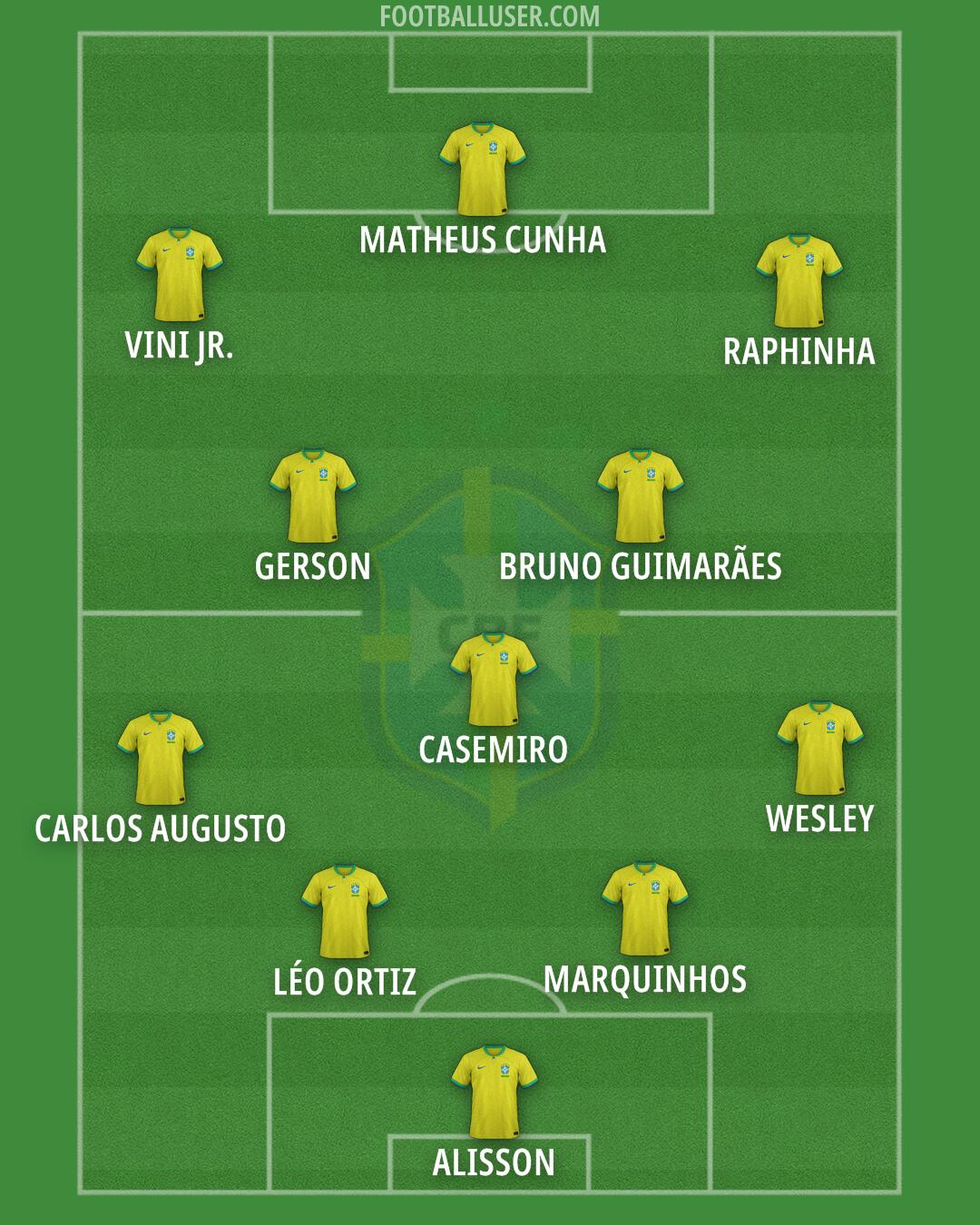
ALISSON · WESLEY · MARQUINHOS · LÉO ORTIZ · CARLOS AUGUSTO · CASEMIRO · GERSON · BRUNO GUIMARÃES · VINI JR. · RAPHINHA · MATHEUS CUNHABrazil looks to play with verticality and quick transitions through a 5-2-3 formation. This lineup aims to use width and pace to stretch the opposition while maintaining a solid base to protect against counter attacks. The tactical identity relies on strong defensive coverage and the ability to launch rapid attacks once the ball is won back.
Alisson acts as the last line of defense, providing security with his ability to sweep behind the line. The back five is composed of three central defenders where Casemiro acts as the anchor to protect the zone, while Léo Ortiz and Marquinhos provide stability. Marquinhos is known for his reading of the game and aerial strength. Carlos Augusto and Wesley operate as attacking wing backs, pushing high to provide width and support the attack. The defenders work together to squeeze the space and prevent the opposition from playing through the middle.
The midfield functions as a double pivot with Bruno Guimarães and Gerson occupying the central areas. Bruno Guimarães uses his passing range to drive the team forward, while Gerson helps to connect the defensive unit to the front three. They must work hard to press in a mid-block and win the second ball to keep the pressure on. This pair is responsible for shielding the back three and ensuring the team can recycle possession safely.
In the attacking third, Brazil employs three attackers to pin the opposition back. Vini Jr. plays as an inverted winger on the left, using his explosive dribbling to cut inside and threaten the goal. Raphinha operates on the right wing, looking to deliver crosses or pull wide to create space. Matheus Cunha leads the line as a pressing centre-forward, looking to link up with the wide players and make runs in behind. The formation creates many opportunities for overlaps from Wesley and Carlos Augusto to join the offensive movement.
One major advantage for Brazil is the ability to create wide overloads when the wing backs push up to join the wingers. The team also possesses great speed of transition, allowing them to move from a defensive block to an attacking phase in seconds. This setup provides strong compactness when defending deep, making it very difficult for opponents to find gaps between the lines.
This formation is built to dominate through quick, direct football and high-intensity transitions. It is best suited for matches where Brazil needs to exploit large spaces behind the opponent's full backs.